|
|
|||||||
 | ||||||||



  |
|
Sweet taste of success
For these Quebec cranberry growers, what started out small has grown into a worldwide business. 
Growing cranberries was going to be just a small project for Martin Le Moine and Marcel Pilote back in 1993. But just nine years later, 30 acres of cranberry production have grown to 100 on their family farm, Atocas Notre Dame, located in Notre Dame De Lourdes, Quebec. And along the way they’ve become one of the largest independent producers of organic cranberries in North America. “It was supposed to be a no-stress project,” recalls Le Moine, a former pork producer. “We really didn’t have a thought or a plan as to how it would turn out.” Today, they supply wholesalers on both coasts with fresh berries packaged under their own brand, Tree Kids. Conventionally grown product supplied to them by contract growers is frozen and shipped around the world. 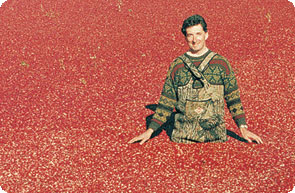
Cranberries are used in sauces, juice, juice blends, drinks, cocktails, nectars, jelly, chutney and relish as well as in baked products such as muffins and breads. According to statistics from Agriculture and Agri-Food Canada, cranberries brought in an estimated farm value of $55.4 million in 1998. That’s fifth in farm value of all fruits produced in Canada after apples, blueberries, strawberries and grapes. Quebec and British Columbia are the major growing areas in Canada for the fruit, which is native to North America. In 2001, Quebec had approximately 2,475 acres in production for a total crop of 39.9 million pounds. An acre yields between 16,000 and 17,500 lb. Le Moine says the growing conditions in Quebec make the province’s industry very competitive as compared to the United States, the world’s largest cranberry producer. “In Eastern Canada we have yields that are as high or higher than growers have in the United States. Production costs are lower and the temperature is perfect so we don’t have to deal with fungus. We don’t have to apply fungicide even in conventional situations. The season is short so we have less weed pressure compared to Massachusetts or Oregon. And we have the cold which is necessary to give them the red colour.”
Cranberries are perennials that grow on low vines in beds or “bogs” that are layered with sand and peat. It takes at least three years before vines can be harvested and five years until the plants are at their optimum. Le Moine says the vines can keep producing for 50 years because of pruning and thinning that keeps them young. Per acre investment to bring a planting into production averages between $20,000 and $30,000 so it’s not a way to get rich quick. At harvest time in October, the fresh berries are dry harvested with mechanical pickers that pick the berries and place them in burlap bags. The berries are then transported to the farm’s packing plant where they are sorted, cleaned and cooled. Berries used for processing to make juice are wet harvested where the fields are flooded and the berries are beaten. Increased production in Canada in the last few years has driven the price per barrel down below the $10 mark making it a challenge for conventional producers to make a decent living. Growers are hoping for a rally in the year to come but waiting can be a costly game. That’s why Le Moine and Pilote started making the transition to organic production in 1997. It began with just a few fields because “everyone was saying that it would not be possible to do this on a commercial farm.” Defying the naysayers, Le Moine and Pilote carried on with support from government research programs that focused on composting and biological pest control. Fields need three years before being granted organic certification so it wasn’t until 1999 that they were able to sell their certified crop. Today, the farm is completely organic and Le Moine says they haven’t been able to produce enough to meet the ever-increasing demand for organic produce. “We were the first organic cranberry farm in Quebec but now there are seven other farms that are supplying us as well with product. Production is growing very fast and next year we expect to have three to four times more production because many of the growers are finishing their transition to full organics this year,” he says. Last year they expanded the business to take advantage of the value-added market by processing cranberry juice and packaging frozen dried sweet cranberries. This meant creating a new partnership with other industry partners and investing in a new building with packing capabilities. “The farm has over 750 acres but 100 acres of cranberries is enough for us. We just want to keep developing the farm and working on the details,” he says. Cranberry production in Canada
|
   |
 |

 09/18/02 07:36:21