


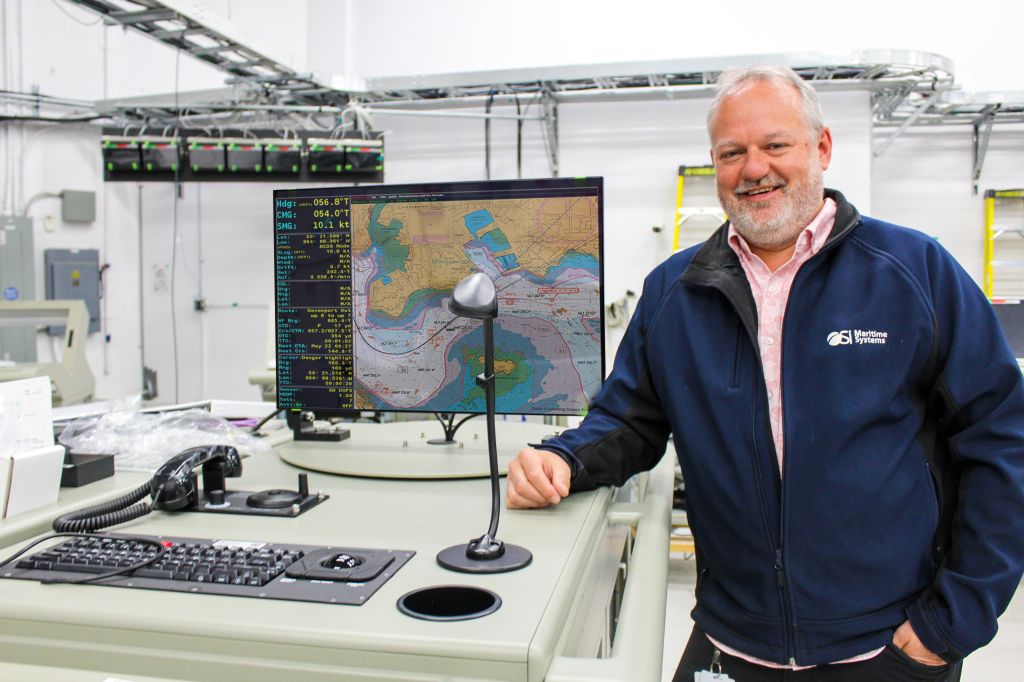
From its first international opportunity with the UK’s Royal Navy to a growing presence across Europe and beyond, OSI has taken a deliberate approach to expansion. Girard shares what the company has learned about entering new markets, building local relationships, investing behind demand and putting the right financial infrastructure in place to support international growth.
Canadian businesses are rethinking how and where they grow internationally. How has OSI’s approach to global expansion evolved over time?
For roughly the first two decades of our existence, OSI was focused almost entirely on the Canadian market.
We built our early expertise serving commercial shipping operators, helping them transition from paper-based to electronic chart navigation. We were perhaps a little too early in some respects. It took a lot of years for navies to catch up to moving away from traditional charting to an electronic charting environment.
That early work built a deep foundation of technical expertise and customer relationships. Over time, we pivoted more decisively towards the naval market and, by 2008, had made a clear strategic choice. Today, 100 per cent of our business is naval and maritime security.
Our first step into international markets came around the turn of the millennium, when we identified an opportunity with the UK’s Royal Navy. They were thought leaders in that space, and they liked what we were doing.
Over the following six years, we became a fleet-wide supplier to the Royal Navy. A UK office followed, eventually growing to a team of about 30 people.
From that foothold, the European market opened up. Denmark became an early customer, followed by the Netherlands and, over time, Ireland, Poland and Portugal.
Today, our technology is trusted by 27 navies across NATO and allied nations. Our business development organization is spread across Canada, the UK, the Netherlands, Germany and Australia.
Our international growth has been methodical, following a disciplined approach to market entry that we developed early in our international expansion and continue to refine and evolve today.
“Today, our technology is trusted by 27 navies across NATO and allied nations.”
How does OSI approach entering a new market?
Our first port of call in any new market is the Canadian Trade Commissioner Service.
Trade Commissioners provide on-the-ground intelligence that goes well beyond what is publicly available. They facilitate introductions at the right levels of foreign governments and naval organizations and help us vet potential local agents and partners.
Having the right local network or representative is also important. In a new market, that could be a retired senior naval officer who understands the procurement environment and the particular dynamics of that country’s defence ecosystem.
We work closely with the Trade Commissioner network to vet those partners carefully.

There is also a significant amount of education involved. Naval procurement cycles are long, and our business development teams can spend years building relationships and helping potential customers understand what modern integrated navigation systems do.
Navies also train and exercise alongside allied fleets already using our platform. When another fleet sees the technology in action during exercises, and how the systems communicate and share information securely, it often sparks interest very quickly.
But international expansion takes time. It could be a two-to-five-year cycle before we see results, and we plan accordingly.
What have you learned about turning an initial opportunity into a lasting presence?
We take a cautious but pointed approach to scaling in new markets. We test the waters, build relationships, win initial contracts and only then commit to a local presence.
Germany is a good example of how that approach works in practice.
We won our first German contract in 2021, building on years of relationship development and the growing visibility of our platform across allied NATO navies. Additional contracts followed in 2022 and 2023.
In April 2025, we opened a dedicated office in Kiel, close to the German Naval Fleet, to support our growing presence and provide local operational capability.
The approach is to earn the business first, then invest in the local infrastructure to support and deepen it.
“We take a cautious but pointed approach to scaling in new markets. We test the waters, build relationships, win initial contracts and only then commit to a local presence.”
That is the model we continue to apply as we pursue opportunities across Europe and beyond.
What financial infrastructure has helped OSI support its international growth?
Expanding internationally introduces financial considerations that need to be planned for carefully, including currency exposure and contractual guarantees.
Foreign exchange is one example. Naval programs are known for schedule delays, which makes predicting cash flows – and therefore managing foreign exchange exposure – inherently challenging.
We work with RBC’s foreign exchange team to lock in forward exchange rates when international payments are anticipated. That gives us a meaningful degree of predictability even in volatile currency environments.

Performance bonding and letters of guarantee are another important consideration.
Many international customers, particularly in Europe, require a letter of guarantee before releasing advance payments. It is a formal commitment that if a supplier fails to deliver, the customer has recourse.
Through our banking relationship with RBC, supported by Export Development Canada, we maintain a $30 million bonding facility. That allows us to provide those guarantees without drawing on operating cash. Without that bonding facility, we would have to support guarantees with cash – and that would really hamstring the business.
We also maintain a flexible line of credit with RBC, which provides additional liquidity as we navigate the timing and scale of international programs.
Defence contracts often involve long development timelines and milestone-based payments. Access to flexible capital allows us to manage those cash flows while continuing to invest in product development and global business development.
What has OSI learned about growing a global business?
The first lesson is to start with Canada’s international trade infrastructure.
The Canadian Trade Commissioner Service can provide local intelligence, introductions and partner vetting that can help accelerate entry into new markets.
The second is to vet local partners rigorously. The right in-country representative can unlock opportunities, so it is important to take the time to make sure partners are reputable and well connected.
Managing currency exposure proactively is another important lesson. International contracts often involve foreign currencies and shifting timelines, and tools such as FX hedging can help protect margins and provide greater predictability.
Financial infrastructure also needs to be put in place early. Performance bonds, letters of guarantee and flexible credit facilities can allow businesses to pursue opportunities without tying up significant amounts of capital.
And businesses need to plan for long sales cycles. Major international contracts can take years to develop, so capital planning, business development strategy and expectations all need to reflect that.
Being Canadian is also a genuine advantage in international markets. Canada’s international reputation, government relationships and involvement alongside NATO allies can help open doors.
Having the Canadian government as a customer, having Canada involved in NATO exercises, having the Canadian government in Germany talking to the German government about OSI – that is invaluable.