



Founded in 1956, Groupe Lacasse designs and manufactures furniture for commercial, education, healthcare and government customers across Canada and the United States. Vallières joined the finance team before stepping into the CFO role and inherited both a newly automated plant and a trade environment that changes week-to-week.
What has changed most for your business over the past year?
The speed. Everything comes at us faster than it used to, and I need to see things coming rather than react to them. The environment changes every week, every day, sometimes every hour.
Right now, I’m immersed in tariffs. Sometimes it’s straightforward – when a tariff is direct, we work out which of our products are affected, how we respond and what it costs us. What’s harder to plan for are the Canadian responses, or when a new support program launches that we might qualify for. My job either way is to understand what’s in front of us and tell the CEO and the sales leadership what it means for our P&L and our cash over the next three, six or 24 months.
But the tariffs themselves aren’t the biggest factor. Uncertainty is. Our customers have projects in mind, and they have our quotes. But then they will delay the capital expenditure because they’re not sure what will happen next with the economy. Sales aren’t falling, but we’re not seeing the increase that our pipeline says should be there.
Lacasse 2.0, the modernization of your plant, was completed before you took the CFO role. What was that investment built to solve?
It’s a good story, even though I wasn’t there for it. Business in the U.S. was strong and volumes were climbing. The problem wasn’t demand, it was hiring. Saint-Pie is a small town, and we already had more than 500 people, most of them in the plant. So the question became: if we want to grow and take some risk out of the future, how do we manufacture twice the volume with the same number of people or fewer?
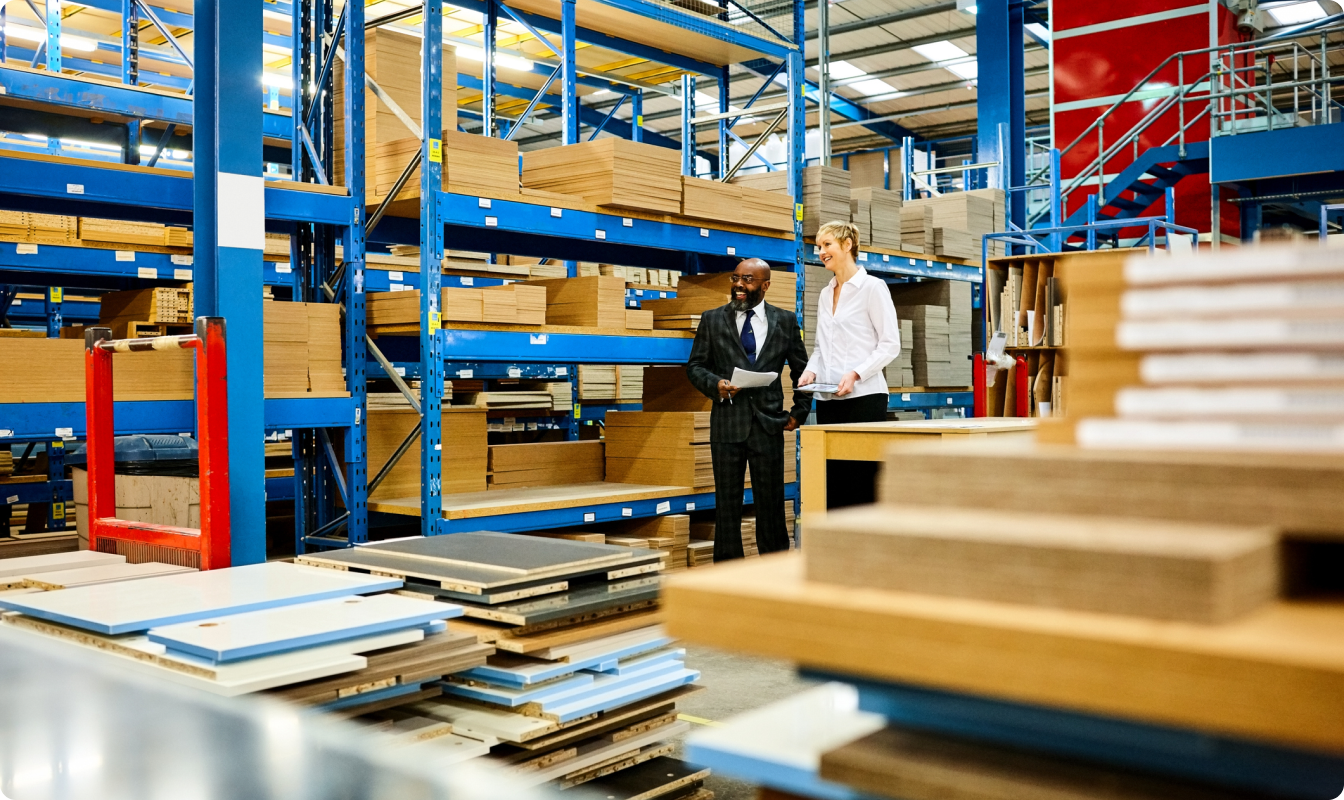
We found a solution with a German manufacturer, who built us an integrated production system. At the centre of it is a five-level vertical storage tower, which I believe is the largest of its kind in North America. Think of a giant metal bookshelf, a hundred times bigger than the one you’re picturing. We build our furniture in two to four weeks, which is close to just-in-time, so we need an enormous amount of inventory on hand. Storing all of that on the ground means a very large plant. Going vertical changed that.
The people in the plant named it Goldorak, after the robot from a Japanese cartoon. It looks like him.
Lacasse put the capacity in place, but the demand cycle it was built for hasn’t fully returned. How do you think about that investment now?
The assumption was sound: we needed to grow, so we needed to be able to manufacture more, and the numbers supported the investment. What we couldn’t forecast was COVID, or the trade tensions between the U.S. and Canada.
So the volume hasn’t arrived on the schedule we anticipated. But when business comes back to where it was in 2018 and 2019, we’ll be ready to put furniture into the market. We have the capacity built already.
In the meantime, we watch the finances closely.
What does managing cash flow look like for you right now?
We’re on an asset-based credit line, so the borrowing base is recalculated every week. I don’t know far in advance how much I’ll be able to draw – that’s the trickiest part of the job right now. When everything moves this quickly, forecasting availability is hard.
To forecast the line, I need to know what came in and what’s going out. My team used to pull the data twice a week. Now they pull it intraday, because we need that picture faster to plan the week ahead and the weeks after it.
The rest is about timing. A lot of our U.S. customers still insist on paying by cheque – despite all our efforts to convert them to more efficient payment methods like ACH or wire. So we have a lockbox in the U.S. and one in Canada. Without them, a cheque would take twice as long to reach Saint-Pie. And I’ve moved more vendor payments onto commercial cards, which gives me more time on those expenses and more room in the cash flow.
We used to have three cards – one for payables, one for the VP of Sales and one for me. Now there are eight or ten. We have limits on each one by type of expense, so I can put more cards out without adding a control problem. The rules are already in place, so I’m not policing it day-to-day.
Roughly 70 per cent of what you make is sold into the United States. How do you handle currency and payments across the border?
On currency, we use forwards, options and spot strategy, and we build the exchange rate into our margins. Those are the two levers. Part of our profit comes from the currency difference, which works in our favour as an exporter, and the forwards give us time to adjust if the U.S. dollar weakens.
Because about 60 per cent of our U.S. business is special pricing – where a customer comes to us for a customized project – we review the margin on every one of those, and the rate at that moment goes into the calculation. If it’s 1.38, I account for it. If it’s 1.45, I account for that. We review the foreign exchange rate annually in our budget process, but really we look at it every week.

On payments, we have a legacy U.S. bank account. RBC put the cross-border structure around it, and now the process is seamless – I approve payments, and everything flows. Transfers between the two banks are fast – and if we need anything faster, we just ask.
We have ten employees in the U.S. Because we’re receiving U.S. dollars, I don’t convert anything to pay them. I just transfer what I need when I know the number.
Where is your growth going to come from next?
We’re an old company, well known in the U.S. and Canada for manufacturing furniture. We’re not one of the giants and we’re not a niche player either. We’re mid-sized, and we can cover every need a customer has – seating, steel, panel systems, laminate furniture – the full range.
We used to do what we call commodity business. You need one desk, we’ll ship you one desk. While we will continue in that part of the market, our new VP of Sales brought in a new strategy, branding us more as a project company, able to take on and manage a full project scope, and to work with the architecture and design community. That moves us toward $100,000 projects rather than $5,000 orders coming in each day. Our capacity was built for this, so we are looking forward to this shift.
What would you say to another CFO planning through this kind of uncertainty?
If you’re facing friction or something isn’t working as you think it should, take it to your banking team. I have found that with RBC, they will find a way to solve it. A lot of people don’t ask, and then live with the friction.
“Our new VP of Sales brought in a new strategy, branding us more as a project company, able to take on and manage a full project scope, and to work with the architecture and design community. That moves us toward $100,000 projects rather than $5,000 orders coming in each day.”
I would also say: know your numbers well enough to act on them quickly. That’s what the last few years have demanded. We made big investments here, and they only pay off if we’re in a position to use them.
We’ve seen this pattern before. There’s a stretch where nobody knows what is going on and everybody waits, and then business comes back. My job is to make sure that when it does, we’re ready for it.
* Source: The Harris Poll, BizPulse Q2 2026.