




In this interview, Beth Burke explains what has changed in the trading relationship between Canada and the U.S., why diversification doesn’t necessarily mean moving away from the U.S., and how businesses can navigate uncertainty while strengthening the foundations for future growth.
What has changed most fundamentally in Canada–U.S. trade?
I really think it comes down to uncertainty. We have operated with the understanding that there would be a set of predictable rules in place for businesses to operate across North America. That has shifted.
Over the past two years, Canadian businesses have been learning to reset the table and look at how strategic investments, supply chains and jobs are impacted by the turbulence and unpredictability of the moment.
But I am constantly hopeful that we are going to get back to a place of more stability.
The renewal of CUSMA will be very important to that. Businesses have been speaking out for a long time, and that is increasing as we move closer to the renewal process, because the agreement is fundamental.
Getting to a place where we can count on the integration that has been so pivotal for business success on both sides is really important. Whether we look at one agreement or the broader relationship, finding a way to create stability and continued commitment to that relationship matters.
How are Canadian businesses adapting – and where are they finding opportunity globally?
I have seen businesses take a strategic view of where their inputs come from and what their supply chains look like. We have seen greater attention to North American sourcing and production, and to where companies can reduce exposure to tariffs and other geopolitical risks.
It has also been an opportunity to look at not being overly dependent on a single market, supplier or transportation route, and to find different ways to expand those options.
Another opportunity I look at constantly is ways to reduce regulation and red tape. That is real, immediate cost saving for companies.
“Because governments are willing to listen, now is the time for us to make the case and be very specific about ways they can create better efficiencies in those processes.”
I also think there are real opportunities for more collaboration between potential competitors or industries that do not always work together.
This has created an opportunity for strange bedfellows, if you will – people who wouldn’t necessarily align with one another. There are moments where the broader picture is much more critical than a niche issue that might otherwise divide people.
Finding those opportunities to come together and push forward an agenda of more cooperation is important, and I don’t think we should let that opportunity go by.
Does diversification necessarily mean moving away from the United States?

For many Canadian companies, the U.S. will remain the largest and most natural partner. That is important to keep in context.
Even if you diversify, the most efficient and profitable route may still remain between Canada and the United States. It’s about figuring out how to maximise those opportunities and ways to expand even within the relationship.
Instead of relying on a single state or a single transportation route, there are alternative options businesses should be looking at, and I see companies evaluating all of those options right now.
There are also companies much more aggressively focused on domestic priorities, but that is very personal to the individual business. It depends on the company’s footprint, its reliance on certain inputs and the markets it serves.
Everything is a balancing act right now. Everyone is trying to spin all the plates all the time.
How important are relationships and collaboration in making trade more resilient?
One of the things I have said from the beginning is that Canadian businesses are going to continue doing business because that is what we know how to do. We are going to find a way.
Company to company, customer to supplier, I think those relationships are what are going to get us through some of the bumpy times in the broader relationship.
The question is whether it is going to be easy and profitable, and keep North America globally competitive, or whether it becomes challenging, tumultuous and costly.
I see the business community doing everything in its power to build the channels that will outlast any political moment or hurdle in the relationship.
One of the things I find most compelling – and that not everyone fully appreciates – is that two-thirds of our bilateral goods trade is intermediate inputs: components and materials that move through the North American supply chain.
You can’t tariff or impact those inputs without impacting the cost of the final product or the jobs associated with it.
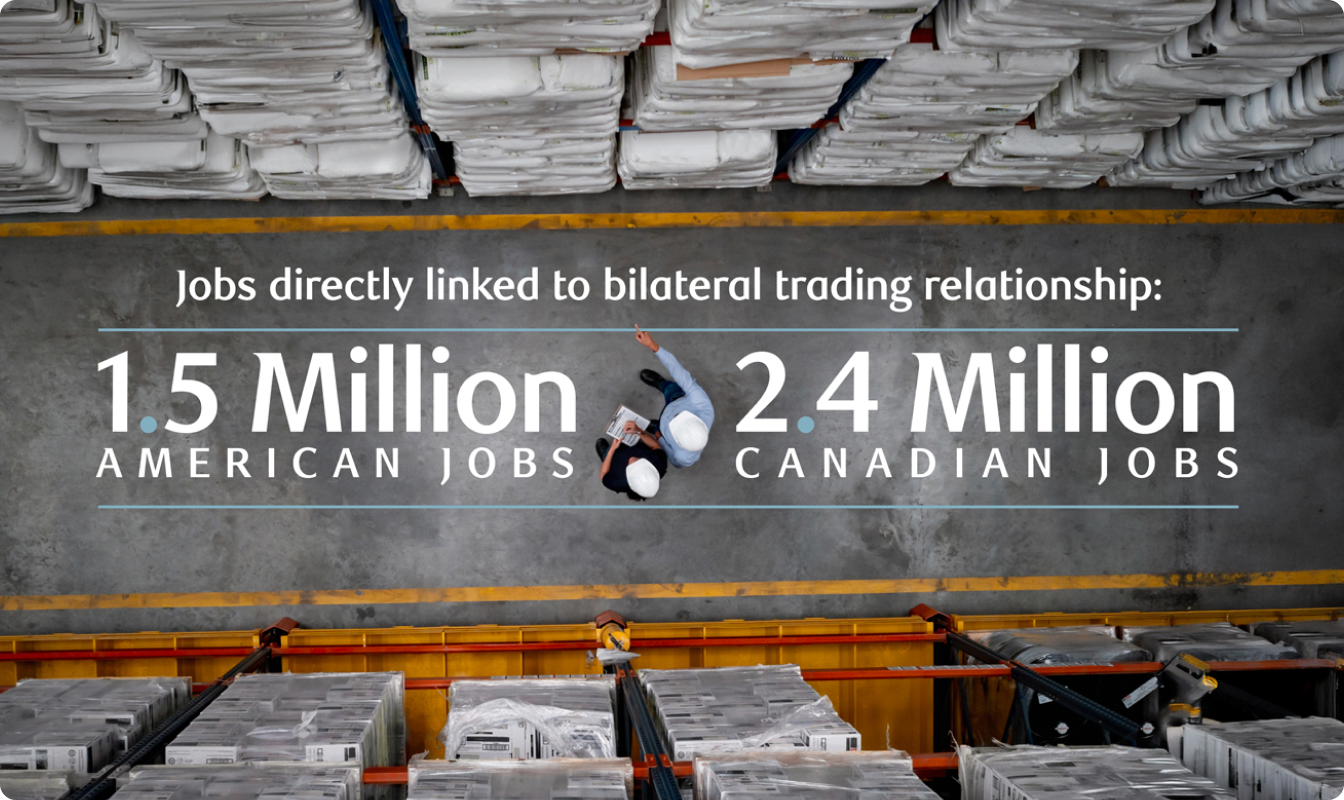
Another striking figure is that 1.5 million American jobs and 2.4 million Canadian jobs are directly linked to the bilateral trading relationship. Those are very significant numbers.
At CABC, we want to make sure there is a real appreciation for the integration of the trade relationship – real supply chains, real communities, jobs and investment.
What should Canadian businesses be doing now – and where can they find support?
I think it is very important to work with industry associations, build coalitions and build relationships.
Businesses need to find a way to build a narrative that can communicate their impact to the public on both sides of the border and make sure they have a voice at the table that is not just singular.
There is much more reception from elected officials when they can see a broader footprint and a bigger picture than just one company or one job.
Going directly to lawmakers is also extremely important, but having data to back it up is one of the most important things you can do.
Some people are really moved by anecdotes and specific stories, but I have seen that everyone is moved by jobs numbers, production lines and economic impact in their community.
Building that case and having your narrative ready is critical. Then finding a way to amplify and multiply that by building partnerships and working through communities that can speak to different markets and different voices is really important right now.
That is a big part of what we do at CABC.
We are truly non-partisan and bilateral in nature. We bring companies together, we bring policy leaders and think tanks together, and we provide a direct channel for business leaders and policymakers to engage. We are also doing a lot of education on both sides of the border to bridge understanding between the two countries.
There are many other places businesses can turn to as well – industry associations, chambers, the Business Council of Canada, think tanks and others providing research and policy insight.
‘There are lots of tools available, but I can’t emphasise enough the power of the collective narrative of this relationship. Finding spaces to come together, amplify what we are doing and speak directly to the people making the decisions is important.’
We have seen the way Canada and the United States can face the world together, compete globally, deepen the business community, create more jobs and create greater stability and safety for people when we work together.
So, while there is uncertainty and turbulence today, I am optimistic that we will get to a place where we can do this together again, because the relationship – and the people within it – make a difference and really matter.
Beth Burke is the Chief Executive Officer of the Canadian American Business Council (CABC), the leading organization advancing cross-border business and policy engagement between the United States and Canada. Beth brings more than a decade of senior-level experience spanning government, politics, and the private sector. Throughout her career, Beth has operated at the intersection of policy, politics, and business, building durable relationships across parties, industries, and borders.