

 EN

Ready to Apply?
Connect with a Credit Specialist


Key Takeaways
- A personal loan is a lump sum of money borrowed from a bank, credit union or online lender: Once approved, you receive the full amount upfront and repay it in fixed installments over a set period.
- Personal loans are generally an unsecured type of loan: which means you don't need to put up an asset like a house or car to qualify.
- Personal loans can be used for a number of purposes: They can help you pay for an event like a wedding or vacation, contribute to your retirement savings or consolidate debt.
- Personal loans offer flexibility: RBC offers both fixed and variable options. A fixed rate locks in your payments for the term, while a variable rate can rise and fall with the market. You can switch between either option at any time without penalties
Planning for a major purchase or life event can be exciting, but covering the full cost upfront isn’t always possible. Whether you’re funding a wedding, a dream vacation or want to consolidate higher-interest debt, a personal loan from your financial institution can help.
This guide breaks down the basics of a personal loan, what it costs, how it compares with other borrowing options and how the application and approval process works in Canada.
What is a Personal Loan?
A personal loan is a fixed amount borrowed from a financial institution and repaid in regular installments over a set timeframe at a fixed or variable interest rate. According to the federal government, most personal loans range from $100 to $50,000, with terms between six months and five years. At RBC, they typically start at $5,000 with a term of one to five years. The personal loan amount you receive depends on how much you need, your income, and expenses. Consider your financial needs and budget carefully and borrow only what you can comfortably afford to repay.
How Do Personal Loans Work?
Personal loans work by providing you with an upfront, lump sum of cash, which you pay back over a defined period. To get started, connect with a financial institution that aligns with your financial needs and goals. Once your application is approved, you'll receive the full loan amount immediately, and your repayment schedule will begin.
Your repayment will include both the principal amount you borrowed and the accumulated interest. Most lenders offer flexible repayment options to fit your budget, allowing you to choose a payment schedule that suits your lifestyle, such as monthly, semi-monthly, bi-weekly, or weekly. At RBC, you can apply for a personal loan in person, by phone at 1-800-769-2511, or book an appointment online.
Fixed vs. Variable Interest Rates
When applying for a personal loan, your lender will offer either a fixed or variable interest rate:
- Fixed rate: A fixed interest rate is typically locked in for a set term of up to five years, though longer terms are available. With your payments remaining the same each month, making it ideal for budgeting and financial planning. You may also be able to negotiate the fixed rate on your personal loan with your lender.
- Variable rate: With the variable option, your interest rate is generally lower than rates offered on a fixed-rate loan, and it rises and falls with changes in your lender’s prime rate (see RBC’s prime rate here). With an RBC loan, if interest rates rise, your payments will likely stay the same, but your amortization term will increase, meaning it will take longer to pay off your loan. If interest rates fall, your payments stay the same, and your amortization term decreases, meaning you could pay off your loan sooner.
At RBC, you can choose between a fixed or variable rate, and you can switch between them at any time without penalty. However, some lenders may charge you a fee for changing rate structures. Take the time to read the terms and conditions of your loan agreement before signing it. Federally regulated financial institutions are obligated to provide you with information about your loan that’s easy to understand.
Whether you choose a fixed or variable rate depends on your risk tolerance and financial situation. Borrowers who want the stability of fixed payments may prefer a fixed-rate loan, while those who value flexibility and are comfortable with rate changes may select a variable-rate loan.
What Can You Use a Personal Loan For?
Common uses for personal loans include:
- Paying for an event like a wedding or family planning
- Debt consolidation, which rolls your debt payments into one single payment, so you can save on interest costs
- Covering a planned vacation or home renovation
- Contributing to retirement savings
When a Personal Loan May Be Useful
Whether getting a personal loan is a good idea largely depends on your own circumstances, current debt load and ability to comfortably repay the loan. If you need a fixed lump sum to help pay for expenses like major home improvements or repairs, a large one-time event such as a wedding, or to consolidate debt, it may be the right option for you. Here are the benefits you should consider.
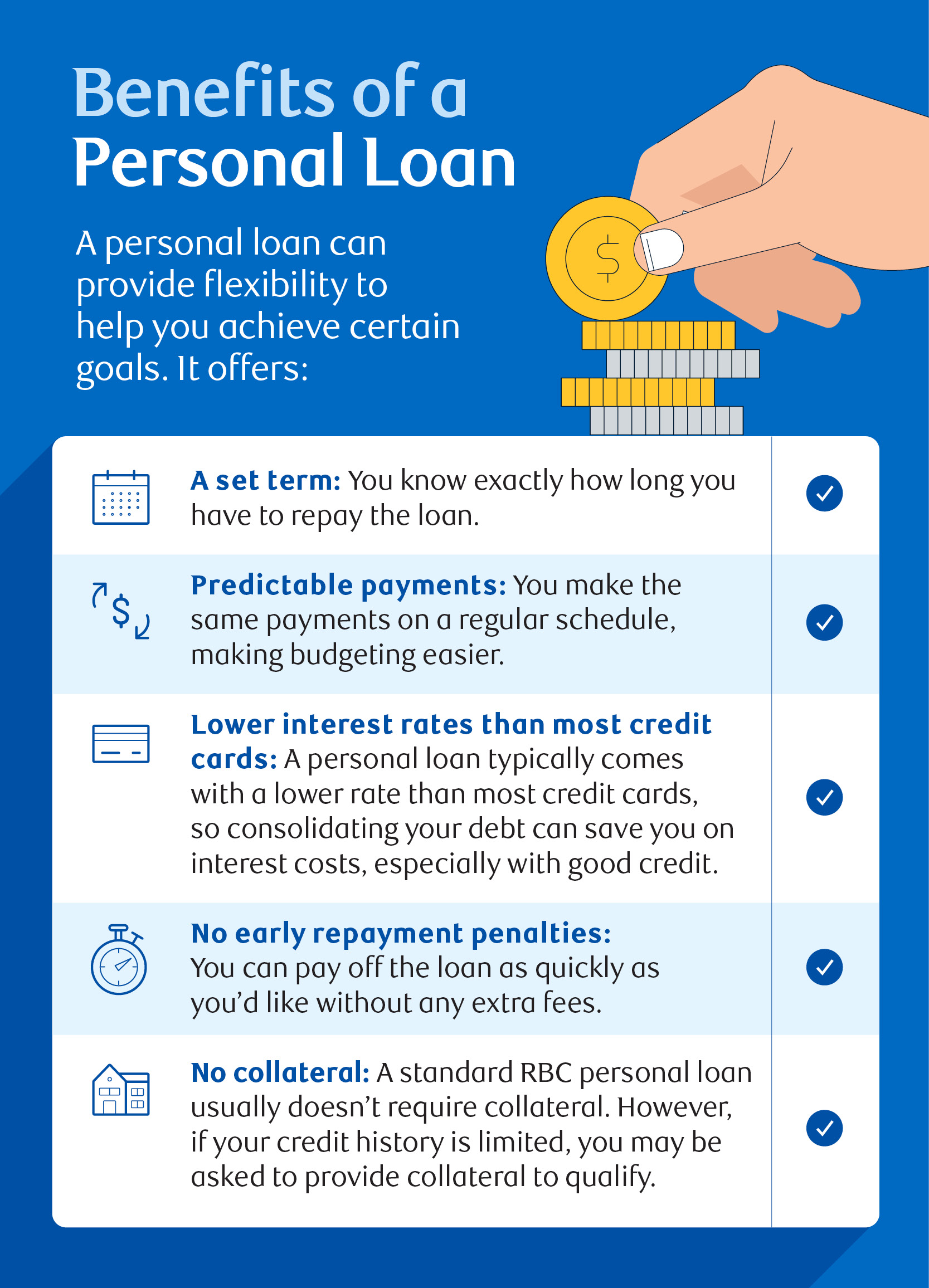
Personal Loan Considerations
Before taking out a personal loan, you may want to consider the following:
- Affordability: Calculate your monthly scheduled payments to ensure a personal loan fits comfortably within your budget.
- Loan size: The more you borrow, the more interest you'll pay, so borrow only what you need.
- Loan types: A variable-rate loan may offer a lower interest rate but could rise and fall in line with your lender’s prime rate. A fixed-rate loan may offer higher interest rates, but your payments are fixed for the duration of the term.
- Debt accumulation: Using a loan to pay off expenses without changing your spending habits could lead to additional debt.
- Impact on your credit score: If you miss or are unable to make payments, it may affect your ability to borrow in the future.
- Fees and charges: Some lenders may charge for missed payments, paying off your loan early or general processing fees. At RBC, we don’t charge a repayment penalty, an annual management fee or withdrawal fees.
Personal Loan vs. Line of Credit vs. Credit Card
When comparing personal loans with lines of credit and credit cards, it's important to understand the key differences. Here’s a breakdown of each borrowing option, including repayment structures, how interest is accrued, whether it’s a lump sum or revolving credit and best use cases.
| How you get your money | How the interest works | How you repay it | What it’s best for | |
|---|---|---|---|---|
| Personal Loan | Lump sum | Interest is usually charged daily on the balance you still owe. | Depending on your lender, you may be able to repay your loan on a monthly, semi-monthly, bi-weekly or weekly payment schedule. | Large, one-time expenses like a planned vacation or wedding, retirement savings and paying off other, higher-interest debts. |
| Line of Credit | Revolving credit | You only pay interest on the amount you borrow. | Monthly, if you have a balance. | Ongoing or unexpected expenses like home improvements, educational costs or medical bills where you don’t always know how much you’ll need to borrow. |
| Credit Card | Revolving credit | You pay interest on the amount you owe, and on cash advances. | Credit cards typically have a 30-day billing cycle. | Everyday expenses such as bills and groceries. |
What Are the Requirements for a Personal Loan?
There are certain requirements you must meet to qualify for a personal loan, outlined below.
Credit Score Requirements
A credit score is a three-digit number used to assess your creditworthiness based on your past credit history, whether you have historically paid your bills in full and on time and the amount of credit you use. The number is calculated by Canada’s two main credit bureaus – Equifax and TransUnion. The higher your credit score, the better your chances of securing a personal loan with favourable terms. For instance, a strong credit score can unlock better interest rates. A score between 740 and 799 is considered very good; 800 and above is considered excellent. When assessing your personal loan application, RBC considers your credit score in the context of your entire financial picture, which includes factors such as your debt-to-income ratio and income. Access a free credit report here.
Income Verification
Income verification is another step your lender will take when assessing your personal loan application. They will typically look at your recent pay stubs and employment confirmation letters from your employer to verify your income. If you’re self-employed, you'll need to provide your notices of assessment from your tax returns. This is the documentation you can expect to be asked for during your application process at RBC.
Debt-to-Income Ratio
Your debt-to-income ratio tells lenders what percentage of your income goes toward paying off debt. What’s considered a “good” debt-to-income ratio depends on your lender and the product you’re applying for. RBC uses this number to assess your ability to repay your loan and determine how responsible you are with your money.
How to Apply for a Personal Loan
To apply for a personal loan through RBC, you can either sign into RBC Online Banking to book an appointment with an advisor, call 1-800-769-2511 to speak to a credit specialist or visit an RBC branch in person.
To complete your application, you’ll need proof of income, including recent pay stubs, a recent employment letter and proof of a permanent address, such as a utility or property tax bill, and a valid piece of photo ID (two pieces if you’re a new client), such as a driver’s license or passport. If you’re self-employed, you’ll need proof of two straight years of income, your most recently filed annual return and a profit and loss statement.
Step-by-Step Application Process with RBC
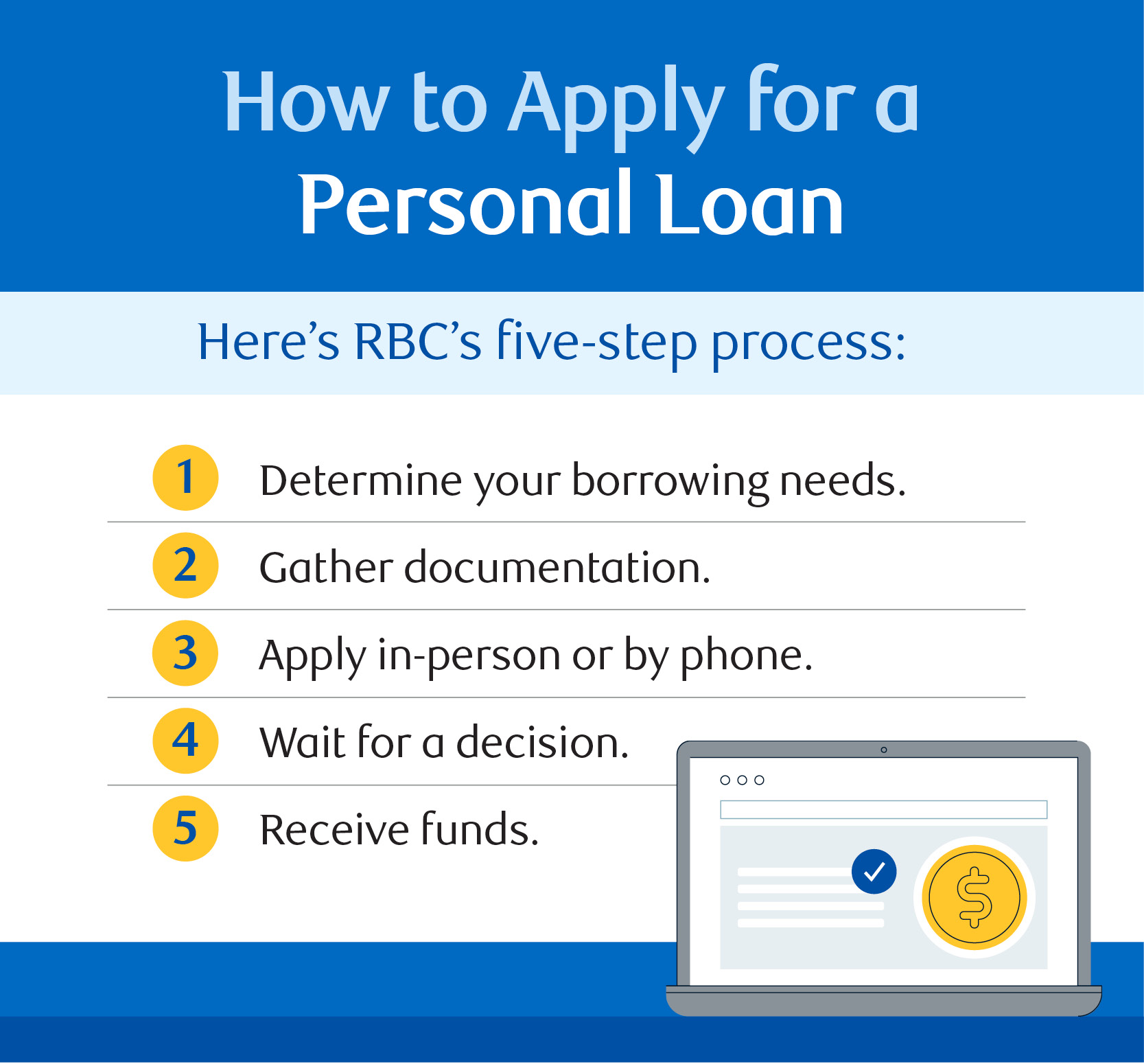
Here is the five-step personal loan application process with RBC:
Applying with a Co-Signer
A co-signer is someone with a strong credit history who can strengthen your application and improve your chances of approval. By co-signing, they've agreed to step in and cover your loan payments if you miss them or stop paying. Your lender may require a co-signer if you have a low credit score, or if you don't have enough income or credit history to apply on your own. Just keep in mind that any missed payments can negatively affect both your credit score and your co-signer's.
How Much Can You Borrow with a Personal Loan?
The maximum amount you can borrow with a personal loan depends on your income, credit score, existing debt and purpose of the loan. Loans backed by personal assets may allow for higher borrowing limits. RBC personal loan limits typically start at $5,000. Use RBC’s Loan Line of Credit Calculator to calculate your loan affordability and know how much debt you may be able to comfortably take on.
Understanding the Cost of Borrowing
The true cost of borrowing goes beyond the amount you receive. When you repay a loan, you pay back the principal plus interest, which is known as your Annual Percentage Rate (APR). There may also be additional charges that affect your overall annual cost of borrowing. By law, lenders can’t charge more than 35 per cent interest annually on personal loans, including any additional charges.
Fees and Charges
Beyond interest, personal loans may come with additional fees and charges. An origination fee is a common upfront charge for processing the loan, usually deducted from your lump sum before you receive it. You may also be charged a late fee if your payment is delayed or there aren't enough funds to cover it. RBC will always provide clear details about any fees you'll pay upfront.
Amortization Schedule
It can be helpful to see how the total cost of a loan changes depending on the length of the term. In this example, let’s say the loan amount is $5,000 and the interest rate is five per cent on a monthly payment schedule:
| Option | Monthly Payment | Loan Term (Month) | Total Cost of the Loan |
|---|---|---|---|
| 1 | $428.04 | 12 | $5,136.45 |
| 2 | $149.85 | 36 | $5,394.76 |
| 3 | $94.36 | 60 | $5,661.37 |
For a more customized payment schedule, use the RBC Personal Loan and Line of Credit Payment Calculator.
*Note: Monthly payment amount includes principal plus interest.
Personal Loans and Impacts on Your Credit
Personal loans can impact your credit score in a few different ways. When a lender checks your credit report after you make a formal application, it’s called a “hard inquiry.” This can cause a temporary drop in your credit score. However, making regular on-time payments strengthens your credit history, which can improve your credit score over time.
Paying Off Your Personal Loan
How you pay off your personal loan depends on the rules set out by your lender. With an RBC personal loan, you can repay your loan early without any additional payments. When you make prepayments, the amount goes toward both your principal and interest, helping you pay off your loan sooner. Any interest owed up to the date of your prepayment must be paid at the same time. There is no penalty for additional payments. RBC also allows flexible payment frequencies, including weekly, bi-weekly and semi-monthly payments, which can help you repay your loan faster and reduce the total interest you pay. Avoiding new debt can also help you pay down your personal loan sooner.
Getting Started with an RBC Personal Loan
A personal loan can provide a straightforward way to borrow, which may help bring you closer to achieving your financial goals. An RBC loan provides clear, transparent terms and flexible ways to repay. Explore RBC’s personal loan options and find an approach that fits your needs. RBC’s Personal Loan and Line of Credit Payment Calculator can help you determine your borrowing capacity and estimate your payment amount before you apply.
Personal Loan FAQs
-
How many personal loans can you have at once?
While there is no legal limit on the number of personal loans you can have at once, each one increases your credit utilization (the amount of available credit that you’re using) and debt-to-income ratio. This can impact your credit score and may affect your ability to get approved for more credit in the future. RBC evaluates your entire financial picture when assessing your loan application to help make sure it’s the best choice for you.
-
How long does it take to receive funds after approval?
The time it takes to receive funds after your loan is approved varies by the financial institution. At RBC, you’ll receive the total loan amount as soon as your application is approved, which generally happens within 48 hours of applying.
-
Are personal loans taxable in Canada?
Personal loans are generally not taxable in Canada because you’re obligated to pay the money back. But unlike business loans, the interest you pay on your personal loan is not tax-deductible.
-
Can I get a personal loan from the government in Canada?
No, the Canadian government does not provide personal loans. Personal loans are typically offered by banks, credit unions, and financial companies that offer loans online. However, the government offers financial support for specific needs, such as student and small-business loans.
-
What happens if I miss a personal loan payment?
A missed loan payment can result in late fees, negative credit bureau reporting, and could potentially go into collections if you continue to miss payments. If you’re struggling to make payments, contact your lender to explore options such as personal hardship relief or a change to your payment schedule. With RBC, you can skip up to the equivalent of one monthly payment each year without penalties (interest continues to accrue).
-
Can I use a personal loan to pay off another loan or a credit card?
Yes, you can use a personal loan to pay off a credit card or other debt. This is called debt consolidation and is a common use for personal loans. Combining multiple debts into one lower-interest loan payment may save you money on interest costs and could help you pay off your debt sooner. It also gives you the benefit of a single, simplified payment.
-
Can you get a personal loan with bad credit?
Yes, it’s possible to get a personal loan with bad credit, but it depends on your credit history, income, and current debt load. Taking steps to strengthen your overall financial profile, such as making your existing debt payments on time or having a trusted co-signer apply with you, can improve your chances of approval.
-
What is the difference between a secured and an unsecured loan?
A secured loan is typically used for larger purchases and is backed by an asset used for collateral. This reduces the lender’s risk, giving them a safety net to cover your balance in a scenario where you can’t repay. Common examples include mortgages and secured lines of credit.
An unsecured loan is not backed by an asset. Lenders will look at your income, credit score, and credit history when approving you. Most personal loans through banks are unsecured; a students line of credit is a common example of this. Keep in mind any missed payments may result in fees and penalties.
References
- Government of Canada, Personal Loans (www.canada.ca)
- Government of Canada, Lines of Credit: Know Your Rights (www.canada.ca)
Share This Article
Apply for a Personal Loan
Whether you want to apply or ask a question, we’re here to help.


This article is intended as general information only and is not to be relied upon as constituting legal, financial or other professional advice. A professional advisor should be consulted regarding your specific situation. The information presented is believed to be factual and up-to-date but we do not guarantee its accuracy and it should not be regarded as a complete analysis of the subjects discussed. All expressions of opinion reflect the judgment of the authors as of the date of publication and are subject to change. No endorsement of any third parties or their advice, opinions, information, products or services is expressly given or implied by Royal Bank of Canada or any of its affiliates.
*
Personal lending products are provided by Royal Bank of Canada and are subject to its standard lending criteria. If your credit history is limited, or you are studying at an educational institution outside of Canada, a co-signor may be required.