


TLDR
-
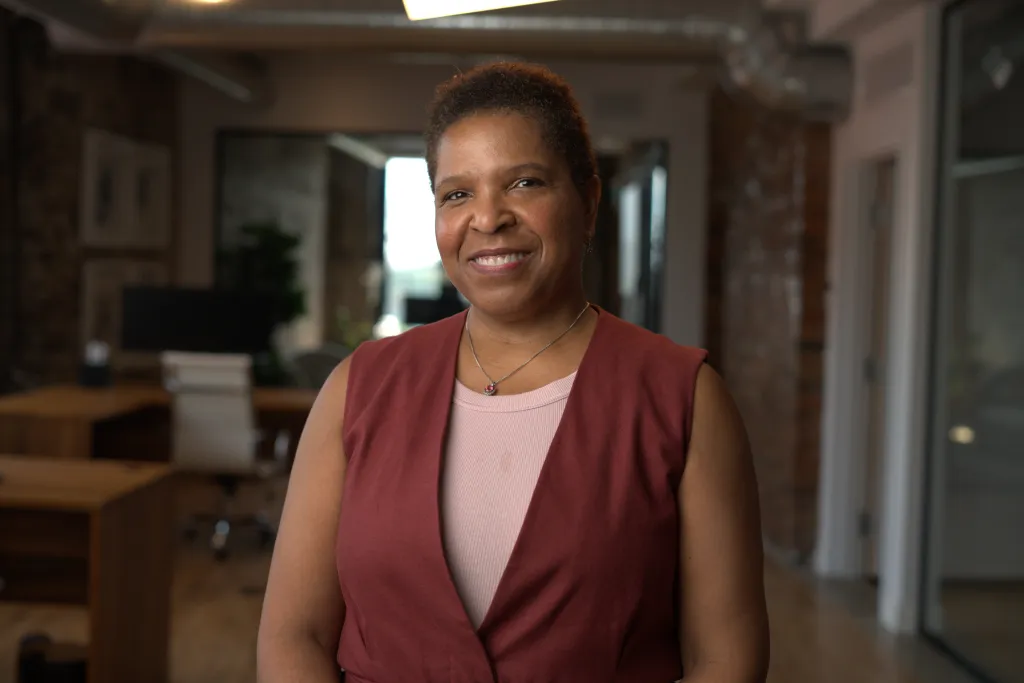
Aminder Kaur Mangat founded AKM Law to challenge traditional legal culture and build a people-first immigration firm.
-
She prioritizes quality over volume, collaboration over hierarchy and values over rapid growth.
-
By fostering autonomy and representation, she has built a self-sufficient team that thrives – even when she steps back.
-
Her advice to entrepreneurs: define your mandate, protect your values and grow in ways that strengthen – not dilute – your purpose.
When Aminder Kaur Mangat was an articling student focusing on civil litigation, immigration law wasn’t part of her plan. But as she puts it, “When you’re articling, you do what you are asked to do.”
So when her principal handed her a detention review file, she took it on. What came next changed the trajectory of her career.
Unlike civil litigation, where disputes often centre on financial outcomes, immigration detention cases involve liberty, family separation and uncertain futures. She was drawn to the deeply human impact she could have.
“These individuals are among the most vulnerable people in Canada,” she says. “I found the work incredibly rewarding, as advocacy in that space is not abstract. It affects liberty, families, and futures.”
She soon became an aggressive advocate for detained immigrants, questioning long-standing practices. In one early case, she argued for the use of GPS monitoring as an alternative for detention, challenging why that option wasn’t available in immigration proceedings when it was used elsewhere in the justice system. As an articling student, she became one of the first to secure a client’s release on that basis – setting a new precedent and changing lives in the process.
That instinct to question what has “always been done” would later shape not just her advocacy, but her approach to building a business.
Named an RBC Canadian Women Entrepreneur Awards finalist, Mangat was recognized for building a firm where quality matters more than volume, clients are heard and lawyers of all backgrounds are given the space to lead without barriers.
A different vision for legal practice
Before launching AKM Law in 2017, Mangat worked alongside senior lawyers in established firms. What she saw was a culture that treated long hours as a rite of passage. Sixty- to eighty-hour work weeks were expected, burnout was a given and volume and billables often drove decision-making.
“This burnout culture always felt wrong to me,” she says. “Working more hours doesn’t automatically make the work better.”
Mangat also found the rigid hierarchies short-sighted. Seniority often dictated whose ideas carried weight – not the quality of the ideas themselves. It didn’t always feel like a team working toward a common goal.
“I wanted to build something on my own and foster a group of people around me who shared the same values,” she explains. “Doing quality work, working collaboratively and advancing clients’ rights in a better way.”
Building a team around shared values
From the beginning, Mangat has been intentional about who joins her team. Her first paralegal placement is still with her today – a reflection of the culture she has created.
How does she find the right staff? She looks for alignment. “I was not trying to replicate a traditional Bay Street model. I was building a collaborative firm where people are trusted to lead,” she says candidly.
Her interviews rarely follow a script. Rather than asking standard questions, she has conversations – about skills, yes, but also about passion. When discussions naturally evolve into immigration policy, client advocacy or systemic gaps, she pays attention.
“I can see where their energy focuses,” she says. “That tells me a lot.”
Over the years, Mangat has built a team that is both committed and collaborative – and one that believes in the firm’s mission as much as she does.
Creating a self-sustaining firm
That culture became especially important in 2023, when Mangat stepped away from the front lines of her practice after the birth of her child. “It was scary,” she admits. “When you feel like you’re holding a lot of the weight, stepping back can be uncomfortable.”
At the same time, the firm was navigating staff turnover and another maternity leave. It was, by any measure, a stress test.
But something important happened: the firm continued to thrive.
“I realized there were a lot of things I didn’t need to do anymore,” Mangat says. “The team had it under control.”
Instead of everything filtering through her, team members leaned into one another. Communication strengthened, accountability increased and the systems she had put in place came through.
It was an experience that reshaped her leadership. With less time spent in the weeds, she could focus on strategic growth and business development. The firm became stronger because she had built something that could function independently.
Advancing diversity and representation in law
From the outset, Mangat wanted to create a firm where women of colour could thrive.
She remembers walking into the Court of Appeal as a junior articling student and noticing that everyone in the room – from the bench to the counsel table – was a white man. She was the only woman, and the only woman of colour.
“I remember thinking, I need to find a space where more of me are represented,” she says. Today, she is building that space.
Mangat knows that doors can close on people because of their names, their accents or the way they present themselves. Members of her team have shared stories of not receiving interviews because they wore a hijab or had unfamiliar-sounding names.
At AKM Law, the opposite happens. She recognizes that when people of diverse backgrounds flourish within the firm, clients benefit. In fact, many feel immediate relief when they can speak to someone in Urdu, Mandarin or Spanish – or simply see themselves reflected in their advocate.
“You can’t imagine how stress-free people become,” she says, “when they know they’ll be understood.”
For Mangat, representation isn’t symbolic – it is practical, powerful and directly linked to better outcomes.
Growing while staying true to the mission
AKM Law has grown steadily over the years, but Mangat’s definition of growth may look different from that of other entrepreneurs.
She didn’t set out a five-year expansion target or map out aggressive scaling plans. Instead, she started small and grew with the momentum that came toward her, taking things one day or one week at a time.
“Growth means different things to different people,” she says. “For me, it means growing my own expertise so I could offer better service – and growing the team so we could expand access to justice.”
She is mindful that the pursuit of growth can easily dilute a company’s purpose. “You need to know what your mandate is – what you want to produce and what that looks like – and have the conviction to stay true to that vision,” she says. “Otherwise, it’s easy to get lost.
For entrepreneurs looking to build values-driven businesses, Mangat offers this advice:
-
Define your mandate clearly. Know what you stand for and what you won’t compromise
-
Let growth serve the mission – not replace it
-
Hire for shared values, not just credentials
-
Surround yourself with people who lift up the vision
-
Treat setbacks as lessons, not failures. They are opportunities to refine and adapt.
-
Remember that leadership is persistence, not perfection.
A small firm, she believes, can still make a significant impact, as long as it stays aligned with its purpose.
“If you lose sight of the purpose behind what you are building, you may still succeed, but it will not feel like success,” she says.
As an RBC Canadian Women Entrepreneur Awards finalist, Mangat has been recognized not only for legal excellence, but for leadership – for advancing opportunities for women of colour, advocating fiercely for clients and proving that a values-centric business model can thrive in a competitive industry.
Build Your Business Confidently
At RBC, we are committed to empowering women entrepreneurs with a wealth of resources, online tools, and services beyond banking.
This article is intended as general information only and is not to be relied upon as constituting legal, financial or other professional advice. A professional advisor should be consulted regarding your specific situation. Information presented is believed to be factual and up-to-date but we do not guarantee its accuracy and it should not be regarded as a complete analysis of the subjects discussed. All expressions of opinion reflect the judgment of the authors as of the date of publication and are subject to change. No endorsement of any third parties or their advice, opinions, information, products or services is expressly given or implied by Royal Bank of Canada or any of its affiliates.