

Key Takeaways
A brand built on a genuine, human story earns lasting loyalty
Doing things differently – being first, thinking creatively and staying true to your values – is how an underdog can stand out among giants
The hardest moments in business can become turning points, opening doors you may not have otherwise pursued
Strong relationships across your network can help you grow during good times and carry you through the tough ones
Yes, they really are two brothers.
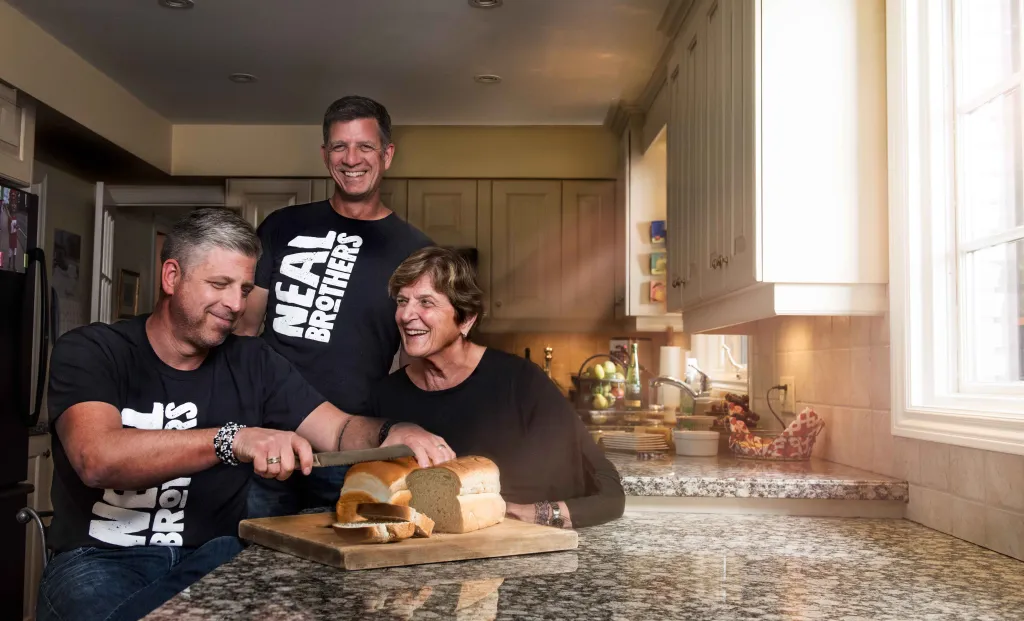
Peter and Chris Neal, the pair behind Neal Brothers Foods, have been in business together since 1988 – long enough that most people who reach for a bag of their organic tortilla chips assume “Neal Brothers” is just a name on a label. It isn’t. There are two of them, they’re actually brothers, and they’ve been building their business side by side since it began as a side hustle, making croutons in their mother’s kitchen.
There’s another thing many people don’t know. To a shopper, Neal Brothers is a brand. To the food industry, they’re both a brand and a distribution business. “We started as a brand,” says Chris. “The industry knows us as two different assets. The consumer only knows us as one.” The distribution side wasn’t the plan – it was simply what it took to get that first batch of croutons from their mother’s kitchen onto a store shelf.
From a batch of croutons to a national brand
Staring out the window of an economics class at Bishop’s University, Peter wondered what else he could do that didn’t require finding a job. He knew a few things: that he didn’t belong in that classroom, that he wanted to work for himself, and that he and Chris both liked to cook. So they decided to try working together for a while and see how entrepreneurship suited them. “I really wanted to buy a Ferrari,” Peter says. “I wanted massive, immediate success.”
While making croutons may not seem like the quickest path to entrepreneurial success, it’s where they started – in their mother’s kitchen. After all, in the late eighties, salads were getting healthier, and the barrier to entry was gloriously low. The pair drove the croutons to local specialty stores in their Volkswagen Rabbits and wrote orders up by hand. If you wanted eleven bags, you bought eleven. There were no cases yet – just recycled LCBO boxes and two brothers figuring things out as they went.
Looking for day-old bread, they caught an early break and quickly fell into a relationship with a commercial bakery owner. “Within five minutes, he said, ‘Here are the keys to my bakery. I’ll see you tonight,’” Chris recalls. He charged them five dollars an hour and let them use his minivan, on the condition the brothers had it back by three so he could pick up his child. The bakery owner didn’t even know their names. Earning trust quickly, and building relationships from it, turned out to be a recurring theme in the Neal Brothers story.
Tortilla chips came next, made by a family in Rexdale who had come to Canada from Spain and milled their own corn. Then came salsa, made to the brothers’ own recipe by a supplier they had found through an employee’s father. From the start, they did things their own way – using carrot instead of starch or sugar to make what they believe was the industry’s first organic salsa – and convincing grocers to move tortilla chips out of the ethnic-food aisle into the snack section. They also developed little hangers to hold their salsa jars right beside their chips. “No one else did that,” says Chris. “It was pretty innovative, considering we didn’t know what we were doing.”
Selling products they hadn’t made felt strange at first, until they looked at it differently: the pair were helping other makers build their businesses too. “We have always taken ownership of the brands we bring in,” Chris says. “We bring them in because of the people behind them.” While other distributors were carrying upwards of 15,000 stock keeping units (SKUs), the Neals carried roughly 600 – and thrived because they knew every one.
How their story built the brand
If there’s a single idea that captures how the Neals went from selling croutons out of their family’s garage to building a national brand, it’s this: “A product without a story is a product,” says Peter. “But a product with a story is a brand.”
For much of the company’s life, telling that story was hard work. There was no social media when they were starting out, and no direct line to the people buying their food. So the Neals went to where their customers were – film festivals, good-food events, farmers’ markets and in-store demos. They were among the first to put “organic” and “all natural, no preservatives” on the front of their packaging, at a time in the nineties when that didn’t matter as much to the average consumer.
The products were only part of it. The real draw was the people behind them: two real brothers, making real food, in Canada. Chris believes the pull of authenticity is more powerful today than it’s ever been. “There is a generation of consumers who really want to relate to a brand,” he says. “They want to feel it and touch it.” It’s how the Neals set themselves apart from the big packaged-goods companies – a story of simple, clean, family-driven food, told by the family itself.
“It’s important to infuse your brand with personality,” says Chris. “Brands need to do that more and more – and I think they have permission to do it.”
That belief influences the purchases they make within and outside the business. “We have an adage in our house that you work hard for every dollar you make,” says Chris. Where you choose to spend it, he adds, is the vote you get – you can put it toward a big franchise, or toward the independent shop with a chef and an owner standing behind the counter. Neal Brothers has spent nearly forty years betting that people would rather spend their hard-earned dollar on a story they believe in.
The years that forced a change
Growth was never a straight line. For the first ten years, the company didn’t reach a million dollars in sales. One year brought a net loss due to currency swings. There was also a stretch when Peter stepped away for a year to pursue another venture, and the business slipped. Then came the hardest blow: the loss of a client that made up roughly 40 per cent of the distribution business, at a time when the industrial real-estate market was booming, and their landlord was looking at tripling the rent on a warehouse they had already outgrown.
Peter is candid that this period took a serious toll on his mental health, and that the brothers reached a genuine low. “We looked at each other and said, we’ve got to do something,” Peter recalls.
So they picked up the phone. A friend in a similar position ran a distribution business whose strengths mirrored their gaps. He had Western reach to their Eastern base and fresh and frozen to their dry and ambient product line. “It took two seconds to realize how good it could be for both our companies,” says Chris. “So we merged four years ago.”
The merger that took the business national
In 2023, Neal Brothers Distribution merged with new partners to form Jonluca Neal – now the largest family-owned natural-food distributor in Canada, with national coverage, warehouses in the GTA and Burnaby, and product in all three temperature categories. The distribution business has since tripled. “That’s when the explosive growth really happened,” Peter says. The brand itself, Neal Brothers, stayed with Chris and Peter.
“Life is good again,” Peter adds. “My mental health, Chris’s, our families, our employees – we’re in the best place we’ve been in in thirty-eight years of business.”
Giving back, with purpose
Community was part of the Neal family long before it was part of the company. Their parents, Chris says, were “king and queen” of giving their time and money, so generosity was simply part of who the brothers were – giving away baskets of croutons to school auctions, donating product to charity golf tournaments, and saying yes to nearly anyone who asked.
When a friend asked why they weren’t supporting the causes closest to them, Peter explained he thought it would look self-serving. His family had lived through serious mental illness and Chris through juvenile diabetes. The friend told him he had it backwards. Supporting what has touched your own family isn’t self-serving – it’s where you can make the most difference.
So the brothers narrowed their focus to mental health and diabetes, took board and committee seats and put money behind both. The latest chapter is “crafted with purpose,” a program directing one per cent of sales from their Crank coffee line to various causes every quarter.
A relationship built on transparency, loyalty and trust
Neal Brothers has been with RBC since the beginning, starting with a bank award for young entrepreneurs that Chris won in the late eighties.
What they’ve valued ever since is continuity and candour. Their current relationship manager has been a constant for fifteen years – she has met their families and every catch-up is spent talking about life as well as business. RBC supported the brothers through the significant transition of merging their distribution arm into Jonluca Neal, and the banking relationship spans the tools that keep the business running – from cash management to commercial cards. “It’s our transparency, too,” Chris says. “From the very beginning, we told them exactly what was going on, whenever anything new happened.”
That trust has run both ways: when the merger happened, their new partners moved their banking to RBC to join them.
Real brothers, real partnership
Ask the Neals what they’re proudest of, and it’s the relationship they have protected through it all. Both their wives come from families that ran businesses of their own, and in each case the relationship between the brothers broke down. Two women who grew up watching what a shared business can do to brothers went on to marry two brothers in a shared business. Peter and Chris took the warning to heart.
They decided early that their own relationship would come first – no children in the business and no succession fights waiting down the road. Just the two of them. There’s also an irony they appreciate: between them they have five daughters and no sons, so the “Brothers” in Neal Brothers ends with them. They seem entirely at peace with that – what they built was never about carrying on a name.
It was never about the Ferrari, either. “Once I realized I wasn’t going to get that Ferrari, it became far less important,” Peter says.
“We treasure what we have as two brothers,” Chris says, “but we treasure what we have as two business partners too. I can’t imagine having done this alone. It wouldn’t have been half as much fun.” Nearly forty years in, that’s the part that still matters most – not the business they built, but the way they’ve built it: side by side.
Connect with an RBC Specialist or speak to your RBC Relationship Manager about accessing tailored solutions to help your retail business tand out in a competitive marketplace.
This article is intended as general information only and is not to be relied upon as constituting legal, financial or other professional advice. A professional advisor should be consulted regarding your specific situation. Information presented is believed to be factual and up-to-date but we do not guarantee its accuracy and it should not be regarded as a complete analysis of the subjects discussed. All expressions of opinion reflect the judgment of the authors as of the date of publication and are subject to change. No endorsement of any third parties or their advice, opinions, information, products or services is expressly given or implied by Royal Bank of Canada or any of its affiliates.