

TLDR
Circular manufacturing models can help businesses to mitigate climate-related risks by managing exposure to global supply chain issues, getting ahead of regulatory standards, and strengthening partnership across their value chain.
Circularity aims to cut greenhouse gas emissions and waste by recovering materials, energy and water. The model lessens demand on natural resources by requiring fewer newly extracted or imported inputs.
Commercial flooring company Interface introduced circular manufacturing processes in the 2000s by developing take-back programs and new product lines that reuse post-consumer materials.
Circularity requires investment, and businesses may find benefits beyond direct return on investment, such as customer value, regulatory compliance, or access to government incentives.
For decades, most industrial manufacturing businesses have followed a linear production model. With a “take-make-dispose” approach, raw materials go in, products come out, and scrap, wastewater and wasted energy are treated as unavoidable losses in the business. When end-of-life products can’t be recovered, they are incinerated or dumped in landfills. All the while, demand for newly extracted raw materials to feed the process keeps growing. In Canada, nearly 94% of manufacturing employs linear production.
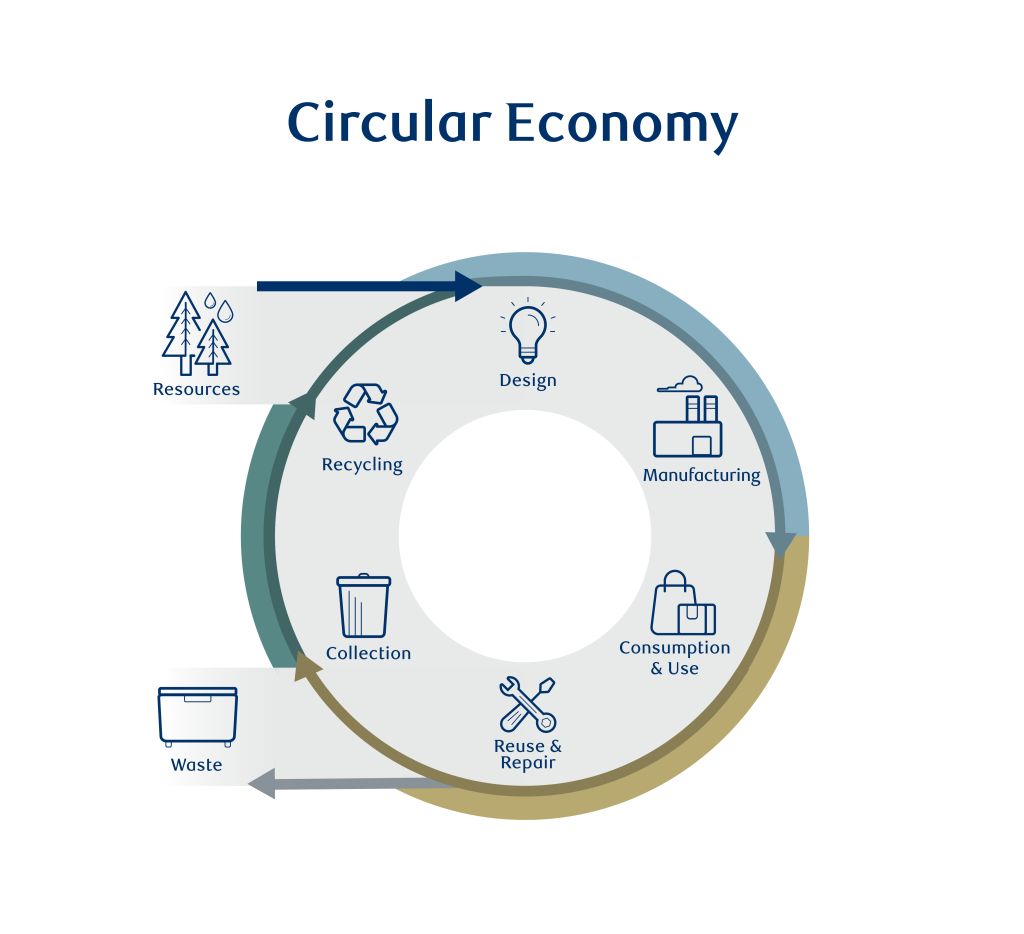
Circular manufacturing offers a different path. The approach is designed to cut greenhouse gas (GHG) emissions and waste by recovering leftover materials, energy and water. It also keeps materials in use longer, which can lessen demand on natural resources and reduce dependency on newly extracted or imported inputs. Globally, more than 90% of biodiversity loss and water stress is caused by extracting and processing natural resources.
Today’s manufacturing businesses are being reshaped by a laundry list of pressures that stretch well beyond the factory floor. A turbulent geopolitical landscape is redrawing global trade routes and disrupting long-standing supply relationships. Source materials like metals, minerals and timber are under increasing strain, making them scarcer and more expensive to access. Governing bodies are tightening the rules around what manufacturers are legally responsible for, and introducing pricing models that make carbon-intensive production methods less viable. Customers and stakeholders, meanwhile, are paying closer attention than ever to how products are made and what happens to them once they reach the end of their usable life.
Together, these forces are causing instability in a business’s value chain and creating risk for operations, reputation, and the bottom line. They’re also pushing manufacturers to take a hard look at their processes to find ways to increase efficiency, reduce costs, minimize waste and maximize material use.
Increasingly, manufacturers are finding circularity to be a competitive advantage, rather than a cost to manage. Atlanta-based commercial flooring company Interface began the journey three decades ago and offers a practical example of what’s possible. They recently committed to becoming carbon negative by 2040, which means the company will remove more GHGs from the atmosphere than it emits.
“We’re constantly evaluating our products, supply chain and factories to reduce waste, lower carbon emissions and ensure that decisions have a strong business case,” says Liz Minné, Interface’s Head of Global Sustainability Strategy. “Sustainability doesn’t just mean the environment. It means people and it means profit.”
How does circular manufacturing cut down on waste?
Where linear manufacturing processes let waste exit the system, circular manufacturing models feed it back in. Products are designed so components can be separated, recovered and reused, reducing waste and reliance on newly-extracted, raw materials.
In a circular model, scrap and offcuts from the production process become material for new products, while goods recovered at the end of their usable life are broken down so the materials can be reused. Water is recirculated and excess heat is captured to power other operations.
Companies can take different approaches to circular production, shaped by their materials, processes and markets. Interface’s focus has been on redesigning its manufacturing processes to reduce the amount of new material needed in its products, and to recirculate resources like energy and water. The company uses 100% renewable electricity across its factories and manufacturing sites worldwide. It has also focused on reducing water use since 1990, with initiatives like recirculating water through carpet tile production processes, and opting for solution-dyed yarn to eliminate water-based dying processes.
Through the company’s take-back program, used carpet tiles are either reused—sometimes through donations to small businesses or community and charitable organizations—or processed so their materials can be reintegrated into new products. Since 2016, Interface has recovered more than 38,000 tonnes of post-consumer carpet tile.
“We bring products back and recycle them: chop them up into little pieces and then put them in future backings,” explains Minné.
Decisions made in the early design stages have the power to shape how much material is lost. For instance, in 2000 Interface designed Entropy ®, one of the company’s modular carpet tile lines, in a way that reduces its installation waste to about 1.5%. That’s compared with 3-4% for typical modular carpet and roughly 14% for traditional roll carpet. It did this by creating tiles made with colours that can blend together, rather than requiring matching dye lots, and can be installed in any configuration. Over the last 25 years, Interface has continued to add new collections and styles, which offer the same benefit of reduced waste.
Today, 52% of Interface’s raw materials are either recycled or derived from plants—resources that produce fewer GHGs than conventional alternatives.
“The approach is always, ‘How do we minimize what’s going in?’” Minné adds. “Once we have that minimum, it’s ‘How do we find renewable sources, ways to recirculate, and then how do we recover our products?’”
How does circularity help to reduce climate-related risks?
Get ahead of incoming regulation and policy that could affect operations
Business may be feeling the pressure to move away from waste-intensive linear models as regulations tightening at both ends of the product lifecycle:
-
At the design stage, the European Union’s Ecodesign for Sustainable Products Regulation introduces new requirements around durability, repairability and recyclability.
-
Extended Producer Responsibility (EPR) programs are expanding globally, shifting end-of-life costs, including collection, recycling and disposal, back onto manufacturers. In Canada, federal and provincial EPRs are expanding across sectors, from packaging, electronics, textiles and apparel to building materials, food production, batteries and hazardous products.
-
The government has also introduced a Federal Plastics Registry that requires companies that manufacture, import or sell plastic products and packaging to report annually on the plastics they put in the market, part of a broader agenda to build a national circular economy.
Manage exposure to global supply chain disruptions
Supply chain disruptions cost organizations an estimated US$184 billion annually, driven by a widening range of risks, including global conflict, trade disputes, natural disasters and a growing dependence on critical minerals such as lithium, cobalt and nickel concentrated in a handful of countries. Manufacturers that rely on newly extracted or imported inputs can be exposed when prices spike or supplies tighten, while circular models offer greater resilience and cost control.
Companies that get ahead of these shifts might find it easier to weather the storm, while those that wait may risk compliance costs and a competitive disadvantage.
“We live in a world where materials are getting scarcer,” says Minné. “Keeping track of where your materials are going and recovering those is going to be a key way to move forward.”
Read more: Value chain analysis in your business’s environmental sustainability strategy
Can circularity help to reduce Scope 3 emissions?
Recovering materials is one thing, cutting GHG emissions is another. Under standard greenhouse gas protocols, a company’s emissions profile is divided into three categories:
- Scope 1 covers direct emissions from owned operations.
- Scope 2 accounts for indirect emissions from purchased energy; and
- Scope 3 captures emissions across the rest of the value chain, including purchased materials, transportation and a product’s end of life.
What role does Scope 3 play in a business’s value chain?
For most manufacturers, Scope 3 represents the largest share of GHG emissions —often 70% or more of total emissions. That’s creating pressure in both directions:
Downstream, buyer expectations are shifting. Large customers, which often have their own emissions targets to meet, are increasingly asking suppliers to demonstrate how they are reducing GHG emissions impacts across production, materials and end-of-life management, with those expectations increasingly embedded in procurement and reporting processes. Those expectations are now showing up directly in contracts and supplier reporting requirements.
That pressure flows back through the supply chain. For many manufacturers, upstream materials represent the single largest share of total GHG emissions. Addressing this means working with suppliers that may be at very different stages of measurement, disclosure and capability to reduce GHG emissions and recover value across the supply chain.
Read more: Mapping a Canadian company’s environmental sustainability journey
At Interface, that reality became clear when the company began mapping its emissions in the early 2000s and identified yarn as the single largest contributor. It urged its yarn suppliers to develop a recycled nylon that could meet performance and durability requirements. Some of its partners dismissed the idea as unrealistic. One supplier chose to invest in research and development, eventually producing a recycled nylon that significantly reduced Interface’s upstream emissions. The same material is now widely sourced by other flooring manufacturers and fashion brands.
“That’s been a business benefit for them and, of course, a business benefit for us, as well,” says Minné.
More recently, Interface conducted an assessment of its top 20 suppliers (accounting for 80% of GHG emissions from purchased goods) using an internally developed framework. The scale is designed to give Interface a consistent way to start conversations with its suppliers about where they are in their emissions reduction journey and what a realistic next step might look like. In some cases, this might include learning from other suppliers that are further along than Interface itself.
By 2030, the company aims to reduce absolute Scope 1 and 2 emissions by 50%, reduce Scope 3 emissions from purchased goods and services by half, and reduce business travel and employee commuting emissions by 30%.
In competitive markets, that effort increasingly matters to the bottom line. “If it’s a one-to-one decision between a competitor, and we have better carbon emissions, that’s a definite advantage,” says Minné.
How can businesses start to think about circular manufacturing?
Circular production requires investment, coordination and often a willingness to rethink long-standing processes. It also doesn’t have to happen all at once.
“[Environmental] sustainability is definitely a long game,” says Minné. “But every single project that we do has to have a business case.”
That doesn’t always mean direct return on investment. Sometimes the return comes through customer value, staying ahead of regulation or accessing government incentives for lower-carbon production. For companies just starting out on the circularity journey, small wins can open the door to larger changes—and innovation doesn’t always require big budgets.
Interface, for instance, previously facilitated an internal program that invited workers on the manufacturing floor to submit ideas for reducing waste. If an idea delivered savings, the employee received a bonus.
“Those people are on the machines every day. They have ideas that management would never think of,” explains Minné. “Using those small successes to build momentum is really important.”
Advice for businesses moving towards a circular manufacturing model
Thirty years of experience at Interface point to a few principles for manufacturers looking to build circularity into their operations, regardless of sector or scale.
Minné recommends starting with a pilot project and learning from it — whether it works or not. “Using those small successes to build momentum is really important,” she says.
From there, look at where value may be leaving the business through scrap, wasted energy, water, excess inventory, or products that have to be remade. Quantifying the associated costs makes it possible to identify where circular approaches offer the strongest return and build the business case to pursue them.
Every product or new idea should make money or save money—ideally, both. Built early and maintained over time, that discipline is what turns initial wins into lasting change.
The question for manufacturers is no longer whether to move toward circularity, but how quickly—and whether they get ahead of the shift or are forced into it.
At Interface, the environmental sustainability journey has reinforced something Minné believes applies well beyond flooring. “In the same way that business caused the problem, it can also solve it.”
Read next: Managing climate-related risk in your business’s value chain
This article is intended as general information only and is not to be relied upon as constituting legal, financial or other professional advice. A professional advisor should be consulted regarding your specific situation. Information presented is believed to be factual and up-to-date but we do not guarantee its accuracy and it should not be regarded as a complete analysis of the subjects discussed. All expressions of opinion reflect the judgment of the authors as of the date of publication and are subject to change. No endorsement of any third parties or their advice, opinions, information, products or services is expressly given or implied by Royal Bank of Canada or any of its affiliates.