


Key Takeaways
The Food Dudes generates revenue in seasonal bursts – some months have a full calendar of events, while others are far quieter.
The company built financial systems that can absorb seasonal peaks and pauses, including flexible payment methods, transparent reporting and financing arranged in advance.
A revenue mix that pairs steady, year-round contracts with higher-exposure event partnerships has made cash flow more predictable.
Partnering with a bank with industry sector expertise means fluctuations are anticipated and planned for, so financing is in place when the company needs it.
In our Treasury Management series, RBC speaks with Canadian businesses about how they’re future-proofing the way money moves through their operations, and what CFOs have learned about managing cash flow, payments, and risks along the way.
On a busy Saturday in August, The Food Dudes might be catering the largest wedding day of the year, the Honda Indy Toronto and the King’s Plate, all at the same time. Eric Choy, the company’s Chief Financial Officer, knows what a day like this does to their cash flow and credit card volume – and how unusual the activity would look to anyone who didn’t understand their industry.
So, he sends a note to Derek Atchison, Senior Relationship Manager with RBC Commercial Banking, ahead of time. “I don’t need to explain it,” Choy says in a recent conversation. “I just need to tell him: on this day, we have all these things happening, so please don’t red flag our credit card traffic.”
The exchange is an example of how the company operates. The Food Dudes runs its business and earns the bulk of its revenue in a concentrated stretch from spring through the holidays, and its working capital cycle routinely requires substantial outlays months ahead of the receipts that offset them. Building financial systems that work with that pattern – rather than against it – has allowed the company to keep growing through fluctuations that could otherwise strain a business.
From a home kitchen to a hospitality group
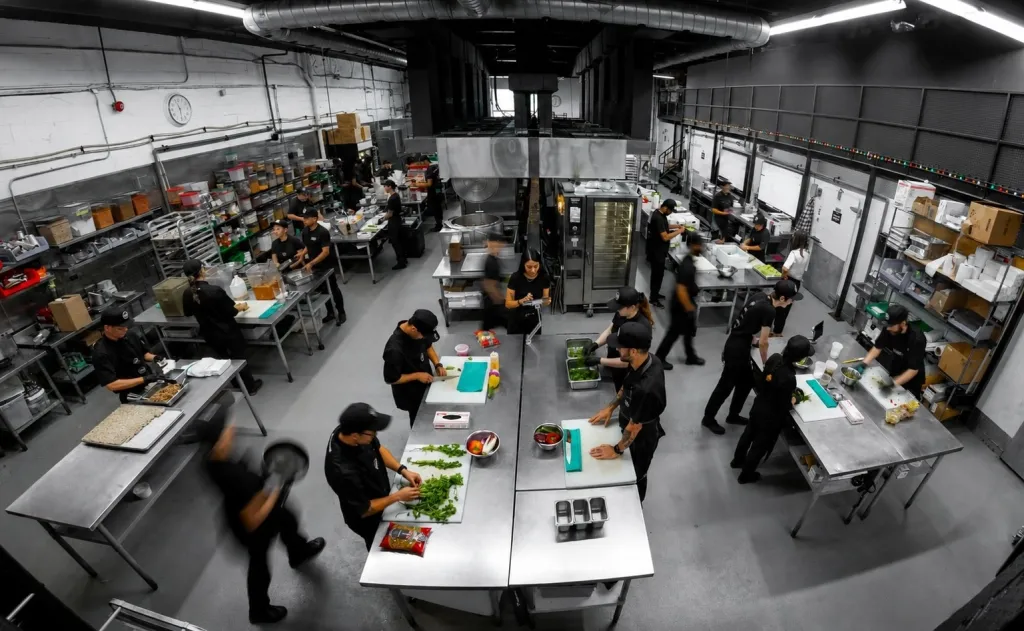
Chef Adrian Niman founded The Food Dudes in 2007, working out of a condo kitchen and catering small dinners. Nearly two decades on, it is one of Toronto’s best-known hospitality operators, running corporate events, weddings, festival programs, museum restaurants, and several of their own restaurant brands.
Choy, who joined the finance team in 2018, describes the business model in a sentence: corporate events and weddings. Even after years of diversification, he estimates those two categories still account for 70 to 80 per cent of revenue.
Our risk exposure is meaningful. “If people don’t gather, we don’t have revenue,” says Choy.
That made the pandemic an existential problem. Between February and March 2020, the company’s event calendar dried up entirely. There were no weddings and no conferences.
The leadership team’s response was to find new uses for existing capacity. They sold at-home meal kits for a few years, and ran a drop-off service and catered outdoor festivals as soon as they were permitted. “Not every decision panned out, says Choy. “But we took some risks, we took on some partners, and we convinced them to trust us with their venues and their events.”
The company emerged from that period with a deeper client list, a more diversified business model, and a clearer view of what its revenue mix needed to look like.
How The Food Dudes manages cash flow around a calendar it can’t control
Seasonality isn’t a problem The Food Dudes can solve – their calendar is set by its clients. What it can control, however, is how well its finances are set up to absorb the pattern – and over the past few years, it has built that capacity in several ways.
Balance the revenue mix across risk levels
Corporate events and weddings remain the core of the business, and they carry the most exposure. They are high value, booked one at a time, and concentrated into a few months of the year. Around that core, The Food Dudes has built three steadier revenue streams.
Venue relationships: Most wedding venues have signed catering agreements long before a couple walks through the door, and The Food Dudes has spent recent years pursuing those contracts directly. “We want to be on the list at venues that only work with a small number of caterers,” says Choy. “The ultimate goal is to be the only one.” Converting one-off bookings into a standing arrangement turns unpredictable demand into a base the company can forecast.
Public-private partnerships: The Food Dudes runs the food and beverage services at four museum properties, most recently signing on with Toronto’s Aga Khan Museum as its food service provider, including operating the on-site restaurant. The arrangement suits both sides: institutions want an operator with a track record, and the company gets steady daily revenue that isn’t tied to an event calendar. “Our partners value someone who’s going to be there for the long term,” says Choy. “They don’t want to search for a new operator every six months.”
Multi-year event partnerships: The Honda Indy Toronto brings recurring, plannable business on a set date each year. The trade-off is that significant inventory is committed months ahead, against returns that depend partly on the weather and on what attendees choose to buy.
Each business stream does a different job. “Selling coffee to gallery visitors is very low-risk,” says Choy. “We balance that with higher-risk business like the Honda Indy.” While these consistent streams don’t flatten the seasonal curve, they do make its shape far easier to anticipate.
Pay suppliers the way they want to be paid
When Choy joined in 2018, the accounts payable process ran the way it ran almost everywhere in food service: suppliers delivered to the loading dock and left a paper invoice; invoices were batched; then the company wrote between 100 and 200 cheques per month.
“That was our industry,” says Choy. “It was a widely accepted standard for anyone who sold food. It was very manual, with a lot of room for error – and about 10 per cent of those cheques would get lost in the mail.”
The push to change came from two directions. On one side, there was the pandemic. Without the ability to be in an office signing cheques, there was little choice but to transition to a digital process. On the other, suppliers were modernizing their own systems and many stopped accepting cheques altogether. With new digital processes came choice, too, and different suppliers preferred different payment methods, whether ACH direct deposit, pre-authorized payment, wire, or email money transfer. This put The Food Dudes in the position of having to match payment methods with whatever each supplier required.
“When a supplier tells us they only accept one specific form of payment, that becomes a conversation with our RBC team about getting it set up,” says Choy. “That’s what it comes down to – if we can’t pay them properly, it can be difficult to continue the relationship.”
Sometimes, the requirement is about timing rather than method. Choy describes a meat supplier whose terms were strict enough that a payment sent on a Friday afternoon and arrived Monday morning wasn’t acceptable. RBC Express ACH Direct Deposits gave the finance team the ability to control the payment’s timing precisely.
Choose systems where reporting travels with the money
A similar shift happened on the receivables side. Where large payments once came by certified cheque or bank draft, clients today want traceable electronic payments and credit card points. And a single wedding might be paid for in pieces by several family members, which requires The Food Dudes to be flexible with their receivables.
At the same time, the finance team needs visibility into what exactly is being paid, when and by whom. A large deposit with no information attached to it becomes a headache – with potentially hours of reconciliation time to go along with it.
“We need the reporting to tell us who has paid as of a particular moment – the name, the company name, invoice number… anything that can help,” Choy notes. “Anyone can take an electronic payment – but it’s the reporting tools that let us identify where that money came from.”
Phillip Marsden, Treasury Solution Specialist at RBC, works with Choy and The Food Dudes team on cash management, and points to what changes when payment information tags along with the payment itself. “The benefit of having real-time information is you’re able to see your cash position as it stands. The previous system was always a day behind, so you never knew exactly where you stood when making payments or payroll.”
Bridge the gaps before you reach them
The seasonality swings in the business are most apparent when looking at working capital. Certain events require the company to pay out well before it collects, and the gap can span months.
For The Food Dudes, RBC’s approach has been to arrange temporary increases tied to specific, known commitments – enough to bridge the gap, then step back down.
While the company has since built sufficient working capital strength that it manages most of that cycle itself, having the credit in place allowed it to manage through leaner cash flow times. The trick, Choy says, is to have a banking team that understands what the company needs.
“When your banking partner understands what you do, and understands that your payroll can fluctuate dramatically over three months, they can actually help your operation,” he says. “That understanding is the whole thing.”
Case study: Financing the Honda Indy event
The Food Dudes’ partnership with the Honda Indy Toronto illustrates the business’ working capital cycle. The company pays roughly half its costs for the event in June. The event runs in July. Payment arrives weeks later. That is a substantial sum out the door for two months, on an event whose returns depend in part on the weather.
“If I had to explain that to someone who didn’t understand our industry, they’d think we were unreasonable,” says Choy. “Why would we pay out that much in expenses and not get paid until two months later? No ordinary business would do that.”
Ahead of the company’s first year with the event, RBC arranged a temporary increase to the operating line specific to that commitment – a solution that was made possible because of a strong partner relationship and deep understanding of the workings of the industry.
A partnership, not a provider
When asked about the single most important financial solution to the business, Choy didn’t name a product or service. He named his team at RBC.
“I don’t think I’ve ever worked with a specialized banking team that understands our industry the way this team does,” he says.
One thing that sets RBC apart is it organizes much of its commercial business by industry rather than size, so teams build depth in the sectors they serve. Derek Atchison’s team, for instance, also works with restaurant chains, franchises, and similar operators, which allows them to openly share context and trends.
The RBC team is clear that the relationship is a two-way street – and Choy’s mindset is a large part of why it works.
“Eric embraces a lot of the recommendations we provide,” says Marsden. “When we discuss new products or services, or ways our other clients are doing things, he takes that in. He might not implement it immediately, but he listens and figures out how it fits into the business.”
The openness has extended well past cash management. Atchison has brought other specialists into the relationship over the years – RBC Group Advantage for employee savings plans, RBC Private Banking, the RBC Insight Edge data platform and RBC Beyond Banking’s advisory team – and says Choy has listened to all of it.
“Eric and the team at The Food Dudes have a growth mindset,” says Atchison. They’re always curious about doing things differently, and always open to how we can help. That’s a big part of where they are today.”
5 Lessons The Food Dudes Has Learned about Managing Seasonal Cash Flow
Balance the risk in your revenue mix: Steady, lower-margin contracts and higher-risk, higher-reward projects do different jobs in a portfolio. This diversification adds some predictability to the cash flow cycle.
Pay suppliers the way they want to be paid: Vendors tend to have preferences about payment method and timing – and may not change them to accommodate a customer. Supporting a full range of payment options protects valuable relationships.
Choose systems with transparent reporting: Accepting electronic payments is table stakes today. Knowing who sent the money, which invoice it settles and where your cash position stands now is what turns a payment system into a decision-making tool.
Bridge gaps before you reach them: A temporary increase to an operating line, arranged ahead of a planned commitment, is an easier conversation than the same request made mid-crunch.
Work with a partner who knows your industry: When your banking team already understands your payments cycle, you spend less time explaining it and more time acting on the advice that fits your business.
Building for the next season
Cash flow volatility isn’t always a problem to be solved. In hospitality, construction, agriculture, tourism, and plenty of other sectors, it is a permanent feature of the business – and treating it as a temporary condition to be waited out could get companies into trouble.
The alternative is to build for it: a revenue mix that balances risk; payment systems flexible enough to meet the needs of all suppliers; reporting that shows the cash position as it stands; and a banking relationship where the fluctuations are understood rather than flagged.
Done well, the pattern stops being something a business must survive and instead becomes something it can plan around – while continuing to flourish.
Managing Fluctuating Cash Flow?
Whatever creates the gaps in your cash flow – whether it’s seasonality, project cycles, or payment terms – RBC Treasury Specialists can help you see your cash position clearly, align how you pay and get paid with your suppliers and clients, and put financing in place before the gap opens.
Talk to your RBC Relationship Manager
Visit the Payment and Cash Management Solutions for payment tools and solutions.
This article is intended as general information only and is not to be relied upon as constituting legal, financial or other professional advice. A professional advisor should be consulted regarding your specific situation. Information presented is believed to be factual and up-to-date but we do not guarantee its accuracy and it should not be regarded as a complete analysis of the subjects discussed. All expressions of opinion reflect the judgment of the authors as of the date of publication and are subject to change. No endorsement of any third parties or their advice, opinions, information, products or services is expressly given or implied by Royal Bank of Canada or any of its affiliates.