


TLDR
-
What began as a Canada-only business has grown into a global operation, with OSI Maritime Systems’ navigation and tactical systems now trusted by 27 navies across NATO and allied nations.
-
A disciplined, methodical approach to market entry, built around local intelligence and relationship building, has been the engine of OSI’s global growth.
-
Being Canadian is a genuine competitive advantage on the world stage – from international reputation to government support and investment in defence.
-
Canada’s financial and trade infrastructure, including support from RBC, has been instrumental in enabling OSI’s international success.
In our Business Beyond Borders series, RBC speaks with Canadian businesses on how they’re seizing opportunity in the global landscape, growing their businesses strategically and navigating the realities of expansion.
The day after the Canadian Government announced the country’s new Defence Industrial Strategy, the Minister of National Defence paid a visit to OSI Maritime Systems’ offices in Burnaby, British Columbia, for a private discussion. It’s a detail that speaks volumes about the respect OSI Maritime Systems has earned within Canada’s defence ecosystem, and the role the company now plays in the country’s evolving industrial strategy.
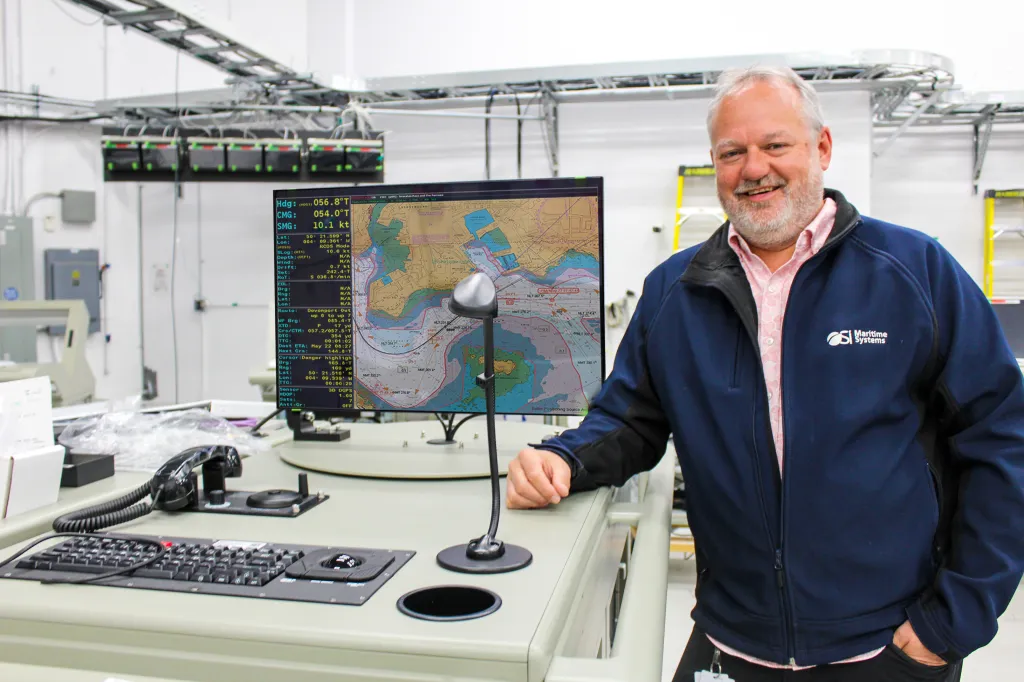
For four decades, OSI has been building navigation and tactical systems that operate on the bridges and control centres of the world’s most advanced naval vessels. Today, OSI’s technology is trusted by 27 navies across NATO and allied nations. The firm is a recognized leader in subsurface navigation, with systems deployed on over 18 distinct classes of submarines worldwide. ECPINS, the company’s flagship software platform, stands alone as the only independently certified WECDIS compliant with NATO STANAG 4564, setting the benchmark for warship electronic navigation.
OSI Maritime Systems is, by any measure, a remarkable Canadian success story. And it was built from the ground up, by a team headquartered in Burnaby, developing its core intellectual property in Canada and growing its global footprint one relationship at a time.
Jim Girard, CEO of OSI Maritime Systems, sat down with RBC to share how that growth happened, and what other Canadian companies can learn from it. During our conversation, Girard reflected on the decisions, partnerships and lessons that helped transform OSI from a Canadian engineering company into a global defence technology leader.
From Canadian innovator to global defence technology leader
For roughly the first two decades of its existence, OSI Maritime Systems was focused almost entirely on the Canadian market. The company built its early expertise serving commercial shipping operators, helping them transition from paper-based to electronic chart navigation – work that was pioneering at the time, even if the broader market wasn’t always ready for it.
“We were perhaps a little too early in some respects. It took a lot of years for navies to catch up to moving away from traditional charting to an electronic charting environment,” Girard explains.
Their early work built a deep foundation of technical expertise and customer relationships that would prove invaluable when OSI pivoted more decisively toward the naval market. By 2008, the company had made a clear strategic choice – and today, roughly 100 per cent of its business is naval.
International expansion began around the turn of the millennium, when OSI identified an opportunity with the United Kingdom’s Royal Navy – a technologically advanced fleet that was looking to modernize its navigation systems. “The UK was the first step into international markets,” says Girard. “They were thought leaders in that space, and they liked what we were doing.”
That first international contract proved transformative. Over the following six years, OSI became a fleet-wide supplier to the Royal Navy. A UK office followed, eventually growing to a team of about 30 people. From that foothold, the European market opened up: Denmark became an early customer, then the Netherlands, and over time, Ireland, Poland and Portugal. Today, OSI’s global footprint extends to 27 navies, with a business development organization deliberately spread across Ottawa, Halifax, the UK, the Netherlands, Germany, Taiwan and Australia.
The growth has been methodical, driven by a disciplined approach to market entry that OSI developed early in its international expansion and continues to refine today.
The formula: How OSI enters new markets
OSI’s international expansion follows a deliberate, replicable approach – one the company applies consistently as it enters each new market.
Start with Canada’s trade infrastructure
OSI’s first port of call in any new market is the Canadian Trade Commissioner Service. Trade Commissioners provide on-the-ground intelligence that goes well beyond what is publicly available, facilitate introductions at the right levels of foreign governments and naval organizations and help vet potential local agents and partners.
“If your first stop isn’t the Trade Commissioner’s Office when you’re going into a new market, it’s probably the wrong first stop,” Girard says.
Find the right local partners
Having a local network or representative on the ground in a new market helps OSI navigate the unique dynamics of that country’s defence ecosystem, such as a retired senior naval officer who understands the procurement environment. OSI works closely with the Trade Commissioner network to vet these partners carefully.
Educate the market and move at its pace
Naval procurement cycles are long, and defence decision-making is a slow process. OSI’s business development teams invest years building relationships and educating potential customers on what modern integrated navigation systems do. Part of this happens because navies train and exercise alongside allied fleets already using OSI’s platform, so they quickly understand the advantages of the system.
“Navies train together all the time,” explains Girard. “When another fleet sees the technology in action during exercises, and how the systems communicate and share information securely, it often sparks interest very quickly.”
Scale thoughtfully and carefully
OSI does not open offices in new markets speculatively. Rather, they test the waters, build relationships, win initial contracts and only then commit to a local presence. It’s a patient strategy, but one that has delivered consistently.
“We take a cautious but pointed approach. It could be a two-to-five-year cycle before we see results, and we plan accordingly,” says Girard. “We don’t jump into a new area, set up an office and hope it all goes well.”
Case study: Expanding into Germany
OSI’s expansion into Germany illustrates how the company’s approach plays out in practice. OSI won its first German contract in 2021, building on years of relationship development and the growing visibility of its platform across allied NATO navies. Additional contracts were secured in 2022 and 2023, and in April 2025, OSI opened a dedicated office in Kiel – in close proximity to the German Naval Fleet – to support its growing presence and provide local operational capability.
The Kiel office reflects OSI’s broader philosophy – earn the business first, then invest in the local infrastructure to support and deepen it. It is a model the company continues to apply as it pursues new opportunities across Europe and beyond.
Managing the financial realities of global expansion
Expanding internationally also introduces new financial considerations – from currency exposure to contractual guarantees – that companies must plan for carefully.
Mitigating foreign exchange risk
Naval programs are known for schedule delays, which makes predicting cash flows – and therefore managing foreign exchange exposure – inherently challenging. OSI works with RBC’s Capital Market foreign exchange team to lock in forward exchange rates when international payments are anticipated, providing a meaningful degree of predictability even in volatile currency environments.
“We’re not a casino,” says Girard. “We like a bit of predictability. If I know I have a million euros coming in 19 months from now, I can hedge that today and know exactly what I’ll receive in Canadian dollars.”
“OSI Maritime Systems demonstrates how the right financial infrastructure enables international scaling,” saysDaxin Zhang, Vice President of Technology and Innovation with RBC. “Defence contracts require performance bonds and advance payment guarantees that can tie up significant capital. By structuring a substantial bonding facility with EDC backing early in their international expansion, OSI can pursue multiple contracts across different markets simultaneously without straining working capital. That kind of proactive financial planning – setting up facilities before you need them – is what separates companies that scale smoothly from those that hit cash flow walls.”
Performance bonding and letters of guarantee
Many international customers – particularly in Europe – require a letter of guarantee before releasing advance payments: a formal commitment that if a supplier fails to deliver, the customer has recourse.
Through its banking relationship with RBC, supported by Export Development Canada, OSI maintains a $30 million bonding facility, enabling it to provide these guarantees without drawing on operating cash. Says Girard: “Without that bonding facility, we would have to support guarantees with cash – and that would really hamstring the business.”
Flexible capital for global operations
Alongside its bonding facility, OSI also maintains a flexible line of credit with RBC, providing additional liquidity as the company navigates the timing and scale of international programs.
Because defence contracts often involve long development timelines and milestone-based payments, having access to flexible capital allows the company to manage cash flow while continuing to invest in product development and global business development.
For OSI, Girard says, that financial flexibility is another key part of the infrastructure that supports global growth.
The Canadian Advantage
In a sector where trust is paramount and geopolitical considerations are ever-present, being Canadian is more than a point of national pride. For OSI, it is a genuine competitive differentiator.
“It’s a huge advantage – especially in today’s environment,” says Girard. “Having the Canadian government as a customer, having Canada involved in NATO exercises, having the Canadian government in Germany talking to the German government about OSI – that is invaluable.”
Canada’s international reputation as a stable, trusted partner opens doors in markets where other nations’ defence suppliers might face greater scrutiny. OSI’s identity as a Canadian company – building its core intellectual property in Burnaby, employing Canadian engineers and technologists and exporting Canadian innovation to allied navies – resonates with procurement officials around the world.
Canada’s recently released Defence Industrial Strategy has further strengthened that position. The strategy signals a meaningful increase in Canadian defence spending – directly benefitting OSI’s domestic business – and creates a new expectation that international defence companies seeking business in Canada demonstrate how they are expanding the Canadian industrial footprint in return.
10 min read from RBC Thought Leadership: Top Risks 2026: Remilitarizing the Maple
“We were already in an excellent position in Canada,” explains Girard. “But this investment strategy has made it even more so. International companies that want to do business in Canada are now looking for Canadian partners – not just for Canadian work, but to show Canadian content in their international programs.”
OSI has spent more than a decade systematically building the government relationships, certifications and program track record needed to capitalize on exactly this kind of moment. While many other companies are only now beginning to figure out how to position themselves in the new defence landscape, OSI already has the pieces in place.
OSI Awarded PacifiCan Grant for AI-Augmented Collision Avoidance System (CADA)
OSI Maritime Systems has been awarded a regional development grant of $2.8 Million from PacifiCan (Pacific Economic Development Canada) in support of CADA – the company’s AI-augmented Collision Avoidance Decision Aid.
CADA is designed to provide naval operators with AI-powered situational awareness and decision support in complex maritime environments, augmenting human judgement with real-time collision risk analysis. At this stage, the technology will advance autonomous navigation capabilities for mostly military applications.
The PacifiCan grant program evaluates investments based on technology readiness level, quality of jobs created and export potential. With defence positioned as a national priority, the grant reflects confidence in OSI’s ability to deliver meaningful economic and strategic returns for Canada.
Simon Wills, OSI’s Director of Government Relations, Marketing & Communications, who led the grant application, notes that the company’s decade-long effort to build strong government relationships – and its proven track record of delivering on defence programs – made OSI a compelling candidate at a moment when defence innovation is at the top of the national agenda.
As the conversation turned to advice for other Canadian companies considering global expansion, Girard pointed to several lessons OSI has learned along the way.
5 Lessons OSI Maritime Systems Has Learned About Growing a Global Business
-
Start with Canada’s trade infrastructure: The Canadian Trade Commissioner Service provides local intelligence, introductions and partner vetting that can accelerate entry into new markets.
-
Vet your local partners rigorously: The right in-country representative can unlock opportunities. Take the time to ensure partners are reputable and well connected.
-
Manage currency exposure proactively: International contracts often involve foreign currencies and shifting timelines. Financial tools such as FX hedging can help protect margins.
-
Put financial infrastructure in place early: Facilities such as performance bonds, letters of guarantee and flexible credit lines allow companies to pursue opportunities without tying up capital.
-
Plan for long sales cycles: Major international contracts often take years to develop. Align your capital planning, business development strategy and expectations accordingly.
Preparing for what’s next
OSI Maritime Systems continues to invest in the next generation of naval navigation capability while deepening its presence in established markets and evaluating new opportunities across the globe.
Its competitive strengths are robust – proprietary software developed in Canada, deep systems integration expertise, trusted relationships with global naval operators and a stellar reputation. Backed by Canada’s Defence Industrial Strategy, a strong banking relationship and a growing pipeline of government innovation support, OSI is well-positioned for its next chapter.
For Canadian companies looking to build something enduring on the world stage, OSI Maritime Systems’ story offers a clear and compelling blueprint: build credibility at home, leverage Canada’s global trade infrastructure and expand internationally with the right partners at your side.
Your Business Is Going Places. Where To Next?
Whether you’re thinking about going global or have already started to trade internationally, RBC Trade Specialists can help you make informed decisions as you expand into new markets.
Connect with an RBC Trade Specialist or contact your RBC Relationship Manager.
Visit the RBC International Trade site for market intelligence, resources and tools to help you grow internationally.
This article is intended as general information only and is not to be relied upon as constituting legal, financial or other professional advice. A professional advisor should be consulted regarding your specific situation. Information presented is believed to be factual and up-to-date but we do not guarantee its accuracy and it should not be regarded as a complete analysis of the subjects discussed. All expressions of opinion reflect the judgment of the authors as of the date of publication and are subject to change. No endorsement of any third parties or their advice, opinions, information, products or services is expressly given or implied by Royal Bank of Canada or any of its affiliates.