

TLDR
-
Carbonhound and RBC recently brought together leaders from across Canada’s food supply chain to discuss the country’s position as a leader in environmentally sustainable agriculture.
-
As Canadian farmers get older, our country’s food future depends on attracting, training and supporting the next generation.
-
Environmentally sustainable agriculture is not only good for the environment, it can also be good for farmers’ bottom line.
-
Collaboration across the value chain is essential to strengthening Canada’s food system.
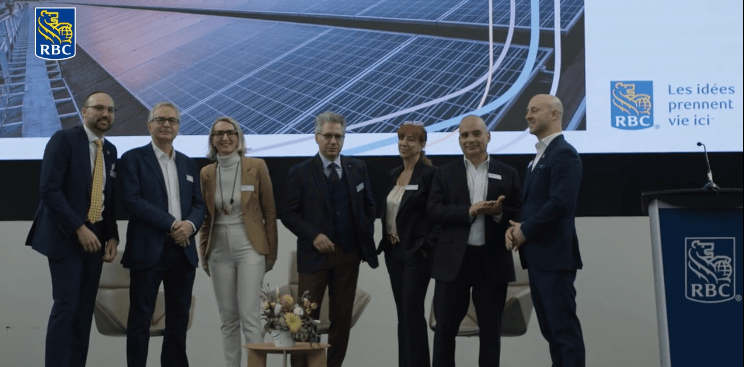
At Canada Climate Week Xchange (CCWX), RBC and Carbonhound convened leaders from across Canada’s food value chain to explore how the country can secure its position as a globally competitive and environmentally sustainable food producer.
Canada’s agri-food sector remains a national strength, contributing to jobs, exports and economic resilience. However, recent research underscores growing pressure points: productivity growth has slowed, domestic commercialization capacity lags peer nations and competition for capital, talent and innovation is intensifying globally – challenges highlighted in the MNP Global Agri-Food Report.
To unpack what this means in practise, Natasha Shute, Director of Sustainable Finance at RBC, moderated a discussion with leaders spanning farming and food manufacturing:
-
Joshua Goodman, Head of Corporate Sustainability at Sobeys
-
Taylor Stanley, Corporate Impact Strategy at Riverside Natural Foods
-
Jason Persall, President of Persall Fine Foods
Together, they explored how Canada can strengthen its food advantage – by nurturing innovation at home, enhancing regional capacity and creating a resilient ecosystem that can compete globally.
RBC’s Natasha Shute shares her key takeaways from the discussion:
1. Canada’s food future depends on the next generation – and on keeping innovation at home
Canada’s agriculture sector has long been a foundation of the national economy and identity. Yet, as highlighted in the discussion and by the MNP Global Agri-Food Report, there is a lag in private R&D investment and commercialization capacity compared with peer countries. While Canada generates strong research and early-stage innovation, too often that innovation is scaled elsewhere.
This innovation gap has implications beyond competitiveness. Research from the RBC Climate Action Institute’s Next Generation of Growth report points to widening gaps in talent pipelines, access to capital and domestic scaling opportunities for agri-food innovators.
At the same time, the nature of agriculture is changing. Modern farming and food production are increasingly tech-enabled, data-driven and entrepreneurial, requiring new skills, business models and financing structures.
Closing this gap will require:
-
Expanding access to capital, training and entrepreneurial support for agri-food innovators.
-
Strengthening pathways that connect research, private investment and real-world deployment.
-
Building talent pipelines aligned with the evolving nature of agriculture
Farming today isn’t what it was a generation ago. It’s tech-enabled, data-driven, entrepreneurial and very much purpose-oriented – but many young people don’t see it that way. Exposing young people to opportunities in agriculture earlier (long before career choices are made), reintroducing agricultural education in schools and supporting young farmers with training and financing are critical to building a long-term talent pipeline, particularly as reskilling accelerates across essential industries.
To remain globally competitive, Canada must not only inspire and support the next generation of farmers, but also ensure that research, innovation and value-added processing stay within our borders – creating jobs, exports and global influence from Canadian soil.
5 min read: Future-Proof Your Farm: Plan and Prepare for the Unexpected – My Money Matters
2. Environmentally sustainable agriculture is becoming a competitive edge
Environmentally sustainable agriculture continues to gain momentum. In an increasing number of case studies, it’s proving itself as a practical path to higher yields, healthier soil and more resilient business models.
What’s especially compelling is that environmentally sustainable practices aren’t just good for the planet. They can reduce inputs, lower long-term costs and create more differentiated products for Canadian and international markets. As such, they have become a strategic differentiator – one that can elevate Canadian exports and food brands globally.
On the ground, environmentally sustainable farming can deliver real-world impact – conservation tillage can help build soil carbon, nutrient use efficiency optimizes the use of fertilizers and crop rotations can boost biodiversity.
But there is a broader competitiveness challenge at play. Canada has world-class agricultural research, food processing and ingredient innovation and environmental sustainability leadership, but early-stage innovations are commercialized or scaled abroad. Retaining and scaling innovation domestically is critical to ensuring Canada not only feeds the world but also exports its know-how, technology and environmental sustainability standards.
Download the RBC report
Seeding Scale: Addressing Canada’s agri-food growth capital gap
3. Collaboration is the catalyst for a stronger, more resilient food ecosystem
Finally – and perhaps most importantly – none of this works without genuine collaboration. Real progress happens when every part of the value chain works together. Building stronger regional supply chains, investing in data-driven sustainability measurement and linking innovation clusters with financing will help keep Canadian ingenuity competitive.
Consider how technology is amplifying what’s possible. AI and data tools are helping farmers measure emissions, monitor soil health and optimize production. Carbonhound, for instance, helps companies collect data on their GHG emissions by using a carbon management tool, which can help to automate data collection and track the impact of business operations. RBC’s collaboration with Carbonhound aims to make it easier for companies to respond to rising requests for carbon metrics and make informed decisions on their path to a low-carbon economy.
Food rescue organizations such as Second Harvest add another layer, pairing data-driven insights with community networks to ensure good food is redistributed efficiently and sustainably.
And underlying all of this is a simple truth: food security is a national security issue. Strengthening domestic supply chains, investing in regional processing capabilities and improving cross-provincial logistics will be essential to Canada’s long-term competitiveness.
5 min read: How Canada’s Food and Beverage Producers Can Adapt to Market Instability – My Money Matters
Canada already has the natural assets, expertise and innovation ecosystem needed to compete globally. What we need now is alignment, and a willingness to scale the ideas, partnerships and practices that are already successful today.
By investing in people, protecting the land that feeds us and strengthening collaboration across the value chain, Canada has a real opportunity to define what the future of sustainable food production looks like on the world stage.
How RBC can help:
The RBC Agriculture Banking & Financial Solutions team is here to help. To support clients on their journey to environmental sustainability, RBC works with Carbonhound, a climate action platform that helps companies measure and track their environmental impact.
Contact your RBC relationship manager to learn more about solutions to help move your business forward.
This article is intended as general information only and is not to be relied upon as constituting legal, financial or other professional advice. A professional advisor should be consulted regarding your specific situation. Information presented is believed to be factual and up-to-date but we do not guarantee its accuracy and it should not be regarded as a complete analysis of the subjects discussed. All expressions of opinion reflect the judgment of the authors as of the date of publication and are subject to change. No endorsement of any third parties or their advice, opinions, information, products or services is expressly given or implied by Royal Bank of Canada or any of its affiliates.
The content of any websites referred to in this article, including via website link, and any other websites they refer to are not incorporated by reference in, and do not form part of, this article. This webpage is also not intended to make representations as to the sustainability-related initiatives of any third parties, whether named herein or otherwise, which may involve information and events that are beyond our control.