


TLDR
-
Value chain analysis can help businesses move beyond reactive climate risk management, and towards a proactive approach in the transition to a low-carbon economy.
-
Climate-related risks are understood within two categories: physical and transition.
-
Physical risk encompasses weather-related disruptions, subsequent challenges accessing insurance, and dangers to worker safety and public health.
-
Transition risk refers to commercial, financial and compliance risks as governments and customers raise expectations for transparency and action to reduce greenhouse gas emissions.
-
Businesses that build resiliency across their value chain can reduce uncertainty and financial risk by mitigating disruption to operations, improving access to insurance, and preparing for changing regulatory and market expectations.
Businesses that proactively assess and build resilience towards climate-related risks are not only reducing uncertainty, but gaining a measurable competitive advantage. Research shows that companies with integrated climate risk planning tend to report stronger operational continuity and financial performance: less operational disruption, improved insurance outcomes, stronger investor and stakeholder confidence, better regulatory and market readiness, and more effective decision-making.
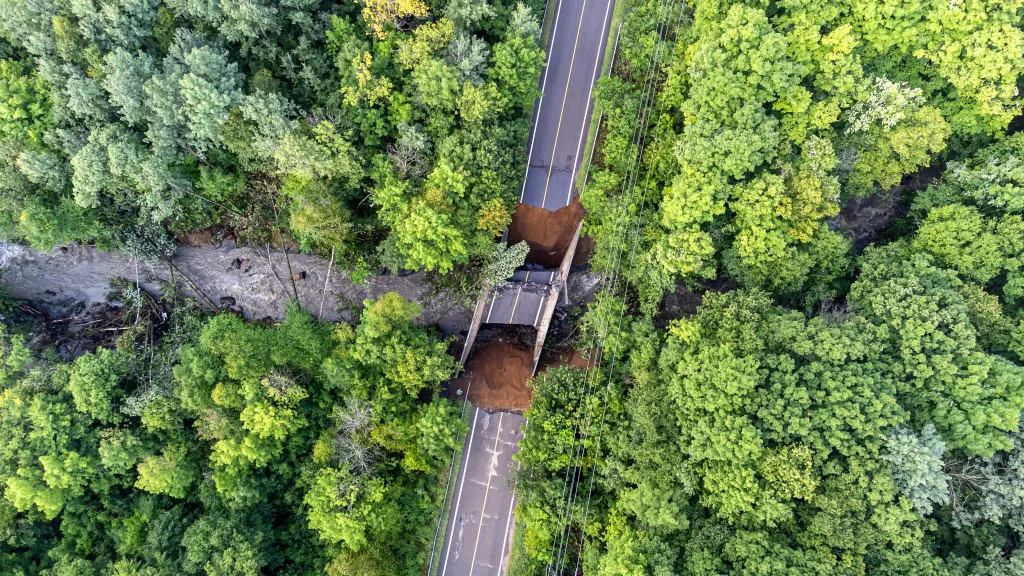
Ask a British Columbian business owner what they remember about 2021, and they’ll likely mention the weather. To start with, an early-summer extreme heat event brought temperatures up to and beyond 40°C, which was followed by a two-month state of emergency from widespread wildfires. Come fall, destructive fall flooding and landslides severed transportation links and cut off vital supply routes, including the Trans Mountain Pipeline, resulting in the Parkland refinery in Burnaby, B.C., experiencing several weeks of downtime. One farming business witnessed its entire blueberry operation go underwater—buildings, plants, seedlings, machinery, and more—in a hit that will take years to recover from.
Across Canada, businesses are factoring climate risk into their operations and capital planning: manufacturers and distributors are diversifying suppliers and warehousing locations to open up new logistics corridors that circumnavigate flood and wildfire paths; agricultural producers are investing in drainage, water storage and climate-resilient crops following losses from flooding, extreme heat and smoke exposure; and commercial real estate owners are retrofitting assets with flood mitigation, backup power and cooling systems to reduce downtime and protect asset value.
Extreme weather is not the only cause of climate change-related risk and instability for businesses, either. Current and incoming legislation both within Canada and internationally is setting new standards for greenhouse gas (GHG) emissions and disclosures, as governing bodies introduce policies to support the transition to lower-carbon economies.
Many organizations are attempting to identify climate-related risks that could impact their business. The Bank of Canada, for instance, released a climate risk disclosure report outlining how it plans to manage these risks, including reducing its environmental footprint and analyzing how its balance sheet would be affected under various climate-risk scenarios.
So, what can companies like yours do to assess and address these risks?
Using value chain analysis to identify climate-related risks
Evaluating risk is not new for business leaders, but climate change has introduced a new set of risks that must be factored into a company’s risk analysis, such as impact to operations, employee health and safety, revenue, and reputation.
While it’s impossible to eliminate every climate-related risk to your business, using value chain analysis to identify potential risks can help business leaders identify ways to reduce and mitigate against financial and material impacts, while ensuring employee health and safety. A value chain encompasses everything that goes into making and selling a product (the supply chain) and into boosting that product’s value, including research and development, marketing, after-sales support, and even how products are disposed of at the end of their life.
When assessing climate-related risk in your value chain, there are generally two broad categories: physical and transition.
Physical risk: How could the value chain be impacted?
Physical risk encompasses the many weather-related risks that could impact a company today, from rising insurance costs to the growing threat of long-term climate change risks and their indirect impacts, such as public health.
Rising insurance costs are a bellwether of physical risk, with many businesses shouldering the costs of higher insurance premiums, reduced coverage, and increased deductibles or exclusions for extreme weather events.
Insurance availability and affordability could increasingly influence where companies choose to operate, invest or expand, as businesses in some regions face premium increases after multiple weather-related claims, coverage restrictions for flood or wildfire exposure, and greater scrutiny of risk mitigation measures. Value chain analysis can help businesses to identify which assets, suppliers and logistics routes are most exposed, and where mitigation plans could help to manage both physical risk and insurance outcomes.
Worker safety is another challenge: researchers expect the number of workers exposed to dangerous heat stress during the day to increase significantly by 2050. In some countries, people are switching to night shifts to help stay cool. In addition, increased and more severe wildfires, flooding, heat events, and storms are anticipated to have a significant impact on businesses overall as time progresses. One estimate predicts between USD$560 billion and USD$610 billion in yearly losses for publicly listed companies by 2035.
These impacts will be both global and local, and not necessarily easy to predict. The record-breaking 2023 wildfire season in Canada, for example, had a minor effect on the country’s overall GDP but a significant one in specific areas, such as the Northwest Territories, where a substantial proportion of potential economic activity was affected by evacuations.
4 actions that could help to mitigate physical risk within the value chain
Here are some ways value chain analysis could help to identify and mitigate physical risks:
-
Identify partners and suppliers who may be operating in areas susceptible to extreme weather events, which could disrupt their role in your business operations.
-
Understand which mitigation efforts across assets, suppliers and logistics could help to improve insurance coverage
-
Implement contingency plans if standard practices are disrupted by climate events, such as logistics and transportation.
-
Ensure processes are in place to safeguard employees from working in unsafe weather conditions, such as extreme heat.
Transition risk: How could the value chain be impacted?
Transition risk is growing as a commercial and financial issue—not just a compliance one—as governments and customers raise expectations for transparency and action. Transition risk considers several forces that may impact your business’s operations, from current or future government policies and legislation, to mandatory GHG disclosures, new and developing technologies, or shifts in the market and changing customer sentiment.
Depending on the type of business you manage and where you operate, you may be expected to measure your business’s GHG emissions. Even when disclosures are not mandatory, some policies have increased the need for credible emissions data by raising expectations around environmental claims or carbon exposure for certain products and markets. For example, Canada’s anti-greenwashing act, Bill C-59, requires companies making environmental claims to have trustworthy data to support them, and beyond Canada’s borders, businesses exporting goods to the European Union could be impacted by measures like the EU Carbon Border Adjustment Mechanism (CBAM), which puts a carbon price on carbon-intensive goods entering the EU.
But whether mandatory or voluntary, tracking and reporting on your business’s GHG emissions could have benefits beyond satisfying regulatory standards. Suppliers could risk losing revenue if customers require emissions disclosures or low-carbon products to help them work towards their own net-zero commitments, and understanding emissions across the value chain can help businesses to anticipate customer demand and plan investments accordingly. Increasing transparency and sharing progress can also help to build trust and loyalty with stakeholders and customers, and could become an important part of your competitive positioning.
Read more: Carbon management: What is it, and should your business do it?
You may have plans to transition to an electrified vehicle fleet, or switch to renewable energy in the factory. Value chain analysis can help to identify the potential risk of stranded or underperforming assets as technology and standards evolve, which could incur financial impacts of retiring existing assets to make way for newer, more energy-efficient alternatives.
Government policies and global standards mean that emission disclosures are imperative to some business operations, but for many companies, the majority of emissions occurs outside of their direct activity (often referred to as ‘Scope 3’). Value chain analysis can help to identify and act on potential regulatory requirements. The Greenhouse Gas Protocol provides a globally-recognized step-by-step guide for businesses to quantify and report their GHG emissions, and third-party carbon management tools can also help businesses to track emissions across multiple datapoints.
4 actions that could help to mitigate transitional risk within the value chain
-
Introduce or refine processes to track and report on GHG emissions, whether through internal teams or third-party carbon management tools
-
Pinpoint areas that are subject to mandatory reporting standards or policies, and work with partners and suppliers to gather data and reduce emissions where necessary
-
Develop a transition roadmap for technological and operational upgrades, planning around the lifecycle of existing assets to manage costs effectively
-
Build communication strategies to share reliable, accurate data with stakeholders and customers
Read more: Emissions explained: Understanding Scope 1, 2 and 3 in your business
Using value chain analysis to move beyond reactive risk management
Businesses that proactively assess and build resilience towards climate-related risks are not only reducing uncertainty, but gaining a measurable competitive advantage. Research shows that companies with integrated climate risk planning tend to report stronger operational continuity and financial performance: less operational disruption, improved insurance outcomes, stronger investor and stakeholder confidence, better regulatory and market readiness, and more effective decision-making.
There’s no question that climate-related risks are impacting business operations, costs and competitiveness. Value chain analysis can help businesses like yours move beyond reactive climate-related risk management, and towards prioritizing action that will protect assets, strengthen supply chains, improve transparency and competitive positioning in the transition to a low-carbon economy.Combined, these benefits demonstrate that mitigating climate risk can meaningfully impact cost management, operational continuity and long-term enterprise value.
Read more: A beginner’s guide to value chain analysis in your business’s environmental sustainability strategy
This article is intended as general information only and is not to be relied upon as constituting legal, financial or other professional advice. A professional advisor should be consulted regarding your specific situation. Information presented is believed to be factual and up-to-date but we do not guarantee its accuracy and it should not be regarded as a complete analysis of the subjects discussed. All expressions of opinion reflect the judgment of the authors as of the date of publication and are subject to change. No endorsement of any third parties or their advice, opinions, information, products or services is expressly given or implied by Royal Bank of Canada or any of its affiliates.