



TLDR
-
Lifestyle creep is the gradual increase in spending that tends to happen naturally over time, often driven by life’s changing responsibilities.
-
Rising costs of living, from groceries to housing, can make lifestyle creep harder to spot.
-
Common signs include earning more but saving less, relying a little more on credit and feeling financially stuck.
-
Simple steps such as automating savings, reviewing subscriptions, tracking spending and doing regular financial check-ins can help prevent lifestyle creep.
-
Working with a financial advisor can help you feel more confident and in control of your finances.
You’ve worked hard to get where you are today. Maybe you’ve scored a promotion, secured a raise and watched your kids become more independent. Life is good. Yet financially, you don’t feel any further ahead than you were 10 years ago. There’s a name for that: lifestyle creep, or lifestyle inflation.
Lifestyle creep is often the result of life’s natural progression. As families grow, responsibilities shift and the number of everyday expenses rises, the costs that come with them rise too. Recognizing lifestyle creep when it happens can help you feel more confident about your spending, keep your long-term goals on track and reduce money stress. Here is how to spot lifestyle creep and why it matters.
What is lifestyle creep?
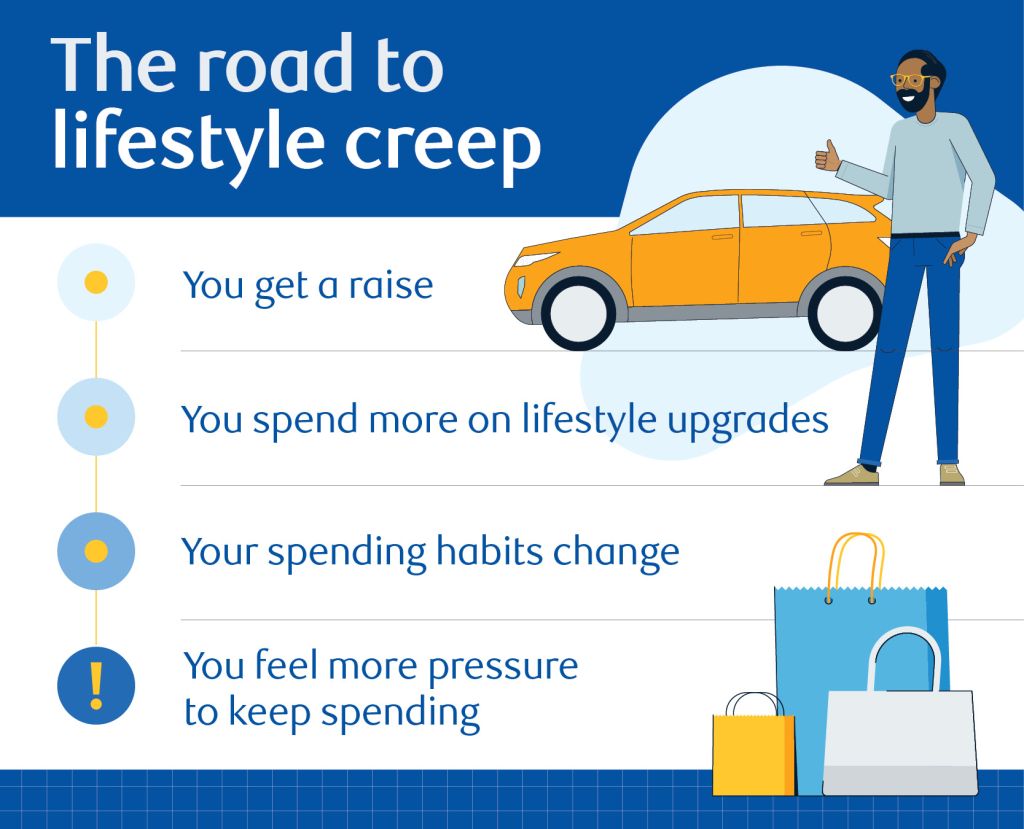
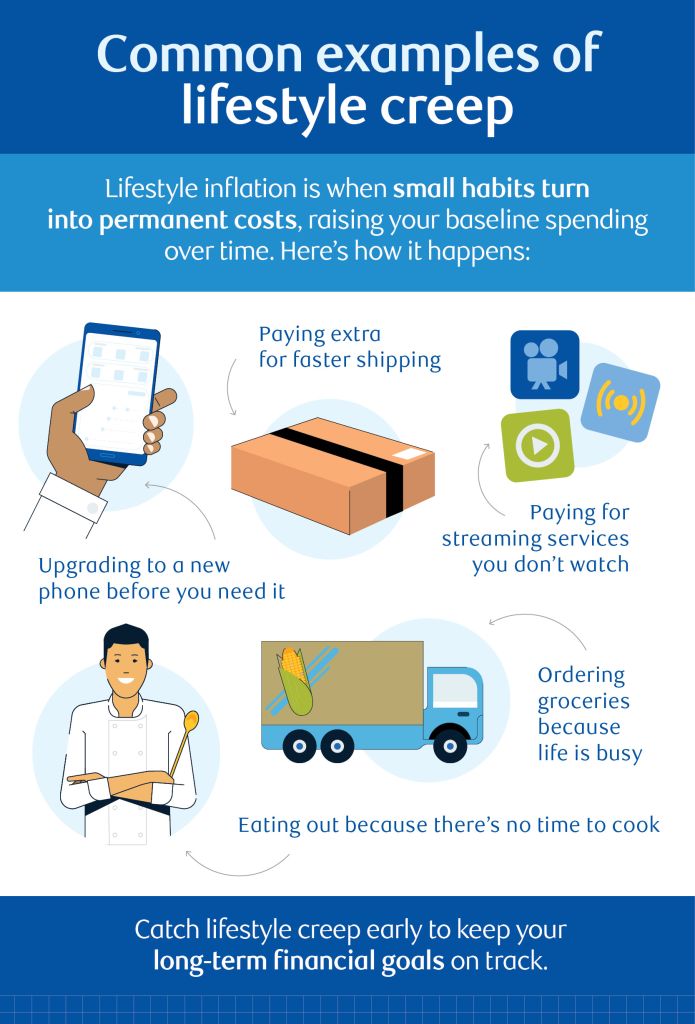
Lifestyle creep, sometimes called lifestyle inflation, is the gradual increase in spending that can happen as income rises. Rather than going into savings or toward debt repayment, any extra money you earn is spent on a rising standard of living. Common examples include upgrading to a newer phone, adding a few extra streaming subscriptions or ordering takeout more often on busy weeknights.
These additional purchases rarely feel extravagant in the moment. They seem normal for your life stage and often appear to be in line with what everyone around you is doing. And once you get accustomed to them, they can be hard to give up. Over time, though, they can add up, making it harder for you to save more, despite earning a higher income.
When does lifestyle creep happen?
Lifestyle creep can happen at any age, but it tends to take root in midlife. This isn’t about being careless with money. Rather, it’s tied to the responsibilities of a stage of life when the financial pressures of running a household, raising a family, caring for aging parents and building a career tend to peak all at once.
More income, more responsibilities
Career growth and earning power are often at their highest in midlife. But so are expenses. According to Statistics Canada, the cost of raising a child from birth to age 17 is roughly $293,000, and that figure climbs past $350,000 if the child stays at home until age 22, as many now do. Homes require maintenance, cars need replacing and, with time at a premium, conveniences like food delivery and housecleaning start to feel like necessities. But at $150 to $250 for a single cleaning visit, they can add up fast.
The Canadian cost-of-living reality
The pressure of managing daily chores and paying for necessities can become more intense when the cost of everything around you is climbing, too. According to the CD Howe Institute, housing costs in Canada have risen faster than in nearly every other advanced economy. Many Canadians also see lifestyle creep exposed during mortgage renewal, when higher interest rates suddenly increase monthly payments. Grocery prices also remain a major source of financial stress. And with general inflation adding to the squeeze, two-thirds of Canadians report that the high cost of living is preventing them from taking control of their finances, according to FP Canada’s 2025 Financial Stress Index. When paying for the basics is a stretch, even small increases in discretionary spending can make it feel like long-term goals are getting pushed out of reach.
Signs of lifestyle creep
One day, you feel good about earning more and dreaming bigger, but soon, it seems like you’re savings aren’t keeping pace. That’s common in midlife, when responsibilities and income rise together. Here are a few clues that you may be dealing with lifestyle creep:
Earning more but saving less
You got the raise you’ve worked hard for, made your bonus or moved into a higher-paying role, but somehow, your savings haven’t grown to match. If more money is coming in but your account balances look the same, that’s a sign worth paying attention to. This can be especially noticeable after a raise, bonus or mortgage renewal, when higher costs or taxes absorb the extra income.
Relying on credit for everyday expenses
If you find yourself relying on credit cards or lines of credit a little more than usual to cover everyday expenses, you’re far from alone. Take it as a sign that it’s a good time to review your budget.
Feeling financially stuck or anxious
Money stress isn’t just about how much you earn; it’s also about how much you keep. If you have what should be a comfortable income but you’re feeling anxious about the future, experiencing rising debts or just not saving as much as you want, it could be time to review your spending habits.
Why recognizing lifestyle creep is important
Understanding the effect that lifestyle creep can have on your finances empowers you to make simple yet meaningful adjustments. Here’s where it starts to matter:
The impact of lifestyle creep on retirement and saving
When savings stall or shrink, even temporarily, the effect on your retirement can compound over time. That’s because growth in accounts like RRSPs and TFSAs depends on consistent contributions over long periods. The earlier you start, the more time your money has to work for you. Even modest, regular contributions in your 30s and 40s can outperform larger ones made later, because time is one of the most powerful factors in building long-term savings.
The financial stress creep
Beyond the dollars and cents, lifestyle creep can carry a physical and mental-health cost. For many Canadians, money worries are a greater source of stress than work, personal health or relationships, potentially leading to sleep problems, headaches and lower productivity, according to the Financial Consumer Agency of Canada. Taking a few simple steps to identify and manage lifestyle creep can help ease this pressure.
Increased reliance on credit
As everyday costs rise, it can be natural to lean on credit cards or lines of credit to bridge the gap between income and spending. According to the Credit Counselling Society’s 2026 Consumer Debt Report, 42 per cent of Canadians report using credit instead of cash (up 7 per cent from the previous year) and those carrying debt are more likely to apply for additional credit or reduce their savings to manage it. Credit can be a useful tool, but if your balances are increasing more than you’d like, taking a careful look at your spending can help you understand where to cut back.
How to stop lifestyle creep
The good news is that preventing lifestyle creep or course-correcting doesn’t necessarily require dramatic changes or drastic cuts. Adopting a more intentional approach to where you spend your money can go a long way toward a healthy financial future. Some steps to consider:
Pay yourself first
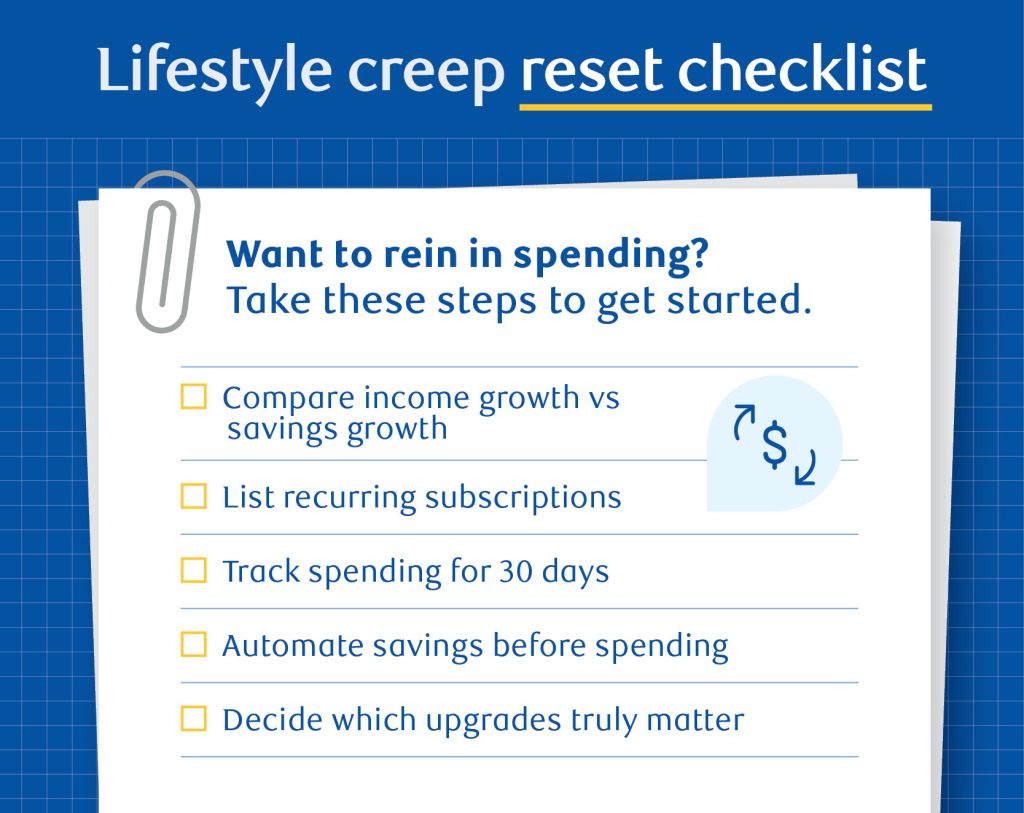
Treat savings like a non-negotiable expense. Consider setting up automatic transfers so that a portion of your income goes into savings or toward debt repayment. This way, saving becomes a natural part of how you manage your money.
Use a budget
Budgeting gets a bad reputation for being restrictive, but at its core, it’s simply a way to see where your money is going and whether that spending reflects your priorities. You don’t need a complicated spreadsheet. Even a basic monthly review of income versus expenses can reveal patterns that have shifted over time. There are also plenty of budgeting apps, both free and paid, that can help you to stay on top of your finances.
Use the RBC Monthly Cash Flow Calculator to get a clearer picture of your income and spending.
Review recurring and invisible expenses
Subscriptions, memberships and convenience services can build gradually over time. They often start small, like a free trial that converts to a paid plan, or a monthly service that has incrementally increased in price. Set a reminder to review them at least once a year. A useful gut check: Would you sign up for this service today if you didn’t already have it? If the answer is no, it may be worth letting it go.
Spend consciously
Conscious spending starts with clarity. When you know what you’re saving for – whether it’s a comfortable retirement, a dream vacation or your teen’s university education – money decisions feel easier and more meaningful. You’re no longer asking, “Can I afford this?” but “Does this move me closer to what I want?” That understanding helps you spend in a way that reflects what matters most to you.
Managing lifestyle creep
Avoiding lifestyle creep doesn’t mean cutting back on the things you enjoy. It’s about making small, thoughtful choices that support the future you want. Here are a few ways to approach it:
Take stock after major life changes
Life transitions, like a new job, divorce, big move or child leaving home, are natural moments to pause and reassess your financial picture. When your income or responsibilities shift, your spending patterns could, too. These moments can be a good opportunity to take a fresh look at your spending and make sure it still reflects your priorities.
Decide what’s worth the upgrade
Not all spending increases are bad. Some genuinely improve your quality of life or save you meaningful time. The key is to be intentional about which ones earn a place in your budget and which ones can be cut.
Protect savings as earnings grow
When you get a raise, a bonus or a new income stream, a common guideline is to direct at least 50 per cent of it toward savings or debt repayment before increasing spending. Balancing spending and saving becomes easier with a solid plan in place. RBC offers straightforward strategies to help redirect cash flow and reduce your debt.
Make financial check-ins routine
You don’t need to obsess over your finances daily. Consider building in one or two check-ins a year where you review your savings, your progress toward goals and your spending, subscriptions and memberships. This is a good opportunity to look over your spending and make sure your savings are still on track.
Lifestyle creep doesn’t mean you’ve failed at managing money
If you recognize lifestyle creep in your own finances, it may be comforting to know you are not alone. Midlife financesare genuinely more complex than they were a generation ago. Housing costs, family responsibilities, unexpected expenses and the rising prices of everyday essentials are real pressures, not personal failings.
Awareness is the first step. Making small adjustments to how you spend and save might be next. Speaking with a financial advisor can help restore confidence and ease money stress during what are, for many Canadians, the most financially demanding years of life. FP Canada’s 2025 Financial Stress Index indicates that Canadians who work consistently with a financial professional are less likely to name money as their top source of stress and more likely to feel hopeful about their financial future. Small but intentional changes now can make a real difference to your savings over time, and having a clearer picture of your money situation can boost confidence and provide peace of mind.
FAQ
Lifestyle creep tends to happen when spending gradually rises alongside income. Small lifestyle upgrades, everyday conveniences and the natural evolution of what feels normal to spend all play a role. In Canada, external factors like rising housing costs, grocery inflation and increasing childcare expenses can accelerate the effect.
The goal is to feel good about where your money is going. Identifying which expenses add value to your life and which ones you no longer need is a good place to start. Consider automating your savings so that financial progress happens before discretionary spending, and review recurring costs at least once a year.
Yes. Gradual increases in spending can hinder your ability to save for long-term goals like retirement. Even modest, consistent contributions made earlier in life can make a meaningful difference, allowing your investments to compound over time.
Awareness is a good first step. Taking a look at your bank and credit card statements from the past few months can help give you a clearer picture of where your money is going. From there, even small adjustments to your spending can make a real difference.
Absolutely. Managing lifestyle creep is about balance. The key is to spend your money consciously and within a framework that also supports your long-term goals. When you know your savings and debt repayment are on track, paying for extra things you enjoy becomes something you can feel good about.
A common guidance is to direct at least 50 per cent of any raise toward savings or debt repayment before adjusting lifestyle spending.
Ready to take the next step? Book an appointment with an RBC advisor to talk through your financial goals and take charge of your financial future.
This article is intended as general information only and is not to be relied upon as constituting legal, financial or other professional advice. A professional advisor should be consulted regarding your specific situation. Information presented is believed to be factual and up-to-date but we do not guarantee its accuracy and it should not be regarded as a complete analysis of the subjects discussed. All expressions of opinion reflect the judgment of the authors as of the date of publication and are subject to change. No endorsement of any third parties or their advice, opinions, information, products or services is expressly given or implied by Royal Bank of Canada or any of its affiliates.