



TLDR
Before you start searching for your first job, reflect on your skills, values and priorities. The right job for you is about more than just salary.
Applying for jobs and meeting new people is a winning combo. Contacts can provide referrals, help you find a mentor and even uncover hidden opportunities.
Using budgeting tools and improving financial awareness can help you get through this job-seeking period with less stress.
Many banks convert student accounts to regular ones after graduation. Consider low monthly fee accounts to help keep costs down.
Making the transition from student life to working life is a huge milestone. One minute you’re studying for final exams, the next you’re navigating job boards, preparing for interviews and starting down the road to financial independence with your first job. It’s exciting—but preparing for your first job can feel overwhelming, especially in today’s competitive market.
The good news? Job seeking doesn’t have to be daunting—even if you have little to no experience. If you’re wondering how to find a job after graduation, you’re in the right place. In this guide, we’ll break down some practical steps for early-career job seekers to help you transition from graduation to full-time employment with confidence.
Understanding your skill set and identifying gaps
Before you apply to a single job, think carefully about what you bring to the table (on top of your degree, of course!).
If you’re applying with little to no experience, consider the qualities and skills you already have and how they might be transferable to a new job. You can also look at current job postings to gain insight into additional skills you don’t yet have but should develop. When it comes to careers for recent graduates, employers understand that not all skills come from paid work.
If you’re an international student approaching graduation, navigating the job market may come with additional considerations such as work eligibility and permits. Make sure to understand your options early as you plan your job search.
What are transferable skills?
Communication, teamwork, time management, and problem-solving are all known as transferable skills – non-technical abilities that can help you succeed in any role. You may have developed these through activities like:
- Leading a student club
- Volunteering in your community
- Participating in group projects at school
- Babysitting or taking care of family members
Once you understand your skills, do your research to identify jobs where they’re most relevant. Browsing job postings will help you learn what employers are looking for and understand what roles you might already be qualified for.
You might also notice that the jobs you want list skills you don’t have. That’s totally normal, and you shouldn’t let it discourage you – there’s no rule saying you must have every skill listed on a job posting to apply (almost no one does). If you’re missing a technical skill, certification or experience, you can work on building it while you’re job hunting. These qualifications can help you stand out in a pool of applicants and help you shine when you get your first job.
How to build a resume for a first job
To get you to the interview stage, your resume has to clear two hurdles: passing the screening filters many employers use and catching the eye of a recruiter who may only skim it for seconds. Use this cheat sheet to help make a good impression.
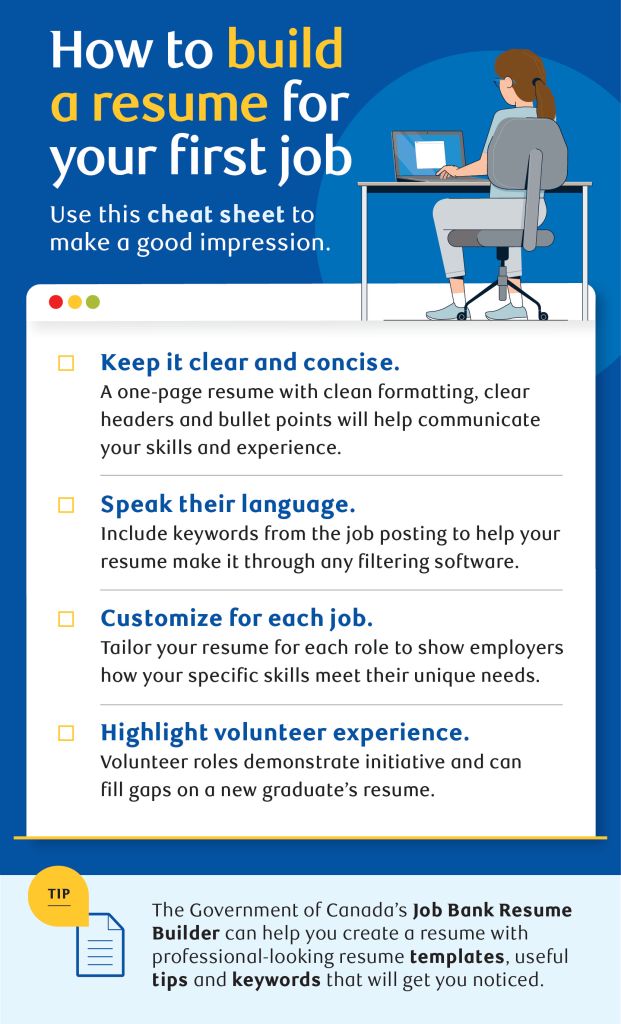
- Keep it clear and concise. A one-page resume with clean formatting, clear headers and bullet points will help communicate your skills and experience.
- Speak their language. Include keywords from the job posting to help your resumé make it through any filters.
- Customize for each job. Tailor your resume for each role to show employers exactly how your specific skills meet their unique needs.
- Highlight volunteer experience. Volunteer roles demonstrate initiative and can fill gaps on a new graduate’s resume.
The Government of Canada’s Job Bank Resume Builder can help you create a resume with professional-looking resume templates, useful tips and keywords that will get you noticed.
How to write an effective cover letter
Many HR professionals consider cover letters to be an essential factor in deciding whom to interview. This is your chance to articulate why you are interested in the role you’re applying for and how your skills align with the company’s needs.
An effective cover letter is never generic. It should directly reference the company, role, and the specific responsibilities outlined in the job description. This gives you an opportunity to show you’ve done your research and understand what your potential employer is looking for.
Cover letter dos and don’ts
| Do | Don’t |
|---|---|
| Describe why you want the role and why you are the right person for the job. | Make it all about you. Employers want to know that you can deliver what they want. |
| Highlight your unique experiences, achievements, and skills to help you stand out. | Repeat language from your resume word for word. |
| Keep your cover letter to one page with proper spacing. | Cram too much onto the page by reducing font size or spacing. |
| Try to find out the name of the hiring manager to personalize the letter. If that’s not possible, a simple “Dear Hiring Manager” will work. | Guess the hiring manager’s name or use outdated greetings like “To Whom It May Concern.” |
How to create a LinkedIn profile that gets you noticed
A LinkedIn profile shows the world who you are by highlighting your education and skills. Here’s how to create yours.
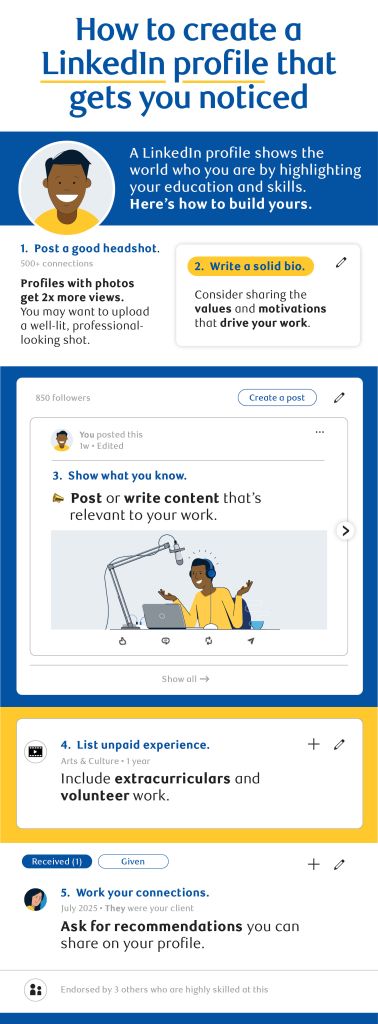
- Post a good headshot. LinkedIn profiles with photos receive twice the views. No need to hire a photographer but make sure the photo is well-lit and that you look professional.
- Write a solid bio. Consider including information about the values that drive your work and what motivates you. Showing your character can help you stand out.
- Show what you know. Demonstrate your knowledge by posting or writing content relevant to the work you want to do.
- List unpaid experience. All experience is good experience. Include any extracurricular activities or volunteer work with organizations or school groups to help you stand out.
- Work your connections. Network with your LinkedIn community and ask your connections for recommendations to share on your page.
Identifying the right roles to apply for
Take time to review job boards such as LinkedIn, Indeed and the Government of Canada’s Job Bank to learn which kinds of roles are listed in your industry. Applying to a wide range of jobs in your field can help your chances as a first-time applicant. According to Canada Job Bank, relevance matters more than volume. Sending out dozens of generic resumes is less effective than tailoring your application to each role.
When considering which jobs to apply for, it’s important to look beyond the annual salary to uncover the full value of the role. Yes, compensation is important, but there are other things to think about. Ask yourself these questions:
- Does the job align with your values?
- What’s the cost of the commute, if any? (Consider hard costs like gas and parking, but also the amount of time it will take.)
- Does the company offer bonuses or perks that you value?
- Will the job require travel?
- Does it offer the flexibility you’re looking for, such as remote work, hybrid work or flexible hours?
Finally, never be afraid to apply to a job posting you find intriguing or that you’re passionate about. The best time to take chances is early in your career.
How to network as a first-time job seeker
Networking is one of the most valuable investments you can make in your career. Connecting with the right people can be even more powerful than applying for jobs online.
That’s not to say you should expect an immediate offer from a new connection. Networking is about building relationships. Job fairs, industry meetups and events are all excellent places to meet professionals in your field. These events can be a significant investment of time (and sometimes money), so make them count with these tips:
- Dress for success. Wear tidy and polished clothes that are appropriate for the event.
- Treat it like a job. While some events may offer food, entertainment and alcohol, make sure to always remain professional.
- Follow up. If you exchange contact information with someone you’d like to get to know, don’t wait for them to make the first move. Send a follow-up email or personalized connection request on LinkedIn that mentions where you met and your shared interests. You could send an interesting article or social post related to your industry, or even ask about how they achieved their success. You may end up with a valued mentor who can offer insight, support and practical advice.
- Volunteer. Doing unpaid work is a powerful way to grow your network as a new graduate. It puts you in rooms with professionals who share your values, and the experience itself strengthens your resume.
How to find a mentor
Finding a mentor can be invaluable as you embark on your career. A mentor can offer insight, support and practical advice based on their own experiences. To find the right fit:
- Search your network. Look for alumni or faculty from your school or professionals you’ve met at events or courses.
- Target the right traits. Look for someone who excels in their work, can communicate clearly and might be genuinely interested in helping you succeed.
- Make a direct ask. Reach out to request a conversation over coffee. Remember that a mentor’s role is to offer guidance, not necessarily to find you a job.
How to prepare for a job interview
Preparing for your first job interview can feel nerve-racking, but remember that you were invited because the employer sees potential in you. The job interview is your chance to show them who you are, demonstrate your confidence in your abilities and show them you’re serious about putting these abilities to work.
You can practice your responses to standard interview questions, but remind yourself that interviews are two-way conversations. To prepare questions that demonstrate your curiosity and engagement, learn everything you can about the company, the role and where the industry is heading.
Some common interview questions include:
- Tell me about yourself.
- Why do you want to work here?
- What motivates you?
- Describe a challenge you overcame.
- Where do you see yourself in five years?
No matter the question, your answers should be positive, concise and honest. If you can connect your answers to real-life experiences, even better.
Being patient during the job search
Looking for a job can be anxiety-inducing, especially when responses are slow. But just like rejection on a dating app isn’t a comment on how worthy you are as a romantic partner, being ghosted by a potential employer is rarely personal. Rejection is part of the process, so it’s important to be clear on what you can control and what you can’t.
Tips for weathering the ups and downs of job hunting
- Take care of your body. Make sure you are eating well, exercising and getting plenty of sleep.
- Take breaks and create boundaries. Decide how long you will spend on your job hunt every day and stick to it.
- Avoid doomscrolling on LinkedIn. Just like any other social media platform, no one’s life or career is as perfect as it seems.
- Stay in touch with your peers. Understanding other people’s journeys can help you keep things in perspective.
- Take note of the closing date for applications. This will give you a realistic idea of when you can expect to hear back.
- Understand seasonal trends. Hiring slows during some times of the year and picks up during others, depending on the industry.
- Diversify your approach. Combining your job search with networking events, volunteering and short-term or contract work might open doors to opportunities not posted on job sites.
- Stay positive. Finding a job takes time, and rejection is par for the course. Try not to let it discourage you.
How to manage your finances as a recent graduate
This job-hunting period is a great time to get your finances in order. Here’s what you need to consider:
-
Update your bank account. Most banks automatically convert a student bank account to a regular chequing account when you graduate. Consider requesting a low fee chequing account.
-
Keep an eye on fees. When determining the right account for your needs, consider all the account features and fees. Pay attention to things like out-of-network ATM fees, overdraft charges and even fees for paper statements from the bank.
-
Build a safety net. Consider opening a dedicated savings account to keep rainy-day funds for unexpected expenses. A high-interest savings account may help your money grow faster by earning a higher rate of return than a standard chequing or savings account.
-
Know your options. Browse our bank accounts to find the right one for you.
-
Budget carefully. Your job hunt may take time, so it’s just as important to keep track of your spending now as it was when you were a student. Use this budget calculator to help with your planning.
Tips for managing student debt
If you’ve graduated with student debt, you’re far from alone. According to Statistics Canada, roughly half of students graduate with debt, and 64 per cent of those students still have debt after three years. The sooner you pay off student debt, the sooner you can start saving for major life events like buying a home, starting a family or even saving for retirement. Here are some tips
-
Know what you owe. Make a list of all debts – including student loans, credit cards and personal loans – along with their specific interest rates. Note that while the federal government has permanently eliminated interest on all Canada Student Loans and Canada Apprentice Loans, if you took out a loan prior to April 1, 2023, you still have to pay the interest accrued up to then.
-
Prioritize high-interest debt. Focus on paying off the debt with the highest interest rate first to save money over time. Play around with a loan calculator to test out different repayment scenarios.
-
Pay more than the minimum. Even small amounts above the minimum payment can reduce your principal and the total interest you’ll pay. Use a monthly cash flow calculator to help create a budget you can stick to.
-
Automate your payments. Once you start receiving a regular paycheque, set up automatic transfers to your debt so you never miss a payment.
-
Find “hidden” cash and savings. Look for student tax rebates (like interest paid on loans) or consider temporarily living with roommates or parents to redirect housing savings toward debt repayment.
Frequently asked questions about landing your first job
That depends on the type of job you’re looking for, but in general, a combination of networking and directly applying for roles on platforms like LinkedIn and Indeed gives grads the best shot at finding a job.
A strong resume is clear, concise and consistent. It should clearly outline your skills, experience and qualifications. It should be concise, since recruiters spend only a few seconds screening each resume. It’s also important to ensure the formatting is consistent throughout the document to make it look organized and professional.
Eye-tracking studies have shown that recruiters only spend seven to eight seconds scanning resumes. Make sure that the top third of your resume clearly demonstrates who you are and what you can bring to the role. Techniques like using bullets and headings and including only key information, such as your name, previous employers and education, can help you pare down.
While putting out lots of well-crafted and relevant applications is important, networking is often seen as the best way to boost the number of interviews you land. Not all jobs are posted, so keeping in touch with fellow alumni, professors and industry professionals can help you uncover those hidden gems.
The timeline will depend on your unique situation and the job market at the time you graduate. Some grads land a job right away, while others take six months or more. According to a 2021 Statistics Canada study, nearly 75 per cent of graduates who held a student job related to their field of study found full-time employment within three months of graduating, compared with around 60 per cent of graduates who held a student job that was unrelated to their field of study.
Careers for recent graduates are out there, and with the right strategy, you can find yours. It’s about setting yourself up for long-term success. By taking the time to understand what you want, build connections and keep your finances on track as you move forward, you’ll build the foundation for a bright and independent future.
This article is intended as general information only and is not to be relied upon as constituting legal, financial or other professional advice. A professional advisor should be consulted regarding your specific situation. Information presented is believed to be factual and up-to-date but we do not guarantee its accuracy and it should not be regarded as a complete analysis of the subjects discussed. All expressions of opinion reflect the judgment of the authors as of the date of publication and are subject to change. No endorsement of any third parties or their advice, opinions, information, products or services is expressly given or implied by Royal Bank of Canada or any of its affiliates.