

TLDR
Principal Gurbir Mundi founded AM Engineering to pursue the growth he knew was possible in his field.
AI adoption started with the architectural team, where rendering tools cut a two-day job down to two hours.
AI is helping the team accomplish more rather than replacing workers, opening capacity for higher-value tasks and new clients.
With AI in the workflow, a 14-person firm is competing for work that once required a much larger team.
Gurbir Mundi, Principal of AM Engineering, has always looked at what’s possible. After 15 years as an engineer at consulting firms and a general contracting firm, he made the switch from working for someone else to starting his own practice – specifically to test the limits of what he could build.
“When you’re working for someone else, you’re limited to the horizons they set,” he says. When you work for yourself, you can open up new horizons – and go after them.”
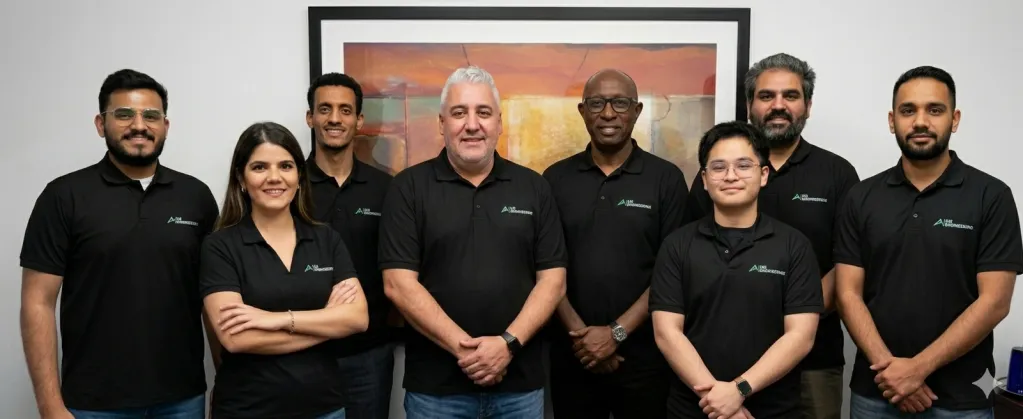
That mindset inspired him to start AM Engineering in 2021 as a team of one, doing residential civil design. Five years on, the firm is 14 people strong, with three engineers, two licensed architects, five designers, plus support staff – taking on multi-dimensional work across civil, structural and architectural design from initial site plan applications all the way through to construction support.
Each step of that growth has come from pursuing new horizons – a new service line, a new market or a new way of working. AI is the latest one.
A steady growth trajectory built on word of mouth
AM Engineering started with residential projects – civil design work like grading and stormwater design. The move to commercial happened naturally, one client at a time.
“We came across clients who were also looking for structural design, and we said, sure, we can help you with that,” recalls Mundi. “Then came clients who asked for the whole package – architectural design, too. That’s when I hired someone with that expertise. It was one step at a time.”
Their evolution was also driven by the market. “When we started, residential land development was huge. Now, residential has slowed down and commercial has picked up,” Mundi says. Commercial tends to be simpler in design but higher in volume; residential is a more niche, demanding market. The mix of the two suits him – he likes the variety, and the balance gives the firm both the volume of work that keeps the business steady and the custom projects that keep the team engaged.
Through it all, growth has come from word of mouth. “We perform well, and the word gets out there,” says Mundi.
How AM Engineering started using AI – and why
Mundi was introduced to AI through his architectural team, who were already experimenting with it for renderings.
“We used to do renderings in software like Lumion and Revit. With AI, we saw a big change – both in time saved the quality of what we were producing,” says Mundi.
That was the turning point. “I sat down with the team and said: if this is the output we’re getting, we have to focus on AI.”
From there, AI use spread across the firm. Today, AM Engineering uses a stack of tools, each for a specific job:
- Gendo.AI – Initial architectural renders are produced in Lumion Pro, then post-processed in Gendo.AI to bring them to life. What used to take two days now takes about two hours.
- Claude – Used by the structural team to review structural design work. “Claude gives us a good breakdown of the background engine that’s doing the structural design. It’s so much easier to review,” says Mundi.
- Chat GBT – Used to surface information from the Ontario Building Code in seconds. “I used to open the PDF and hit Control-F to find specific details. I don’t have to search manually anymore,” he explains. The same tool also handles planning distribution reports that used to take two days.
- Microsoft Copilot – Part of daily work across the firm, especially for email and communications.
Civil design is next on the list of opportunities. “We haven’t started yet, but we are exploring the options,” says Mundi. “It’s a new thing, and it’s all evolving very quickly.”
The benefits of using AI at AM Engineering
As a business owner, Mundi is always looking to save time and improve quality – without losing his workforce in the process. “We want to get them involved,” he says. The way he sees it, AI creates room for more work, not less.
“AI actually creates more opportunities for us, because we’re able to take on more jobs and clients – ultimately, we can scale more,” says Mundi. “We’re playing three different balancing games – we want to grow, keep our workforce and stay profitable.”
The benefits the firm is seeing:
- Better quality work – particularly in rendering and design review
- Significant time savings on routine and research-heavy tasks
- More capacity to scale – taking on more clients without adding headcount one-for-one
- Higher workforce satisfaction – staff spend more time on higher-value, more interesting work
Before and after: where AI is saving time
| Task | Before AI | With AI |
|---|---|---|
| Architectural rending for a house or building | 2 days | 2 hours (~80% time saved) |
| Crafting planning distribution reports | 2 days | Seconds to hours |
| Finding Ontario Building Code information | Hours | Minutes |
| Structural design review | Full review cycle | ~50% time saved |
“AI has been a game-changer for our business,” says Mundi. It takes away so much of the time or effort that used to go into finding information. Now, we can focus on other tasks that actually allow us to scale – bringing in more clients and meeting submission timelines. Those things are very critical in our field.”
Why human oversight is non-negotiable – and why transparency matters
For all the time that AI saves, Mundi is clear about what it doesn’t change: the rules of engineering.
“We still need an engineer to sign off on the design. We still need an architect to sign off on the architectural drawings. AI will help us get there faster – but it cannot replace humans.”
Mundi likens it to surgery. AI can improve the quality of the work and remove some of the small errors a human hand might introduce – but you can’t replace the surgeon. The accountability stays with the professional.
That belief is what helps define where Mundi will – and won’t – lean on AI. Rendering is one thing. “That is simply a picture we’re creating, something before it’s been built.” Structural and civil design are something else entirely. Those designs have to meet minimum building code requirements, and the safety of the people who will use the building depends on getting them right. AI can support that work, but it can never own it.
That’s where transparency comes in. The reason Mundi feels comfortable using Claude for structural review isn’t just that it’s fast – it’s that he can see how it got there.
“Claude posts all the formulas so we can see for ourselves. It helps with confirming the work, but completely relying on AI for a full structural design will never happen. Someone always has to double and triple-check. We are cautious when it comes to anything structural or engineering-related.”
It’s a simple rule, but a useful one for any business evaluating AI tools: choose the ones you can see into. If you can audit the logic, the formulas, the sources and the reasoning, you can use the tool with confidence.
As for the team itself, learning the tools has been the engineers’ own job. “That’s pretty much the way things go with us engineers,” says Mundi. “Once they teach us for four years, it’s self-teaching after that. We have to keep updating our skills and knowledge.”
Advice for businesses starting their AI journey
Talk to any group of Canadian business owners about AI, and you’ll get the full range of reactions. Some are already using it daily and looking for the next tool. Others are skeptical or silently worried – about costs, job placement or handing over too much of the work that defines their business. Many simply don’t know where to start.
Mundi understands all of it. He went through the same internal calculations himself, and he’s candid about what he learned. “I always tell people we have to go with the flow. We have to keep up with what’s happening in the industry, or else we’ll be left behind.”
He offers this practical advice for businesses at any stage:
- Start now. Many tools are free today and won’t necessarily stay that way.
- Treat AI as a scaling lever, not a headcount replacement. The goal is more capacity, better quality and more clients – not fewer employees.
- Choose tools you can see into. Transparency – being able to review the formulas, sources and logic behind an output – matters more than impressive results.
- Keep humans accountable. AI facilitates the work, but engineers, architects and other professionals still sign off
- Be selective about where you apply it. Rendering, research and communications are lower-risk starting points; safety-critical design needs more caution.
- Expect to self-teach. The tools evolve quickly. Staying current is part of the job – just like it is for any technical field.
What’s next for AM Engineering
AI isn’t replacing the workforce. If anything, it will likely make the firm bigger.
“With the AI tools we have access to, we can target more revenue this year with the same number of employees. But because we’re able to take on more work, we can add more clients – which ultimately ends up adding more employees too,” says Mundi.
Mundi’s rule of thumb: If the firm scales by more than 15%, that’s the trigger to bring on more people. The math works because AI is doing the work that used to consume hours of professional time, freeing the team to pursue work they didn’t have the capacity to take on before.
Another major focus on the horizon is expanding AM Engineering’s client base. Currently, the majority of the company’s clientele is from the private sector, while they also work with public companies. The next step is to pursue more opportunities within the public sector and continue growing their municipal presence this year.
What businesses can learn from AM Engineering’s playbook
AM Engineering’s AI story is about using the right tools to do more of what a business is already good at – and freeing the team to take on the work that drives the business forward.
Used well, AI can save time, improve quality, open up capacity to scale and – perhaps counterintuitively – help a business grow its workforce. The firms that weave it into their work will be the ones setting the pace. Holding off on adopting AI tools, on the other hand, may result in falling behind.
The lesson from AM Engineering is that you don’t need to dive in fully to get started. Pick a single use case where the value is obvious, such as a research task or email workflow, and choose a tool that can help you complete that task better and faster. As always, keep the professionals in the loop and learn as you go.
As Mundi puts it, “Go with the flow. The industry is moving. The opportunity is to move with it.”
AI is moving fast, and the pressure to adopt can feel overwhelming when you’re also managing clients, cash flow and everything in between. Sometimes the best place to start is by learning from someone who’s already been there. That’s the idea behind AI in Action – a series spotlighting Canadian small business owners who are putting AI to work in real, practical ways. Each story is a window into how a fellow entrepreneur made the leap, what they learned and what it’s actually meant for their business.
This article is intended as general information only and is not to be relied upon as constituting legal, financial or other professional advice. A professional advisor should be consulted regarding your specific situation. Information presented is believed to be factual and up-to-date but we do not guarantee its accuracy and it should not be regarded as a complete analysis of the subjects discussed. All expressions of opinion reflect the judgment of the authors as of the date of publication and are subject to change. No endorsement of any third parties or their advice, opinions, information, products or services is expressly given or implied by Royal Bank of Canada or any of its affiliates.