

TLDR
-
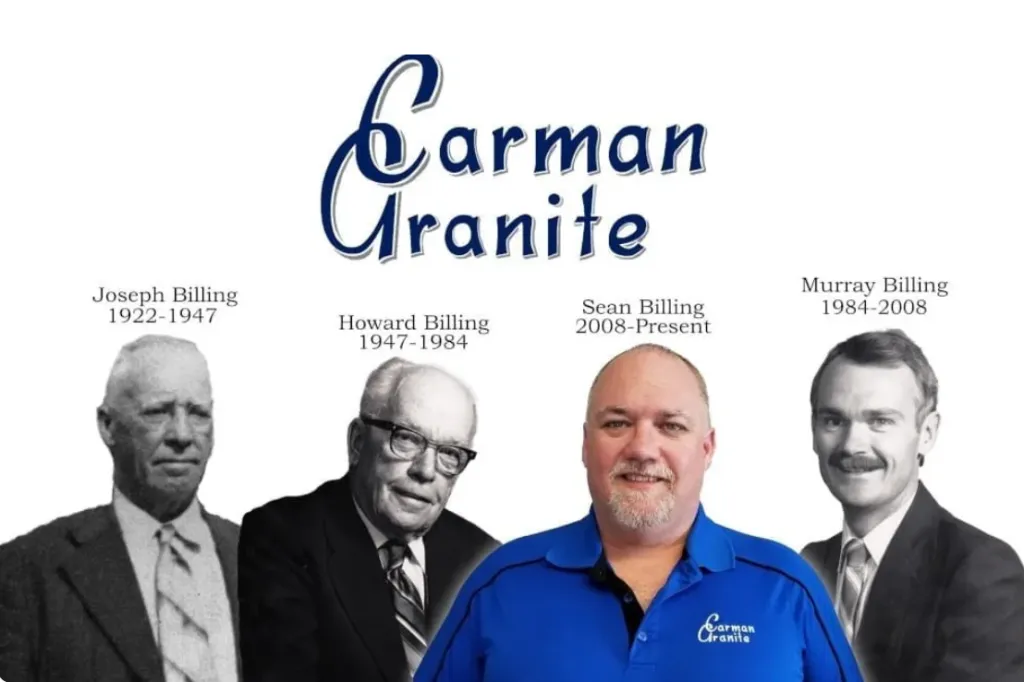
Carman Granite is a fourth-generation family business with over a century of expertise in the stone industry
-
Specializing in countertops and monuments, the business has evolved from its roots as a local monument shop into a high-capacity fabrication facility
-
Under the leadership of Sean Billing, Carman Granite is using AI to serve its customers with efficiency and empathy
-
With workers hard to find in rural Manitoba, AI can fill some of the gaps and free the team from time-consuming admin
Carman Granite has been in business since 1922, when Joseph Billing took over Carman Memorial from his uncle. In those days, stone arrived by boxcar and was hauled the last stretch by horse and sleigh – a trek far easier across winter snow and ice than over rough summer roads. The tools were hammers and chisels, and every customer came from the surrounding community.
Over the years, the tools evolved – to sandblasting, to diamond etching, to laser – and cranes and forklifts replaced the horses. “Every generation has done a good job of growing and making it a better, current and more viable business,” says Billing. He believes his great-grandfather would have been proud of how far Carman Granite has come – though he could never have pictured where it stands today: the oldest family-run business in Carman, Manitoba, using AI to serve the community it has called home for over a century.
An old trade, an open mind
Increasingly, clients arrive at Carman Granite with a monument design already in hand – one they generated themselves using AI. It doesn’t faze Billing in the least. “They get on ChatGPT, create their own design and come into the meeting to get it made,” he says. “I have some peers who don’t like the idea, but I do. As long as the design is decent, we can create what they’re looking for. To me, that’s special.”
That openness has led Billing to build a small but growing stack of AI tools, each doing a specific job – on both the artistic side of the business and the admin behind it.
-
-
Nano Banana – monument design
Billing and his team use this image-generation tool to turn a family’s wishes into a monument design. A client might come in describing the things a loved one cared about, and Billing translates that into a custom image – often capturing something they couldn’t quite put into words. Work that once meant hours in Photoshop now takes minutes. -
Airtable – admin and workflow
If Nano Banana powers the artistry, Airtable runs the operation behind it. “We have a great process, but it’s very labour-intensive as far as the admin side goes,” Billing says. -
Inventory alerts
The same system watches stock levels. If inventory is running low, it flags the shortage, suggests which supplier to order from and drafts the email. “I just have to approve it and hit send,” says Billing. -
Gmail summaries
“I get way too many emails in a day,” says Billing, who works on Google platforms. Built-in summaries let him read a handful of bullets and get up to speed on a long thread in seconds.
-
The payoff has the greatest impact on client communication. Because notifications now go out once a monument is set, families hear from Carman Granite right away – a meaningful change during an emotional time. “They’re getting notified faster,” Billing says. “With my old way of doing things, this could sit in my folder for a week if I got tied up.”
For Billing, the case for using AI is simple. “What I’m able to offer people today is 100 times better than what I could do even a year ago – in terms of both artwork and administration. Why would I do 35 minutes of work when I can do five?”
Staying ahead of AI capabilities
Billing is the first to admit he isn’t trying to track every new tool himself. “I’m not sure I am staying on top of it,” he says of trending AI. The pace is relentless – he points out that Nano Banana is considered the best image tool today, “but a week from now that could change.”
Two things help him keep up on the latest capabilities:
-
An AI consultant: Billing works with someone whose full-time job is building systems for businesses like his. “He’s staying on top of everything, giving us great ideas and proposing a direction for us,” says Billing. “He maps out next steps and tells us what the next piece will take off our plate.”
-
Industry seminars: His trade group, the Canadian Monument Builders/Ontario Monument Builders, has run seminars for years, but lately the focus has turned to technology – including sessions on how AI can help businesses. It’s a sign of a generational shift, Billing notes, as the younger cohort takes the reins and appetite for these tools grows across a traditionally hands-on industry.
The part that won’t be automated
For all the AI that Billing has adopted, there’s one area he’s resisting. His consultant has shown him automated phone attendants so convincing that callers can’t tell they aren’t speaking to a real person – but he’s not interested. “I’m not ready for that, especially in our industry,” he says. “I think there still needs to be a personal touch.”
That same instinct applies to his staff. Billing still employs artists for work that calls for a human hand, and he’s clear that AI hasn’t reduced his need for staff. If anything, his constraint is finding workers – he has room for two more full-time people right now and can’t fill the roles. From his perspective, AI isn’t replacing workers, but rather helping make his business more efficient – so his team can spend time on the most meaningful work.
More than a century in one community has taught Billing what keeps a business alive – the personal connection behind the work. “We’re the oldest family-run business in our community. Our reputation means everything, and we protect that very closely. That is a large part of doing business in rural Manitoba.”
Billing’s daughter – the next generation – feels much the same way. At 20, she’s working in the business alongside her father. And while she is proficient in AI, she prefers to work with her hands. “She’s old school,” Billing shares. It’s a fitting continuity for a business that has always balanced tradition with progress.
Advice for reluctant business owners
Billing is candid about what has worked for him and offers practical advice for owners who may be hesitant about integrating AI into their businesses.
-
Start with strong processes. AI enhances a good process, but it won’t fix a broken one. “If you don’t have a good process already, AI is useless to you,” says Billing. “But if you have a good process already and there is some repetition in your business, AI can really help to streamline your operation.
-
Use it to learn it. The tools reward regular use. “The more you use it, the better it gets,” says Billing – both because the tool learns your patterns and because you get better at asking it to complete tasks. He likens prompting AI to learning a new language – the clearer you get, the better the results.
-
Lean on experts. You don’t have to figure it out alone. A good consultant can do the heavy lifting of choosing and connecting tools, then point you to the next opportunity, freeing you to focus on running the business.
What’s next for Carman Granite
Countertops make up 70 per cent of the business – a clear opportunity for the same efficiencies. Billing has deliberately held off on automating that side until he’s confident the systems are solid. “Countertops move at a much faster pace,” he says. “So when I make the switch, I want to be ready.”
In the meantime, Billing and the team are going to continue to automate their office work and keep learning more about the artistic capabilities of AI tools. “AI will continue to play a larger role here. I think my staff is getting sick of hearing it, but we have to continue on this road, because the efficiencies we get from it are necessary in today’s market,” he says.
Plenty of Billing’s peers want no part of AI. He sees the hesitation as fear of the unfamiliar more than anything else. “They don’t know how Artificial Intelligence could actually help them. They think, ‘we’ve been doing it this way forever, why would I change now?’ I’m just not that guy. I feel that if you’re not going to use it in the next few years, you’re going to be so far behind that it will be hard to catch up.”
Four generations in, the tools have changed beyond recognition – from chisel to laser to AI – but the instinct has stayed the same: every generation of Billings has found a way to move the business forward. This one is no different.
AI is moving fast, and the pressure to adopt can feel overwhelming when you’re also managing clients, cash flow and everything in between. Sometimes the best place to start is by learning from someone who’s already been there. That’s the idea behind AI in Action – a series spotlighting Canadian small business owners who are putting AI to work in real, practical ways. Each story is a window into how a fellow entrepreneur made the leap, what they learned and what it’s actually meant for their business.
This article is intended as general information only and is not to be relied upon as constituting legal, financial or other professional advice. A professional advisor should be consulted regarding your specific situation. Information presented is believed to be factual and up-to-date but we do not guarantee its accuracy and it should not be regarded as a complete analysis of the subjects discussed. All expressions of opinion reflect the judgment of the authors as of the date of publication and are subject to change. No endorsement of any third parties or their advice, opinions, information, products or services is expressly given or implied by Royal Bank of Canada or any of its affiliates.