

TLDR
Even after three decades of business growth, Minimax continues to innovate to meet evolving customer expectations that are changing the way they do business.
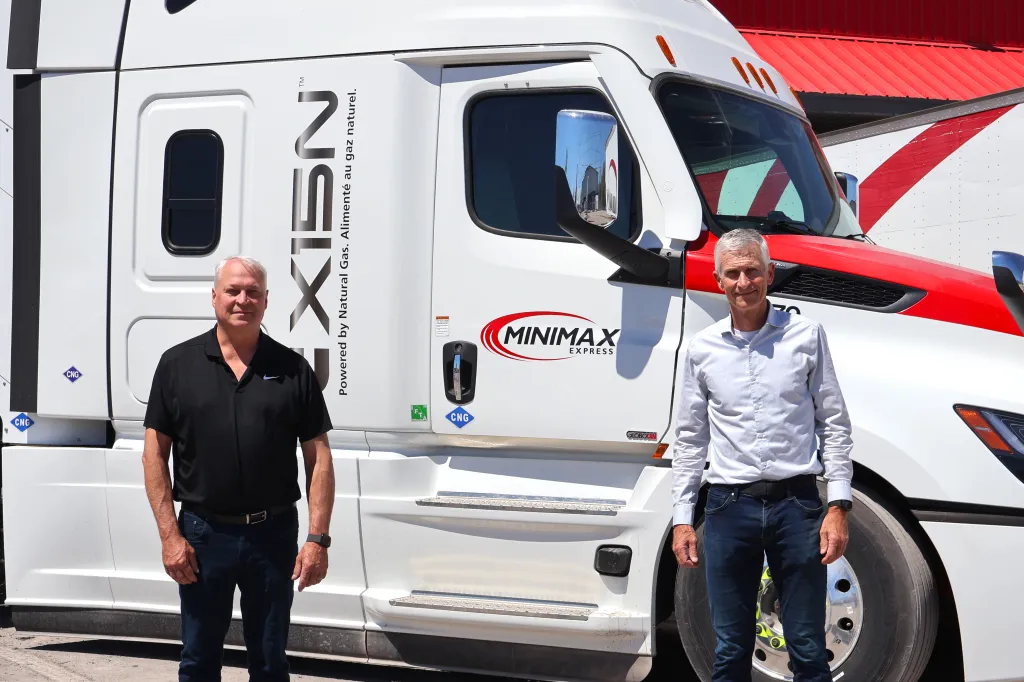
Minimax Express reduces emissions through optimized routing, driver coaching and the introduction of six compressed natural gas trucks to their fleet.
Their investments are paying back across multiple dimensions, including cost savings, environmental impact, customer satisfaction and business growth.
Minimax is using environmental sustainability to strengthen customer relationships, reduce operating costs and prepare for evolving transportation sector requirements.
Yves Poirier, President of Minimax Express Transportation Inc., and his brother Marc, the company’s Vice President, learned about the trucking business around the dinner table.
Their father started Minimax just over 35 years ago after nearly three decades in the industry – and the conversation usually circled back to the road. “We started 35 years ago with three trucks and the goal of servicing clients in Ontario and Quebec,” Poirier says. “And 35 years later, that’s what we do.”
Everything else has scaled up. Minimax now runs 175 tractors and 250 trailers out of six locations with 300 employees, and the work that used to be defined simply by a truck, a driver and a trailer has been reshaped by advanced technology and a new commitment to environmental sustainability.
Moving environmental sustainability up the priority list
“It still takes a truck and a driver and the infrastructure to pick up freight, load it to a trailer and get it delivered,” Poirier says. “But a lot has changed, too.”
Customers expect real-time visibility on their freight, and they expect it to arrive the next day – or even the same day. Over the years, Minimax has invested in the technology needed to meet those demands.
More recently, new customer expectations have sparked a different shift. Customers have started asking what Minimax is doing about its greenhouse gas (GHG) emissions, and those questions are coming up earlier in the process. “Comments about these considerations used to come up casually in conversation during requests for pricing and quotes,” Poirier says. “Now it’s become very important. Customers are asking more questions and becoming far more interested in what we’re doing to support an environmentally sustainable future.”
Indeed, shippers and enterprise customers are increasingly expecting emissions transparency and environmental sustainability reporting from their transportation providers – and that expectation is influencing procurement decisions, RFP competitiveness and long-term supply chain partnerships.
For more on how emissions are categorized, see Emissions Explained: Understanding Scope 1, 2 and 3 in Your Business.
Poirier suggests that two forces are moving environmental sustainability up the priority list. For one, larger shippers are working to lower their own reported GHG emissions, and a carrier with a smaller emissions profile helps them achieve that. And, those same shippers are likely being asked by their own customers to disclose reliable emissions data across the entire value chain.
For a closer look at mapping these pressures across operations, see A Beginner’s Guide: Value Chain Analysis in Your Business’s Environmental Sustainability Strategy.
Poirier had been thinking about more environmentally sustainable operations for some time, but – like many business owners – wasn’t sure where to begin. A request from a Minimax customer to complete the EcoVadis Assessment, a globally recognized rating across environmental impact, labour and human rights, ethics and environmentally sustainable procurement, provided a starting point of sorts. The process was demanding and, bringing to light gaps the team hadn’t identified before, helped clarify where to begin their journey.
A series of steps adding up to measurable change
With a clearer view of where Minimax could improve, Poirier mapped out a series of practical changes – each one valuable on its own, and even more powerful in combination.
Education: Poirier signed up for online environmental sustainability courses through the Canadian Institute of Traffic and Transportation (CITT), with the goal of learning enough to ask better questions of vendors and partners.
Route management: A single truck can make up to 20 stops a day. Better routing means fewer kilometres, less fuel and lower emissions on every run.
Driver coaching: Minimax tracks driver patterns, including hard braking, hard acceleration and hard cornering. Each driver receives a scorecard on their tablet, rated green, yellow or red, and the results are posted in the drivers’ room. “You don’t want to be in the red,” Poirier says. Smoother driving is safer, cheaper and cleaner at the same time.
Wider operational changes: Minimax has partnered with Ducks Unlimited on wetland remediation, switched its facilities to LED lighting and continued to expand recycling.
Fleet upgrade: The biggest move came in January 2025, when Minimax bought its first compressed natural gas (CNG) truck. The fleet now includes six, each one displacing the diesel emissions of the truck it replaced. Across the rest of the fleet, a move to automatic transmissions has eliminated manual shifting, which has a measurable fuel and emissions benefit.
Turning emissions data into a decision-making tool
Around the same time, Natasha Shute, Director, Sustainable Finance with RBC, reached out to discuss the work Minimax was doing. Shute provided advisory support on emerging transportation sector trends, peer activity, customer expectations and environmental sustainability-related business opportunities, helping Minimax evaluate how emissions data could support broader operational and strategic decision-making. In one of those early conversations, she suggested they connect with Carbonhound, a carbon management software platform that helps businesses measure, reduce, verify and market their carbon emissions.
“We figured if RBC was recommending them, they must be reputable,” says Poirier. The RBC introduction lent the platform immediate credibility, and Minimax brought Carbonhound on as a partner.

How RBC helped
RBC’s Climate Advisory Solutions team connected Minimax with Carbonhound — turning a complex environmental sustainability data challenge into a clear, trackable dashboard. Ask your RBC advisor how we can help you find partners for your environmental sustainability journey.
Today, Carbonhound is giving Minimax a clear view of emissions across the business. “We have a clear picture of how much natural gas it takes to heat our warehouses, we can track our electricity usage and the emissions of our diesel trucks,” Poirier says. “For every building we have and every piece of equipment, we know the impact. We simply supply Carbonhound with our data and they make it so simple.”
Sanders Lazier from Carbonhound shares, “With Carbonhound tracking, Minimax can confidently estimate that their six CNG trucks will avoid approximately 950 tonnes of CO₂‑equivalent greenhouse gas emissions over their lifetime compared with the diesel trucks they replaced. The figure can improve further with renewable natural gas.”
Returns across multiple dimensions
Like any business decision, Minimax’s investments had to make commercial sense. The six CNG trucks alone carry a roughly $125,000 premium per unit over diesel – no small expense. Fortunately, the return comes from several directions.

By the numbers
6 CNG trucks operating in the fleet
950 tonnes of CO₂-equivalent greenhouse gas emissions avoided over truck lifetime
2–3 years projected payback period (with Green Freight Program grant)
175 trucks across 6 locations — all subject to route optimization and driver coaching
“With anything in business, you always look at the ROI. All the things we do, teaching drivers to drive in a certain manner, buying trucks with automatic transmissions, a transport management system that does a better job of dispatching, so we save miles… all of these are good for the environment, but at the same time, there’s good ROI on it.”
— Yves Poirier, President, Minimax Express
Direct cost savings
The cost of diesel has climbed considerably through 2026 and is expected to continue to rise. Meanwhile, natural gas pricing remains stable, allowing the CNG trucks to run on the same predictable budget all year. What’s more, the reservoir tanks on the CNG trucks are built to outlast the vehicles themselves, and can be transferred to new trucks, further improving the long-run economics.
On top of that, Minimax applied for Natural Resources Canada’s Green Freight Program grant on five of their trucks and was selected. “With the incentive, it looks like we will be able to recoup the cost in two to three years. Without the incentive, it might be three to four years,” Poirier says.
Grants and incentives can shorten the payback period on environmental sustainability investments by years. RBC Beyond Banking collaborator GrantMatch can help organizations identify and access the grants and incentives available to them. Find out how to put them to work for your business.
Measurable environmental impact
Sanders Lazier from Carbonhound shares, “With Carbonhound tracking, Minimax can confidently estimate that their six CNG trucks will avoid approximately 950 tonnes of CO₂‑equivalent greenhouse gas emissions over their lifetime compared with the diesel trucks they replaced. The figure can improve further with renewable natural gas.”
Minimax views CNG trucks as a practical transitional investment – one that helps reduce emissions and test ROI while electrification solutions and infrastructure for medium- and heavy-duty fleets continue to evolve.
Regulatory readiness
Starting with model-year 2027, the U.S. Environmental Protection Agency’s (EPA) new heavy-duty engine standard requires an 82.5 per cent reduction in NOx emissions from current levels – a standard that directly affects Canadian carriers running freight across the border. The CNG engines Minimax bought in 2025 already meet that standard. Bringing diesel engines into compliance is expected to cost roughly $30,000 per engine. “All of a sudden,” Poirier says, “the difference in natural gas and diesel trucks is getting smaller.”
For more on getting ahead of these requirements, see From Reactive to Proactive: Managing Climate-Related Risk in Your Business’s Value Chain.
Commercial differentiation
“I think this will help us win business,” Poirier says of their investment. “Of course, our clients are very cost-conscious – but with price and service level being equal, this might turn some customers in our favour.” Outside of municipal fleets, very few carriers (if any) in the region operate this many CNG trucks, which gives Minimax a clear position with customers who also prioritize environmental sustainability.
Poirier ties the four threads together. “With anything in business, you always look at the ROI,” he says. All the things we do, teaching drivers to drive in a certain manner, buying trucks with automatic transmissions, a transport management system that does a better job of dispatching, so we save miles… all of these are good for the environment, but at the same time, there’s good ROI on it.”
Advice for businesses starting their own environmental sustainability journey
For business owners thinking about where to begin their own work, Poirier shares five recommendations from his experience.
Start with education: A baseline of knowledge, whether through courses, trade press or peer conversations, is what allows the right questions to be asked and the right answers to be evaluated.
Bring in experts early: A partner like Carbonhound turns what looks like a complex undertaking into a simple dashboard.
Use the partners you already trust: RBC proactively reached out to Minimax with advice and the Carbonhound introduction. The people who already understand the business can often open doors.
Be proactive: Regulations like the EPA’s 2027 rule are coming into effect, whether businesses are ready or not. Those who begin their transition early are in a materially different position than those who wait until the requirements are in place.
Invest in what matters: Notes Poirier: “Whether it’s technology or people or equipment, if you don’t invest, you’ll fall behind.”
What’s next for Minimax
Minimax is preparing to set formal emissions targets for 2030. The dataset is still young, with disciplined tracking only beginning in 2025, but every additional month of data sharpens both the current picture and the future targets.
As Minimax continues to mature its environmental sustainability strategy, RBC’s sustainable finance team continues to support the company through strategic advisory discussions – using the emissions data and operational insights to help establish measurable targets and identify future opportunities for efficiency improvements and financing solutions to advance environmental sustainability-related investments over time.
For a primer on where to begin, see Ready to Tackle Your Company’s Environmental Sustainability Strategy? Start with Scope 1 and 2.
Meanwhile, succession planning – often the harder question in a family business – is already addressed. Between Poirier and his brother, four of the next generation are in the company. “We’re very fortunate because we have our succession figured out,” Poirier says. “The beauty with trucking is that it’s kind of unlimited. There are so many people who ship freight in Ontario and Quebec.”
The core of the business at Minimax has not changed. As they celebrate their 35-year anniversary, their trucks are still picking up freight in Ontario and Quebec, just as they always have. What has changed is what it takes to do the work well – and to keep doing it. Cleaner engines, route optimization systems and emissions tracking have positioned Minimax for what comes next: new regulations, new customer expectations and a new generation of leaders ready to build on a stronger foundation.
How RBC can help
To support clients on their journey to environmental sustainability, RBC works with Carbonhound, a climate action platform that helps companies measure and track their environmental impact. Speak to your RBC relationship manager today to learn more.
Visit: rbc.com/impact
This article is intended as general information only and is not to be relied upon as constituting legal, financial or other professional advice. A professional advisor should be consulted regarding your specific situation. Information presented is believed to be factual and up-to-date but we do not guarantee its accuracy and it should not be regarded as a complete analysis of the subjects discussed. All expressions of opinion reflect the judgment of the authors as of the date of publication and are subject to change. No endorsement of any third parties or their advice, opinions, information, products or services is expressly given or implied by Royal Bank of Canada or any of its affiliates.