



Key Takeaways
Tariffs aren’t new to Canadian businesses, but the U.S.-Canada trade environment continues to evolve, including the rates applied and the products affected.
Canadian business owners have demonstrated resilience time and again. Drawing on proven tools and strategies can help you stay adaptable as trade conditions change.
Business scenario planning – also known as ‘what if’ planning – can help you prepare for different outcomes and make decisions amid uncertainty.
Government programs and RBC resources can help businesses affected by tariffs manage cash flow, find new markets and invest in their operations.
Canadian business owners are no strangers to disruption. From pandemic shutdowns to supply chain issues to talent shortages and inflation, they’ve navigated significant challenges in recent years. Since 2025, shifts in U.S.-Canada trade policy have created another source of uncertainty for many businesses.
But the question today may be less about how to prepare for tariffs and more about how to keep your business flexible and moving forward. Fortunately, adaptability is something Canadian businesses know well. The lessons learned through past disruptions – along with thoughtful planning, greater flexibility and a Plan B (and maybe a Plan C) – can help you respond to whatever comes next.
What does the U.S.-Canada tariff environment look like now?
The trade relationship between Canada and the U.S. remains fluid. Since early 2025, the U.S. has introduced and adjusted tariffs affecting Canadian goods, while Canada has responded with countermeasures of its own. While much of the trade between Canada and the U.S. continues to move tariff-free, tariffs now affect a broader range of specific products and sectors.
Because the details can change quickly, be sure to check current sources before making business decisions. The Government of Canada provides current information on Canada’s tariff response, including counter-tariffs, tariff relief and support for businesses, while the Canadian Federation of Independent Business (CFIB) maintains information for Canadian small businesses.
How can tariffs affect Canadian businesses?
Tariffs are a common trade tool – countries around the world use them, and Canada and the U.S. have applied them to each other’s goods at various points over the years.
As goods enter a country, they are classified by customs. Some goods have a government-mandated tariff added to the cost that the buyer must pay, essentially a sales tax, before the goods are released at the point of entry (for example, a retailer buying inventory or a manufacturer securing parts to make their products). The impact of these tariffs on the Canadian economy and Canadian businesses depends largely on which products are affected, how long the tariffs remain in place and whether there’s any further escalation.
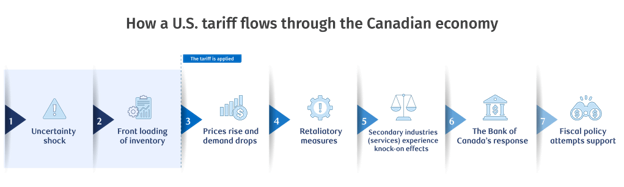
Source: RBC Economics
Canadian businesses of all sizes feel the impact of tariffs – not just big business. While 56 per cent of Canadian goods exported to the U.S. come from larger businesses, 43 per cent of exports are from small and medium-sized businesses. And according to a 2025 Statistics Canada report, the U.S. was the only export market for nearly two-thirds of Canadian exporting businesses.
While no one can predict exactly where trade policy will go next, there are ways to manage its effects on your business.
Five ways to keep your business adaptable as trade conditions change
1. Regularly reassess your tariff exposure
Trade-sensitive industries are the most exposed to tariffs. If your industry trades a lot relative to your production, it’s more likely to feel the impact. RBC Economics outlines that, to date, manufacturers of steel, aluminum and copper products, motor vehicles and parts, and softwood lumber have seen the most direct effects, particularly in Ontario and Quebec. Because the products affected can change, it’s a good idea to review your exposure regularly.
Keep in mind, some industries may contend with indirect impact – restaurants in towns reliant on automotive manufacturing, for instance, may see fewer customers if there are layoffs or even extended uncertainty.
If your business relies on goods imported from the U.S., check regularly whether they’re covered by Canada’s counter-tariffs. And if you export, confirm the tariff treatment that applies to your goods and whether they qualify for preferential treatment under the Canada-United States-Mexico Agreement (CUSMA). Keep in mind that some newer U.S. tariffs may apply even to CUSMA-compliant goods. The Trade Commission Service’s guidance on U.S. tariffs and CUSMA compliance can be a useful starting point, and a customs broker can help you confirm how your products are classified.
2. Build more flexibility into your supply chain and customer base
Decades of free trade have led to integrated supply chains across Canadian and U.S. borders. This means goods travel back and forth throughout production lifecycles – a product may be manufactured in Canada but require parts from the U.S. – or vice versa – and may be shipped back and forth before it’s completed.
In other circumstances, companies might import supplies from China or Mexico, which may transit through the U.S. Businesses that rely on transitioning goods – even if those goods aren’t destined for the U.S. – could be affected.
If you sell online and ship small orders to U.S. customers, note that the U.S. has ended its duty-free treatment of low-value shipments. Orders that once crossed the border duty-free may now be subject to duties, which can affect your pricing and your customers’ experience.
How might tariffs affect your business?
| If you export to the U.S. | If you import from the U.S. |
|---|---|
If your products are subject to U.S. tariffs, they become more expensive for your U.S. customers. This could mean they become less competitive in the U.S. market:
|
If the U.S. goods you rely on are subject to Canadian counter-tariffs, the prices you pay will rise and your margins may narrow:
|
3. Make scenario planning a regular habit
Scenario planning is one of the best ways to manage your business through periods of uncertainty. Often defined as “what if” planning, business scenario planning involves making assumptions about what the future will bring to understand how different situations may affect your business.
With tariffs changing over time, there are plenty of “what ifs” to consider. Revisiting your scenarios regularly – every quarter, for example, or whenever a tariff announcement affects your industry – can help you respond quickly.
Watch this webinar re-cap: RBC Small Business Talks: Incorporating Scenario Planning into your Business Plan
Scenario #1: What if sales slowed?
If the U.S. is one of your primary markets, you may face softer demand – especially if American consumers can find an alternative to your product for less.
Possible solutions:
Initiate new marketing programs to reach new client groups
Adjust product features to appeal to a new audience
Explore alternate markets
Scenario #2: What if profits take a hit?
If the cost of your inputs increases, your bottom line may be affected.
Possible solutions:
Revisit your market analysis and consider raising your prices
Look for alternate suppliers that aren’t subject to tariffs
Find ways to reduce your fixed and operating costs
Scenario #3: What if the Canadian dollar fluctuated?
Changes in trade policy can affect currency markets, and swings in the loonie can affect what you pay suppliers and what you earn from U.S. customers. How do you manage economic circumstances beyond your control?
Possible solutions:
Consider raising your prices to offset the impact of a lower CAD
Renegotiate supplier contracts where possible
Look for domestic suppliers to mitigate foreign currency concerns
Scenario #4: What if you needed to take on more debt?
If higher costs or slower sales put pressure on cash flow, consider ahead of time how much additional financing your business could comfortably manage.
Possible solutions:
Look for lower-interest-rate debt, especially for longer-term needs
Renegotiate terms with lenders, if possible
Meet with an advisor to discuss your options
Buy Canadian
If you’re purchasing parts, inventory, materials or other goods, consider supporting your fellow Canadian business owners whenever possible.
4. Diversify your markets – and your sources of revenue
For businesses that rely heavily on U.S. customers, replacing that market may not be realistic. But adding customers, markets or sales channels can reduce reliance on any one source of revenue. That could mean exploring opportunities in other international markets or finding new ways to grow closer to home.
As you consider your options, RBC tools and support can help you identify potential markets, global trading partners and new supplier networks.
There may be opportunities within your existing Canadian customer base, too. Could you reach a new demographic set through different marketing or product features? Are there new sales channels you can tap into? Adapt an existing product for a different customer group? As you evaluate your products and your markets, consider how you might further innovate or differentiate your offering. This may be the time to get creative!
5 min read: Turning Point: Real Entrepreneurs Share Their Marketing Secrets for Growing a Customer Base
5. Strengthen your operations and protect your cash flow
When input costs rise or demand changes, operational efficiency becomes even more important. Look across your business for opportunities to lower costs, improve productivity and preserve cash. Can technology automate time-consuming and expensive manual processes? Could you renegotiate supplier terms or adjust purchasing schedules? Does your current space still match your needs? Read our Five Tips to Help Find Hidden Savings and Offset Rising Business Costs for more ideas.
It’s important to remember that Canada is a major market for the U.S. – in fact, Canada was the largest source of imports for 22 U.S. states in 2025, and cross-border trade sustains millions of jobs and businesses on both sides of the border. So, as a Canadian business owner, you do have some negotiating leverage when working with U.S. customers and suppliers. Staying informed and flexible can help your business keep moving forward as trade conditions evolve.
Where can you find support for the impact of tariffs?
Support is available from several sources, including:
-
The Regional Tariff Response Initiative, offered through Canada’s regional development agencies, helps eligible businesses affected by tariffs manage short-term cash flow pressures and invest in projects that strengthen their resilience.
-
The Business Development Bank of Canada (BDC) offers financing for businesses affected by tariffs.
-
Many provinces and territories have programs of their own. Check initiatives where you do business.
-
If you import goods that are later exported, the Canada Border Services Agency’s Duties Relief and Duty Drawback programs may let you avoid or recover tariffs paid.
-
In some cases, businesses can request relief from Canada’s counter-tariffs through the federal remission process.
Trade conditions can change quickly, but your business doesn’t have to stand still. Regularly reviewing your exposure, testing different scenarios and building flexibility into your suppliers, markets and operations can help you make informed decisions as the environment evolves.
And sometimes, the first challenge is simply understanding how a particular tariff could affect your business. For straightforward answers on how tariffs work, direct and indirect impacts and steps businesses can consider, explore Tariffs FAQ: Top Questions Asked by Canadian Businesses.
This article is intended as general information only and is not to be relied upon as constituting legal, financial or other professional advice. A professional advisor should be consulted regarding your specific situation. Information presented is believed to be factual and up-to-date but we do not guarantee its accuracy and it should not be regarded as a complete analysis of the subjects discussed. All expressions of opinion reflect the judgment of the authors as of the date of publication and are subject to change. No endorsement of any third parties or their advice, opinions, information, products or services is expressly given or implied by Royal Bank of Canada or any of its affiliates.