



Key Takeaways
Low-fee chequing accounts in Canada typically charge $4 or less per month and include a set number of debit transactions plus core digital banking features like Interac e-Transfers.
Many institutions follow the Financial Consumer Agency of Canada (FCAC) Low-Cost Account Commitment, which caps the monthly fee at $4 and requires at least 12 debit transactions per month.
Students, seniors receiving the Guaranteed Income Supplement, newcomers to Canada and RDSP beneficiaries may qualify for a no-cost version of the same account.
Multi-product programs like the RBC Value Program may rebate the monthly fee when you hold an eligible combination of accounts — no large minimum balance required.
The right fit depends on your monthly transaction volume, existing products and how much you value digital tools versus in-branch service.
What is a low-fee chequing account?
A low-fee chequing account is a basic, everyday banking account that charges a small monthly fee for your core banking needs.
It sits between no-fee chequing accounts, which charge nothing but may come with more limits, and premium accounts, which can cost $30 or more per month, and often bundle extras like travel insurance and credit card rebates.
In most cases, “low-fee” translates to $4 a month, aligning with the benchmark set by the Financial Consumer Agency of Canada (FCAC).
For that fee, you can expect the essentials:
A debit card
Interac e-Transfers
Pre-authorized payments
Cheque writing
Digital banking access that covers online banking through your desktop and mobile banking through the bank’s app
What you typically won’t get are premium perks like free overdraft protection or out-of-network ATM fee waivers.
RBC’s Day-to-Day Banking Account is a classic example of how low-fee chequing accounts work. It carries a $4 monthly fee and includes 12 debit transactions of any kind per month, plus unlimited Interac e-Transfers.
Why do I need a low-fee chequing account?
Low-fee chequing accounts aren’t for everyone, and they aren’t a shortcut to paying less for banking. In fact, depending on your transaction habits, a low-fee account could end up costing you more than a premium account.
Choosing the wrong type of account can mean paying for features you never use or running into per-transaction surcharges that cost more. Here’s a quick way to check if a low-fee chequing account fits your needs:
A low-fee account may make sense when most of your transactions are e-transfers, you primarily use a different account, you make very few debit transactions, or you’re eligible for a rebate or no-cost version.
A different tier of account may be a better fit if you use your debit card a lot, have a high volume of monthly transactions, or are looking for bundled benefits like overdraft protection or travel benefits.
Other common types of chequing accounts in Canada
Canadian banks typically organize their chequing accounts into tiers, sorted by monthly fee and what you get in return.
Beyond the basic low-fee accounts discussed in this guide, most fall into three broad groups.
1. Unlimited or mid-tier chequing accounts
Mid-tier chequing accounts charge a higher monthly fee than low-fee options, but remove the transaction cap entirely, giving you unlimited debit transactions and Interac e-Transfers.
They often come with extras like rebates on fees when bundled with other banking products.
For example, the RBC Advantage Banking account has a $12.95 monthly fee, but the RBC Value Program gives you a rebate on part or all of the fee of an eligible chequing account when you hold at least two eligible product categories, such as:
A personal credit card
A personal investment like a Tax-Free Savings Account (TFSA) or Registered Retirement Savings Plan (RRSP)
A residential mortgage.
These accounts may suit you if you use your debit card regularly and want to bank without counting transactions. They may be more than you need if your monthly activity is light, in which case you could be paying for unlimited access you rarely use.
2. Premium or all-inclusive chequing accounts
Premium accounts, like RBC’s VIP Chequing Account, sit at the top of the lineup and offer the opposite of low-fee and no-fee accounts. They have the highest monthly fee of all account types, but bundle the widest range of perks, which may include:
-
Credit card annual fee rebates
-
Travel and other insurance coverage
-
Safe deposit box discounts
-
Waived bank fees on linked accounts
This type of chequing account can be a good fit if you’re able to offset the monthly fee through the bundled perks, such as a rebated premium travel credit.
Some chequing accounts offer a fee rebate if you carry a minimum monthly balance, which can be a good way to access premium features without increasing your overall cost of banking. Make sure to ask how much you’ll need to keep in your chequing account, and whether that’s an average or minimum balance.
These accounts may not be worth it if you wouldn’t otherwise use those extras, since the perks only pay off when you actually draw on them.
3. Specialty chequing accounts
Specialty accounts are designed for people with specific needs, such as seniors, students, newcomers to Canada, and people who need to bank in U.S. dollars.
Many waive the monthly fee entirely for eligible clients or for a set period, such as a newcomer’s first year in Canada.
Each account type has different benefits and drawbacks, meaning suitability depends on the group you fall into and the type of specialty account you’re looking at. If you’re a student, for example, a student account may be a viable option, provided you meet eligibility criteria.
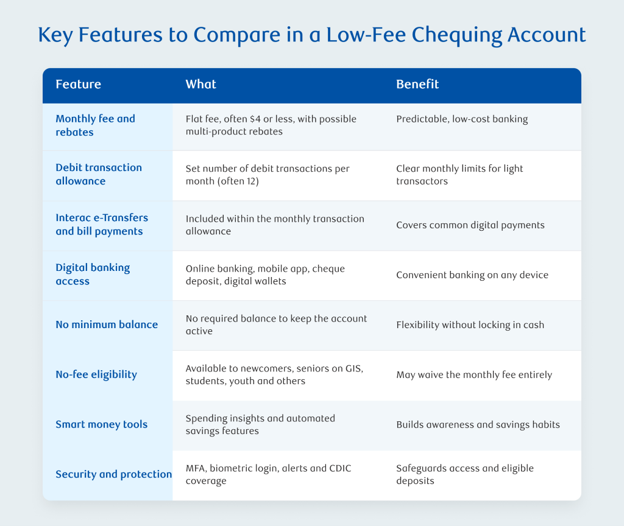
Key features to look for in a low-fee chequing account
Not all low-fee accounts are designed the same, and beyond the actual fee you pay, features, eligibility requirements, and transaction limits can differ.
Here’s what to look for when choosing between low-fee chequing accounts.
Monthly fee and rebate options
Low-fee accounts generally have a flat monthly cost, often $4 or less for accounts under the FCAC Commitment. Look for any rebates that may apply when held alongside eligible products from the same bank.
Included debit transaction allowance
A low-fee chequing account type has a maximum number of debit transactions per month (commonly 12 under the FCAC Commitment). You’ll pay extra for additional debit transactions, so clarify what the per-transaction fee will be.
Interac e-Transfers and bill payments
Electronic fund transfers — including Interac e-Transfers — are often included within the monthly transaction allowance on low-fee accounts, but it’s worth checking, especially if you make a large chunk of your payments electronically.
Digital banking access
Look for digital banking solutions such as:
Online banking
A mobile app
Mobile cheque deposit
Digital wallet integration (e.g., Apple Pay, Google Pay, Samsung Pay).
No minimum balance requirement
Many low-fee chequing accounts do not require a minimum balance. Depending on how much cash you plan to leave idle in the account, this may or may not be a priority for you.
Eligibility for no-fee options
Newcomers, seniors receiving the Guaranteed Income Supplement, Registered Disability Savings Plan (RDSP) beneficiaries, students, youth and other groups identified by participating institutions may qualify for a no-cost version of a low-fee account.
If you’re part of one of these groups, confirm with your provider.
Smart money tools
Look for features like NOMI Insights and NOMI Find & Save can help track spending habits and set aside small amounts automatically.
Security and fraud protection
Finally, make sure your funds are kept safe and secure by choosing an account that offers multi-factor authentication, biometric login, transaction alerts and CDIC deposit insurance coverage on eligible deposits.
Which low-fee chequing account is right for me?
There’s no single best low-fee account, only the one that best matches how you bank.
The answer to these questions can help you narrow down your options:
-
How many debit transactions do you make a month? If you regularly exceed the transaction limit that most low-fee accounts include, the per-transaction fees may make a higher tier cheaper overall.
-
Are you eligible for a no-cost version? Students, youth, newcomers to Canada, seniors receiving the Guaranteed Income Supplement and RDSP beneficiaries may qualify for a no-fee version of the same account.
-
Which mobile banking tools matter to you? If you bank mostly by app, look at the mobile experience, mobile cheque deposit and budgeting features.
-
Is your money protected? Confirm the account offers Canada Deposit Insurance Corporation (CDIC) coverage on eligible deposits and security features like transaction alerts.
-
Will your needs grow? If you expect your monthly transactions to grow or change over time, check how easily you can upgrade to a higher tier later.
-
Can you qualify for a fee rebate? You may qualify for a fee reduction or waiver by holding other products with the same institution, like with the RBC Value Program.
Next steps: Explore a low-fee chequing account
A low-fee chequing account can take the friction out of everyday money management. If your banking is straightforward and your monthly transactions are modest, it may give you the essentials you use most without paying for extras you don’t.
If that sounds like you, the next move is to find the option that fits.
You can weigh different RBC accounts side by side on the compare chequing accounts page, or look more closely at a specific low-fee option like the Day to Day Banking Account to see whether its features and fees match how you bank.
FAQ
No. A low-fee account charges a small monthly fee, often $4 or less, while a no-fee account charges nothing.
The line between the two bank account types does get a bit blurry, though, as many low-fee accounts waive the fee entirely for eligible clients, such as seniors or students, effectively making them no-fee.
Low-fee chequing accounts in Canada typically cost around $4 a month.
Under the Financial Consumer Agency of Canada (FCAC) Commitment on Low-Cost and No-Cost Accounts, participating institutions cap the fee on these accounts at $4.
In some cases, yes, though it depends on the policies set by your bank for your specific account type.
Many banks let you reduce or waive the fee through a multi-product rebate rather than a minimum balance. RBC’s Value Program, for example, may rebate the monthly fee when you hold an eligible mix of products and complete a few regular account activities each month.
If you exceed your monthly transaction limit, you can usually continue to use your account, but each debit beyond your included limit adds a per-transaction fee.
Most banks in Canada offer low-fee bank accounts, with the lowest monthly fee typically being $4. RBC’s Day to Day Banking account is an example of a low-fee chequing account.
You can often reduce this to $0 a month through bundles, rebates, or meeting no-cost eligibility criteria, meaning it’s less about which bank has the lowest fees in Canada and more about how you structure your banking and account setup.
This article is intended as general information only and is not to be relied upon as constituting legal, financial or other professional advice. A professional advisor should be consulted regarding your specific situation. Information presented is believed to be factual and up-to-date but we do not guarantee its accuracy and it should not be regarded as a complete analysis of the subjects discussed. All expressions of opinion reflect the judgment of the authors as of the date of publication and are subject to change. No endorsement of any third parties or their advice, opinions, information, products or services is expressly given or implied by Royal Bank of Canada or any of its affiliates.