



TLDR
Bank accounts are a convenient and useful place to keep your money, whether for everyday use or saving for the future.
Different account types offer different advantages – which one is best for you depends on your needs and goals.
It’s important to understand your account’s features and terms, such as applicable fees, interest rates and transaction limits.
Bank accounts are easy to open and often come with extra benefits such as online and mobile banking, budgeting tools and rewards programs.
Adult life comes with a certain amount of administration. We all need to move money around regularly to do things like pay rent and tuition or buy groceries and gas. A convenient and practical way to do this is with one of the most essential financial products: a bank account.
But what are the benefits, what types of bank accounts are available in Canada, and how do you open one? Here, we break down the details you need.
What is a bank account?
At its simplest, a bank account is a type of account you open with a bank to keep your money safe, allowing you to deposit, save up, withdraw funds and more. On top of that, you might use your bank account to pay bills, earn interest or make daily purchases (by using your debit card – a payment card linked directly to your account).
Types of bank accounts
There are two main types of bank accounts in Canada: chequing accounts and savings accounts. Here’s how they differ and the best uses for each:
Chequing accounts
Also known as transaction accounts, chequing accounts are intended for day-to-day banking needs, such as paying rent, buying groceries or receiving direct deposits from your employer.
Advantages of a chequing account:
Easy access to funds
Use of a debit card to make purchases
Convenient online bill payments
Higher number of included transactions compared to other types of accounts
Coverage from the Canada Deposit Insurance Corporation (CDIC). More on that below
Disadvantages of a chequing account:
Typically, lower interest rates than savings accounts (often no interest).
Potential monthly and/or transaction fees.
Savings accounts
These accounts help you to put money aside for future financial needs such as a vacation, a wedding or education costs.
Advantages of savings accounts:
Generally, higher interest rates than chequing accounts
May offer low or no monthly fee to help your money grow
Offers the freedom to access your cash at any time without withdrawal penalties
Disadvantages of a savings account:
Limited transactions, making them unsuitable for day-to-day banking
Potential fees for exceeding transaction limits
Does not offer the same returns as longer term savings in other investment product types (though the tradeoff is the ease of access)
Interest rates on savings accounts
In the context of a bank account, the interest rate is the percentage the financial institution agrees to pay you for keeping your money in that account. Depending on your account’s applicable interest rate and how much you’ve saved, you might receive interest deposits from the bank every month.
The higher the interest rate and the more money in your account, the more interest you’ll earn. So it can be worth seeking out a high-interest savings account that might help boost your savings.
Interest rates on chequing and savings accounts vary depending on the bank and account type. They may also change over time in response to economic factors.
Generally, savings accounts offer higher interest rates than chequing accounts. That’s because they’re designed to help you grow your money. The higher the interest rate, the more interest you’ll earn on your deposits.
Why do we need a bank account in Canada?
Your primary bank account – generally a chequing account – is often your financial hub, the place where money comes in and goes out. Having a second bank account – usually a savings account – is a convenient way to set aside funds for the future.
When it comes to financial management, you can use your bank account to:
Receive and store money, be it your paycheque, a scholarship, student loan funds or cash gifts from family
Pay bills for things like internet service, your cell phone, utilities or credit cards — either manually or automatically
Have regular expenses such as rent automatically deducted
Withdraw cash from an ATM when you need it
Make cashless transactions in stores using your debit card
Transfer money to individuals or businesses
Transfer money into other accounts, such as investments
Save money for future needs and goals
Your bank account offers a number of security benefits, too. One of these is deposit insurance. Most Canadian banks, including RBC, are members of the Canada Deposit Insurance Corporation (CDIC), a federal institution that protects people’s eligible deposits in the unlikely event that your bank goes out of business. This coverage applies separately for each insured category at each member institution, meaning your eligible deposits are protected up to $100,000 per category, such as those held in your name alone or in a TFSA.
Types of bank accounts in Canada
Depending on your needs and what you plan to use the account for, you might want to consider opening a specific type of account. Some of these options include:
-
Joint accounts, useful for couples or families who share finances
-
Business accounts, with certain features and benefits specific to entrepreneurs
-
Newcomer accounts, with tailored options for new residents in Canada
-
Student accounts, which feature benefits for students such as lower fees and special offers
-
Kids’ accounts, designed to help children 12 and under learn about the basics of financial management. A parent or legal guardian is required to present their ID to open the account
How to choose the right bank account for your needs
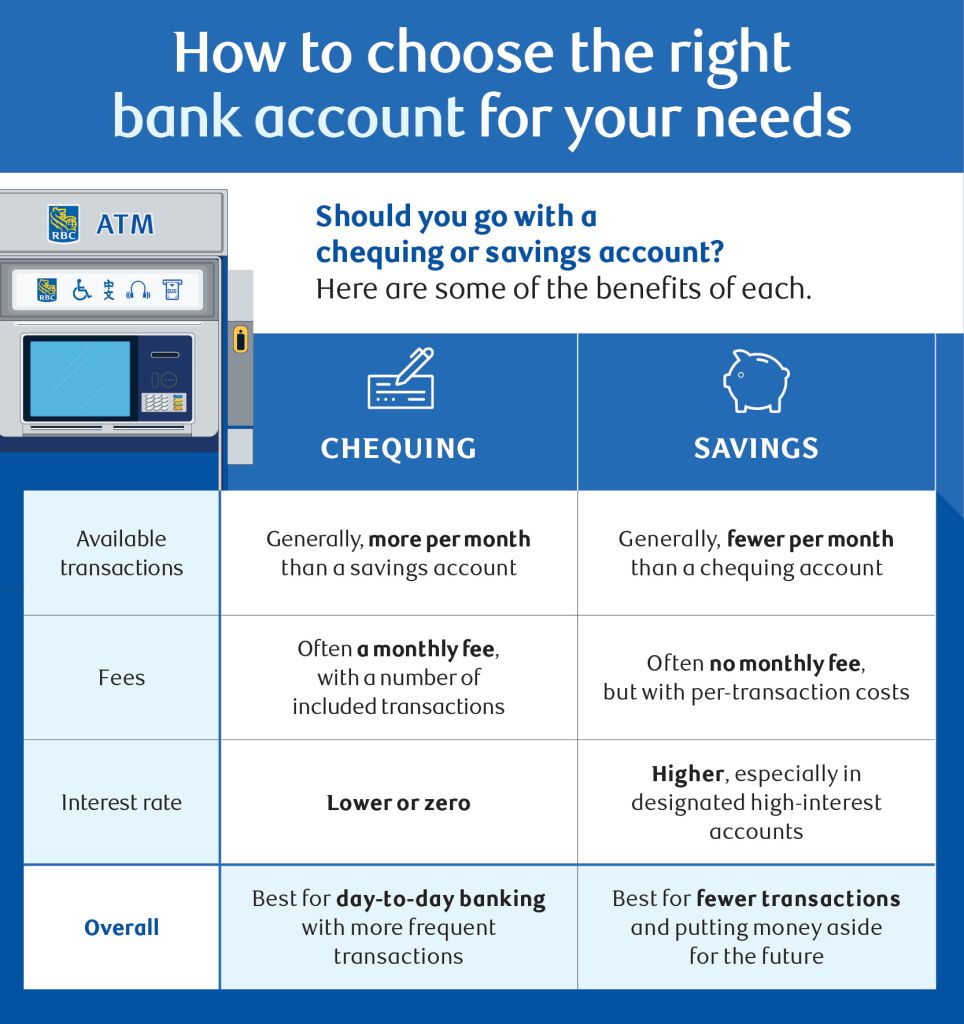
Should you go with chequing or savings? That depends on your needs and your goals. To help you choose, here’s a comparison of the two types of accounts.
| Chequing | Savings | |
|---|---|---|
Available transactions |
Generally, more per month |
Generally, fewer per month |
Fees |
Often a monthly fee, with a larger number of included transactions |
Often no monthly fee, but with per-transaction costs |
Interest rate |
Lower or zero |
Higher, especially in designated high-interest accounts |
Overall |
Best for day-to-day banking with more frequent transactions |
Best for fewer transactions and putting money aside for the future |
If you don’t yet have a bank account, start with a chequing account for day-to-day money management. But you don’t have to stop there. Many people have both a chequing and a savings account, one designated for everyday banking and one for savings goals.
Some Canadians even hold multiple savings accounts so they can organize money in virtual buckets. For instance, you might have one savings account for short-term goals such as vacations, and another for your emergency fund. Provided there are no fees involved (more on this below), this can be a convenient way to help keep your money in order.
RBC offers multiple accounts designed for a wide range of banking needs. If you’re not satisfied with the one you choose, the bank will refund up to three months of account fees.
For personalized guidance on product suitability and your specific financial needs, we recommend connecting with an advisor or using our online account comparison tool to find the right fit.
Fees, limits and interest: What you need to know
Before opening a bank account, it’s important to understand the terms and conditions to ensure it’s the right choice for your needs.
Not all bank accounts have the same terms and conditions. Your bank will be able to explain which fees, limits and interest rates apply to any bank account you’re considering opening or already have.
Fees on bank accounts in Canada
While not every bank account routinely charges fees, every bank account has the potential for fees, depending on how you use it. There are a number of different types:
Monthly fees:
A specific amount you pay every month to hold and use your account
The fee amount depends on the type of account, and some (especially savings accounts) don’t have a monthly fee at all
Your bank might reduce or waive the monthly fee if you meet certain conditions, such as maintaining a minimum balance or having a certain number of different products with the bank
ATM fees:
A per-transaction charge for using certain ATMs to withdraw cash
Often, banks offer free withdrawals from their own ATMs but charge a fee for withdrawals from out-of-network ATMs, such as those run by other banks or private companies
Transaction fees:
A per-transaction fee for things like paying a bill or transferring money
Many accounts come with a certain number of included transactions per month. After that, you’ll pay a fee for each transaction
Service fees:
-
A fee for specific administrative tasks or less common transactions that are not covered by your standard monthly account fee, such as printing statements or requesting bank drafts.
There might also be additional fees for things like foreign transactions or overdraft protection
Understanding bank account limits
Some accounts come with certain limits to protect security. Understanding them can help you avoid unexpected declines or fees.
Transaction limits: Some accounts may limit the number of free withdrawals or transfers you can make each month. Exceeding these may result in a fee per transaction. Closely monitor your account statement to see if you often exceed your transaction limit. If so, consider upgrading your account to accommodate your transaction needs.
Daily withdrawal or purchase limits: Your debit card may have a daily limit on how much you can take out at an ATM or spend at a store. This limit can usually be increased if needed. Don’t hesitate to contact your bank if you think you can benefit from a higher withdrawal limit.
Transfer limits: E-transfer services like Interac e-Transfer usually have daily, weekly or monthly limits on how much you can send or receive. If you find the limit too restrictive, you can easily increase it by contacting your bank.
Hold periods: When you deposit a cheque, the bank may temporarily hold a portion of the money for a few business days to make sure the cheque clears. Hold periods are also applicable for certain point of sale transactions.
Who can open a bank account in Canada?
All permanent and temporary residents of Canada who are 13 years or older (or 14 in Quebec) can open a bank account. This is true regardless of whether you have a job or money to deposit right away. You may also be able to open an account if you don’t live in Canada, provided you meet certain conditions.
How to open and manage your bank account
Opening a bank account is fairly straightforward and can often be done either in person or online. There are many convenient tools available to help you manage your account and your money. Here are some things to know:
Step-by-step guide to opening an account
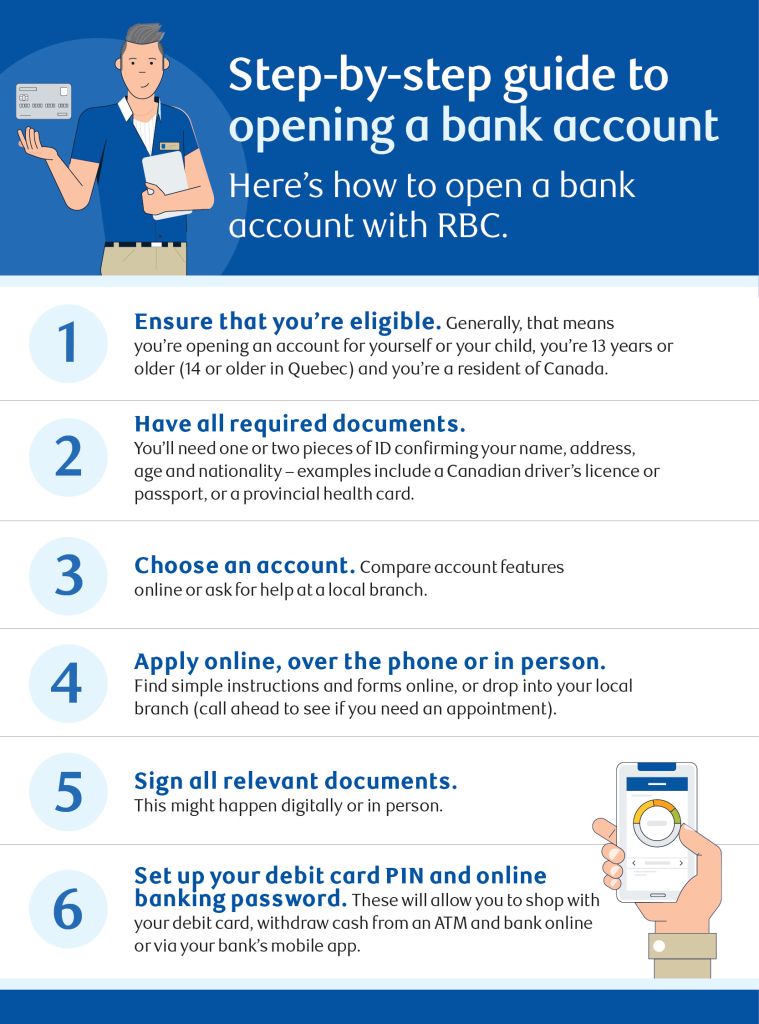
The specific steps involved in opening a bank account might differ from institution to institution, but they’re generally similar. These are the steps to open an account with RBC:
Online and mobile banking
One convenient feature of typical bank accounts in Canada (including those from RBC) is the ability to do banking from virtually anywhere, via your cell phone, tablet or computer. For instance, you can:
Use your bank’s app to send an e-transfer (a digital transfer of funds from one account to another) to a friend or family member.
Use online banking to set up automatic transfers from your chequing account into your savings account.
Pay bills using your cell phone, from the comfort of your couch.
Direct deposit
It’s common for employers to deposit your pay directly into your bank account, whether it’s for your full-time job or your side hustle. This also applies to payments you might collect from your small business, such as via an online shopping platform.
Not only is this convenient – working automatically every payday – but it also ensures your money appears in your account faster. Your employer, client or payment processor should have instructions on how to get started with direct deposit.
Security best practices
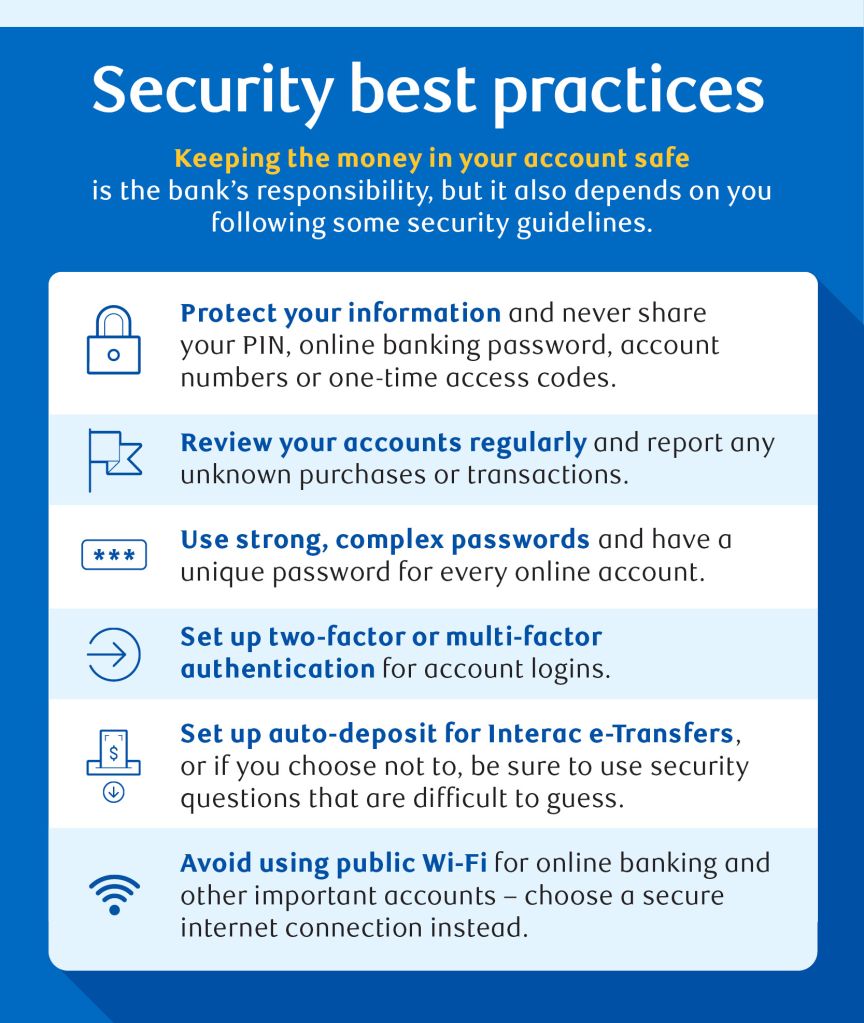
One advantage of using a bank account is that it’s a safe place to keep your money. That’s the bank’s responsibility, but it also depends on you following some security best practices. For example:
Making the most of your bank account
Your bank account is more than just a place to keep money and pay your bills. Here are some additional features to look for:
Budgeting and spending tracking
Your bank account might offer tools and techniques for financial management, such as:
Alerts for unusual transactions
Tools to help you analyze your monthly cash flow and categorize your spending
Smart budgeting recommendations based on your habits
Rolling forecasts of payments and deposits to help you track your cash
Savings and rewards
Some bank accounts come with associated benefits, such as:
Earning points on relevant transactions.
Discounts and offers from certain retailers.
Reduced or waived monthly fees.
Maximizing interest and minimizing fees
Some tips to make your account work for you financially include:
-
Choose higher interest accounts for savings.
-
For day-to-day banking, choose an account that includes the right number of transactions for your needs.
-
Avoid extra fees by sticking to ATMs within your bank’s network, staying within your transaction limit and not withdrawing more money than you have.
If you frequently incur extra transaction or service fees, consider switching to a bank account that better meets your needs.
Utilizing perks and promotions
When shopping for a new bank account, you might be eligible for promotions — such as receiving cash or a gift — if you meet certain conditions. While gifts offer instant value, cash-based incentives allow you to reinvest the reward and begin earning interest immediately.
Current account holders may also be eligible for bank offers and upgrades. Check your RBC Mobile app or Online Banking for promotions you might find useful and be sure to read the fine print before committing.
Common questions about bank accounts in Canada
Some bank accounts have no monthly fee, making them free so long as you don’t incur any additional charges, such as transaction fees. Other bank accounts may have reduced or waived monthly fees for customers who meet certain criteria.
Yes, you can open multiple bank accounts at multiple institutions. Some people use multiple bank accounts as a tool to help them save and budget. Just be careful to avoid too many fees.
At RBC, new clients opening accounts online can typically complete their application in 10 minutes or less, while applications in person or over the phone might take 30 minutes. Existing clients can usually open a new account even faster.
In most cases, you don’t need to maintain a minimum balance. But the details depend on your account. Some high-interest savings accounts, for example, might require a minimum balance for you to earn certain interest rates. And some premium accounts may require a minimum balance to waive fees.
Chequing and savings accounts are both useful, but each type offers different advantages. For example, you might have a chequing account for your day-to-day banking and a savings account for putting money aside for future needs and goals.
This article is intended as general information only and is not to be relied upon as constituting legal, financial or other professional advice. A professional advisor should be consulted regarding your specific situation. Information presented is believed to be factual and up-to-date but we do not guarantee its accuracy and it should not be regarded as a complete analysis of the subjects discussed. All expressions of opinion reflect the judgment of the authors as of the date of publication and are subject to change. No endorsement of any third parties or their advice, opinions, information, products or services is expressly given or implied by Royal Bank of Canada or any of its affiliates.