



Key Takeaways
Digital banking solutions are the apps, online portals and connected services that let you manage accounts, move money and pay bills from your phone or computer.
Key features to evaluate: mobile app quality, Interac e-Transfer support, security layers, account management tools and digital wallet integration.
Digital banking in Canada has several layers (encryption, multi-factor authentication, fraud monitoring and bank-backed guarantees) reinforced by Canada’s 2025 consumer-driven banking framework.
Choosing the right option comes down to how you actually bank: your usage habits, fee structure, CDIC coverage and whether you need cross-border tools.
What are digital banking solutions?
Digital banking solutions are the tools, such as online banking portals, mobile apps and connected services, that let you open accounts, move money, pay bills and monitor finances from a phone or computer.
Full-service digital banking solutions usually bring together:
-
Everyday accounts like chequing and savings
-
Payments and Interac e-Transfers
-
A digital banking app
-
Security controls
-
Support access
You may also come across a few related terms that sound similar but mean different things:
Digital banking platform: The bank’s underlying system (you don’t interact with this directly)
Digital banking software solutions: The technology that powers the platform, like fraud detection systems or encryption and authentication software.
As a client, the part you interact with day to day is the app and online portal.
What is the difference between digital banking and online banking?
There is a little bit of overlap here.
Online banking usually refers to managing your accounts through a web browser. Digital banking is the broader term. It covers online banking plus mobile apps, digital wallets, e-Transfers and other connected services.
In short, online banking is one part of digital banking.
Key features to look for in a digital banking app
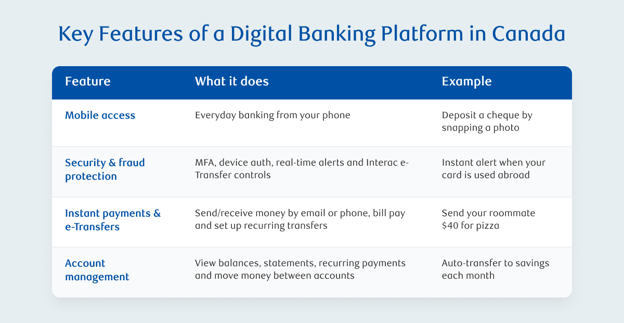
Most digital banking apps offer similar features, though there can be differences in the details. What matters most, though, is how those features fit how you bank day to day.
These are the main capabilities that tend to separate a useful app from a frustrating one.
Mobile access through a digital banking app
A strong digital banking app lets you do your full range of banking from your phone or tablet. That means not just letting you check your balance, but manage accounts, make transfers and download statements all while on the go.
Mobile cheque deposit is a good example. Instead of driving to a branch or using an ATM, you can snap a photo of a cheque in your app and deposit it in seconds.
Security and fraud protection features
Because it’s your money moving through the app, security features matter just as much as convenience. Look for:
-
Device authentication
-
Instant card/unblock settings
-
Fraud monitoring
-
Secure Interac e-Transfer controls, such as autodeposit
Real-time transaction alerts are important. Getting a text alert the moment someone tries to use your card in another country gives you a chance to block the card before they make any further transactions
Instant payments and Interac e-Transfers Instant payments and Interac e-Transfers
A full-featured banking app gives you flexibility over payment methods, letting you send and receive money by email or phone number, pay bills via direct debit or Mobile Pay, and set up recurring transfers.
Say you owe your roommate $30 for pizza. With an Interac e-Transfer, you can send it in a few taps using only their mobile number.
Account management tools
Beyond paying others, a good app helps you stay on top of the bigger financial picture and better manage your money. That means:
Checking balances
Viewing statements
Setting up recurring payments
Moving money between accounts whenever you need to
Check you credit score
These tools also make it easier to build good habits. Setting up an automatic monthly transfer to savings, for instance, can help you set money aside without having to think about it each month.
What should you look for in the best digital banking app?
With most banking now happening on a phone, the app has become a deciding factor for many people comparing digital banking solutions.
But there’s no single “best” app for everyone. The right fit depends on how you actually bank. A frequent traveller, a first-time saver and a small business owner may each prioritize different things.
As you compare your options, look for:
-
High app store ratings and consistent updates, which suggest the app works reliably and keeps improving
-
Independent industry recognition, such as awards and rankings from third parties acts as a useful signal that an app is well-built and well-supported
-
Full feature coverage, including Interac e-Transfer, mobile cheque deposit, digital wallet support and bill payments
-
Built-in money insights and budgeting tools that help you track spending and plan ahead
-
Biometric login and real-time security alerts to help keep your account protected
-
Accessibility features and multilingual support, so the app works for a wider range of people
No app will check every box perfectly, so it can help to focus on the features that match how you manage your money day to day. If you deposit cheques often, for instance, you’d weigh mobile cheque deposit more heavily than someone who rarely does.
What makes a digital banking app secure?
A secure digital banking app relies on several layers of protection working together, which usually include:
End-to-end encryption, which scrambles your data as it travels
Multi-factor and biometric authentication, which confirm it’s really you logging in
Device recognition, which flags unfamiliar phones or computers
Round-the-clock fraud monitoring, which watches for unusual activity and raises anomalies
Many Canadian banks back their digital banking apps with security guarantees, with promises to reimburse you for unauthorized transactions (provided you’ve met your responsibilities for keeping your information safe).
For example, RBC’s Digital Banking Security Guarantee protects you against any eligible digital transactions you didn’t make or approve, so long as you fulfill your responsibilities. That means that even if all of those security layers fail and something bad happens, you’re not left out of pocket.
The regulatory environment around digital banking security is strengthening, too.
Canada’s consumer-driven banking framework (often called open banking) is being introduced to let you share financial data with third-party apps through secure connections called APIs, rather than the riskier practice of handing over your banking username and password. The framework is still rolling out, but it’s positive to note that secure data-sharing in Canada is moving in a safer direction.
Beyond technology, your own habits play a big role in keeping your accounts safe. A few practical steps can go a long way:
Use strong, unique passwords and use biometric login where you can
Set up transaction alerts so you’re notified of activity right away
Avoid banking over public Wi-Fi, which can be less secure
Be cautious of phishing attempts asking for your login details
For more on protecting yourself online, RBC’s Cyber Security resources offer practical guidance on spotting fraud and keeping your accounts safe.
How to choose the right digital banking solution
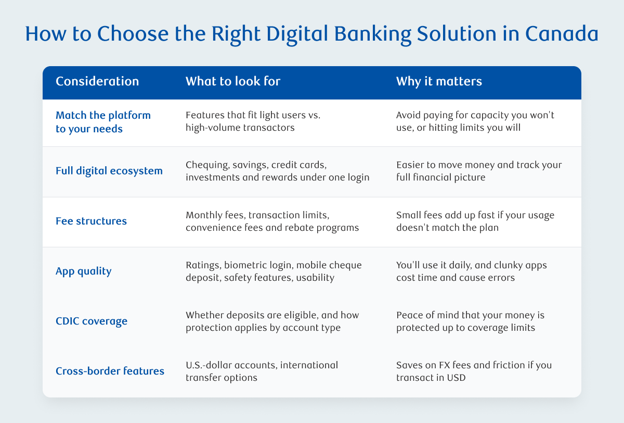
Usually, you choose a bank first, and digital banking solutions come with it. But that doesn’t mean a bank’s app should be an afterthought — it’s probably where you’re going to do the majority of your banking.
Here are five criteria to bear in mind while comparing different options to ensure you choose a bank whose app suits your day-to-day banking needs.
Match the account type to your usage/needs
Choosing the right account type is an important step that comes before you look at digital tools at all. The right fit can mean avoiding fees you’d otherwise pay if you’re working with the wrong account.
Look at how often you transact, and what those transactions are.
A light user might pay a handful of bills a month, make occasional debit purchases and rarely use an ATM. For them, a low-fee or no-frills account with a capped number of free transactions can be plenty.
A person making dozens of debit purchases, pre-authorized payments and transfers each month may be better served by an account with unlimited transactions, since going over a monthly limit can trigger per-transaction fees.
You can compare RBC chequing accounts to see how transaction limits and features line up with your habits.
Look at the full digital banking ecosystem
An app is the digital interface for your day-to-day banking needs, but the best banks give you a whole range of tools to help you manage your money.
Consider the entire digital banking ecosystem on offer, and look for tools like:
Spending trackers
Automated savings features
Budgeting tools
Personalized insights on your spending habits
RBC’s NOMI is a great example. It analyzes your monthly cash flow, categorizes your spending, and more, to show you exactly what your money is up to and what it’s going to do next.
Features like these can turn an app from a place you check your balance into one that helps you make decisions.
Check fee structures
Banks don’t typically charge for app access directly, but understanding exactly what you’re paying for with a given bank does help you decide whether the digital banking solutions they offer are worth it.
Review monthly fees, transaction limits, convenience fees and any rebate programs.
Fees add up over time, so an account that matches your usage can save you money, especially if you’re able to access a rebate or monthly fee waiver, like with the RBC Value Program.
Confirm CDIC coverage
Check whether deposits are eligible for protection from the Canada Deposit Insurance Corporation (CDIC), which covers eligible deposits up to $100,000 per category, to keep your money safe.
Canada’s major banks are CDIC members, so eligible deposits held with them are automatically covered. When banking with smaller digital banks or fintechs, it’s worth confirming.
If the provider is not a CDIC member, then your money is only protected if they place it as an eligible deposit with a CDIC member institution, in an account in your name or held in trust for you. If you’re banking with a newer provider, confirm where your money is actually held and whether it qualifies before you assume it’s covered.
Cross-border transfer features
If you send or receive money internationally, look for tools that support cross-border transfers, like:
Multi-currency accounts
U.S. dollar accounts
International wire transfers
Foreign exchange tools that show you the rate before you send
This can be particularly important for anyone who regularly transacts in U.S dollars, such as snowbirds who spend winters in Florida or freelancers getting paid in USD.
Next steps: get started with digital banking
Digital banking can take much of the friction out of managing money day to day, letting you pay bills, track your spending habits and move funds between accounts, all from one secure and convenient place.
If you’re ready to start making the most of digital banking solutions, opening an account is your first step.
FAQs
There’s really no “one size fits all” option here. The best digital banking app for you depends on how you bank.
Light users may value simplicity, while people who make a large number of transactions each month may want budgeting tools and broad feature coverage.
Look at:
App store ratings
Security features
e-Transfer and mobile cheque deposit support
How well the app connects to your other accounts
This depends on the bank you’re considering. A number of Canadian banks let you open everyday accounts online in minutes, though you’ll typically need to verify your identity and provide some personal details.
The best online bank account ultimately depends on what you’ll use it for.
If you’re looking for a safe place to keep your savings and don’t plan on making frequent withdrawals, then an RBC High Interest eSavings Account may be a good fit. This wouldn’t be the best online bank account for someone who makes purchases and withdrawals regularly, however. They’d be better off with an Advantage Banking Account.
This article is intended as general information only and is not to be relied upon as constituting legal, financial or other professional advice. A professional advisor should be consulted regarding your specific situation. Information presented is believed to be factual and up-to-date but we do not guarantee its accuracy and it should not be regarded as a complete analysis of the subjects discussed. All expressions of opinion reflect the judgment of the authors as of the date of publication and are subject to change. No endorsement of any third parties or their advice, opinions, information, products or services is expressly given or implied by Royal Bank of Canada or any of its affiliates.