



Key Takeaways
Reviewing your spending and identifying a few flexible expenses is often the fastest way to save.
Automating a recurring transfer to a savings account on payday, even a small amount, removes the need to make a savings decision every month.
Behavioural habits like pausing before non-essential purchases and trying a no-spend weekend can reduce impulse spending without feeling restrictive.
Once core habits are in place, tools like NOMI Find & Save and registered accounts, such as a Tax-Free Savings Account (TFSA), can help your savings grow with less effort over time.
1. Review your spending and look for flexible expenses
When looking to save money, the first step is always to take stock of where your money is actually going.
That means downloading your bank statements, reviewing your spend history, and categorizing expenses to understand where you spend money and why. From there, you can start to make decisions around how you’ll manage your expenses going forward.
Some expenses (like rent or gas) can’t be changed easily. What you’re looking for here are flexible expenses — expenses you can pause, reduce or redirect toward savings.
You could, for example, decide to:
Put an unused streaming subscription on pause for a few months
Reduce the number of delivery orders you place each month
Find a cheaper gym membership that still offers what you actually need
Replace the daily or weekly Loblaws run with a focused bulk shop at Costco once a month
Pro tip: NOMI Find & Save automatically analyzes spending to find spare money and moves it into savings.
2. Build a budget that feels realistic and flexible
Budgeting isn’t exactly an exciting to-do list item, but it’s something your future self will thank you for. A flexible, realistic budget can help you divide money across essentials, everyday spending and savings without feeling overly restrictive.
Flexible is the key word here.
Many budgeting tips focus on strict rules that don’t really line up with how the real world works. Emergency trips to the vet or mechanic happen, but even small changes in daily life can impact how your actual spending compares against your budget, such as a long detour on your daily commute that pushes up your gas costs.
If this sounds like you, the 50/30/20 approach might be a good way to create a flexible budget that helps you save money.
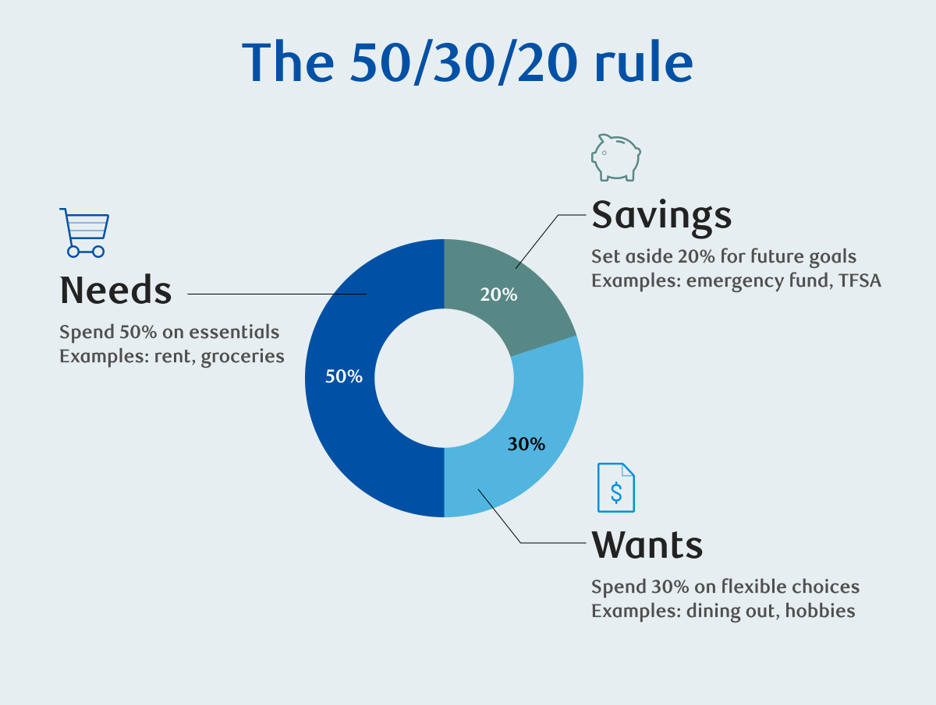
With this approach, you split your income into three buckets:
50% for needs
30% for wants
20% for savings
This way, you don’t need to itemize every single cost, and if one of those daily expenses does increase one month, you have some room in the “wants” bucket to deal with it.
If you’d prefer a more tech-forward approach to budgeting, NOMI Budgets can create personalized monthly budgets, eliminating the hassle of creating one manually.
3. Move savings first with automatic transfers
A simple way to save consistently is to move money into savings before you have a chance to spend it by setting up automatic transfers.
When you automate a transfer, you make the decision now, not later.
There is no monthly negotiation with yourself and no temptation to skip it, because saving becomes the first thing that happens as soon as you get paid.
Setting up automatic savings transfers has a few advantages:
You save consistently without relying on willpower or memory
Your savings grow steadily, even during busy or expensive months
Scheduling the transfer for payday means the money moves before everyday spending begins
Small, regular amounts can add up faster than you might expect over time ($100 a week ends up being over $5000 at the end of the year)
Most banks make it easy to schedule recurring transfers from your chequing account to a savings account. You choose the amount, the start date and how often you want it to happen, then confirm.
With RBC’s Save-Matic, it takes just four steps:
In RBC Online Banking, under Quick Payments and Transfers, click on Pay Bills and Transfer Funds.
On the left-hand menu, click on Set Up Save-Matic.
Enter the Amount you want to save, choose your From and To accounts when to start, and select how often from the Receive Frequency options, then click on Submit.
Review your information and click on Confirm.
4. Build a buffer for unexpected expenses
An emergency fund can act as a financial buffer for unexpected costs, such as urgent travel, car repairs or home expenses.
While the common piece of advice is to save up three to six months’ worth of essential living expenses, that’s not practical for a lot of savers today.
While this is a good long-term goal, it’s often more realistic to start smaller.
You might set your initial emergency fund goal at $500, which could be enough to cover smaller expenses, like an emergency bus ticket to visit a sick family member or replacing the washing machine.
Once you’ve hit that goal, you set a new one, perhaps growing the fund to $1000.
Keeping the discipline not to take money out of that account for non-emergency expenses is the tricky part, which is where something like a High-Interest Savings Account works well, providing an extra financial incentive (a high interest rate) to keep your money where it’s supposed to be.
5. Add a 48-hour pause before non-essential purchases
Automatic transfers work because they control your behaviour (they don’t give you a chance to negotiate with yourself and decide not to spend this month).
This one’s another behavioural finance hack:
Each time you want to make a non-essential purchase, wait 48 hours. It’s based on the 1972 FTC Cooling-off Rule, which is designed to protect consumers against rash decisions they later regret.
This one’s especially important when weighing up a purchase that is triggered by a sale or an ad you’ve just seen, which often act on that urgency.
Just leave the items you want to buy in your online cart or write them down somewhere, and come back to it after 48 hours. If it still feels useful after the waiting period and fits within your budget, you make a more intentional choice.
And if you forget about it entirely, then you probably didn’t need it that much in the first place.
6. Turn money you didn’t spend into savings
Strategies like the 48-hour pause on non-essential purchases don’t just help you spend less, but they can also help boost savings.
Instead of letting the money you decided not to spend get absorbed into other purchases, consider transferring it to a savings account. That way, there is a tangible impact to avoiding impulse purchases that helps you meet your savings goals faster.
7. Use separate accounts to organize your savings goals
Many savers find it helpful to keep money in different savings accounts. You might, for example, hold accounts to save toward:
Your next holiday
An emergency fund
That new phone you’ve been eyeing up
Planned home repairs or renovations
The main benefit of having multiple savings accounts is clarity. When each goal has its own space, you can see exactly how close you are to reaching it. You’re also less likely to dip into money set aside for something else when it’s labelled with the specific goal you’re working toward.
8. Remove saved payment details to create a pause before purchases
One-click checkout is designed to make spending fast and frictionless, which is exactly why it can lead to impulse purchases, which often end up being an expense you regret.
Try deleting stored cards from shopping apps, turning off one-click checkout and taking a moment before completing any non-essential purchase. If you have to get up, find your card and re-enter the details, you give yourself a few extra moments to decide whether the purchase still feels worthwhile.
Removing saved payment details also lowers the risk of accidental or impulse buys on shared devices, an added online shopping security benefit.
9. Consider a no-spend weekend once a month
A no-spend weekend is a short personal challenge where you pause all non-essential spending for a couple of days. You do it on the weekend, because that’s where a lot of out-of-the-ordinary spending occurs, like going out for lunch or shopping online in bed on a Sunday morning.
Here’s how it works:
Pick your weekend and stock up on food you already have
Line up free or low-cost activities like a library visit, a walk or a movie night at home
Skip online shopping and non-essential buys for the whole weekend
Notice what you actually missed and what you didn’t
Move what you would have spent into your savings
It’s not something you do every week, but it’s a good strategy to help yourself become more aware of your weekend spending habits without being overly restrictive.
10. Make your savings progress easier to see
Just like taking progress photos or tracking your weight on the scales helps you visualize progress when taking control of your health, making savings progress visible when taking control of your finances is key to staying motivated. Seeing progress over time can make saving feel more tangible and reinforce consistent habits, even when results build slowly.
You could use a simple savings tracking spreadsheet (Excel and Google Sheets can whip up graphs easily to visualize progress), while digital banking tools like RBC’s NOMI Insights can help you automate progress tracking and provide personalized updates.
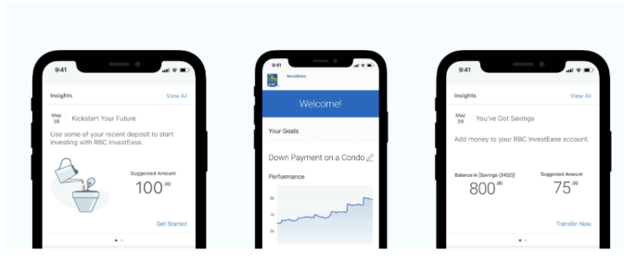
We also have a simple savings calculator to help you see how your money could grow over time. Try it out here.
Take the next step toward saving more
Knowing where your money goes and picking a few habits that fit your life can really boost your savings. Reviewing your spending, building a flexible budget and setting up an automatic transfer on payday are small steps that tend to add up faster than expected.
Once those habits are in place, the right tools can help you go further.
NOMI Find & Save can set money aside automatically without you having to think about it. It can analyze your spending, create a budget, transfer spare money to savings and track savings progress to keep you motivated.
FAQs
The $27.40 rule is a daily savings idea based on simple math: setting aside $27.40 a day adds up to just over $10,000 over a year.
It’s not a hard-and-fast rule. Instead, it’s more about visualizing the impact of small but consistent habits. $27.40 a day is achievable for many (you might spend that on dinner out without thinking twice, for instance), especially when the result is $10,000 saved after a year.
The 30-day rule is a way to avoid impulse spending. When you want to make a non-essential purchase, you wait 30 days before deciding.
It gives that initial urge time to fade, so you avoid making purchases you end up regretting later (we’ve all been there).
This article is intended as general information only and is not to be relied upon as constituting legal, financial or other professional advice. A professional advisor should be consulted regarding your specific situation. Information presented is believed to be factual and up-to-date but we do not guarantee its accuracy and it should not be regarded as a complete analysis of the subjects discussed. All expressions of opinion reflect the judgment of the authors as of the date of publication and are subject to change. No endorsement of any third parties or their advice, opinions, information, products or services is expressly given or implied by Royal Bank of Canada or any of its affiliates.